Rolf Berndt - Böcker
Visar alla böcker från författaren Rolf Berndt. Handla med fri frakt och snabb leverans.
7 produkter
7 produkter
1 006 kr
Skickas inom 7-10 vardagar
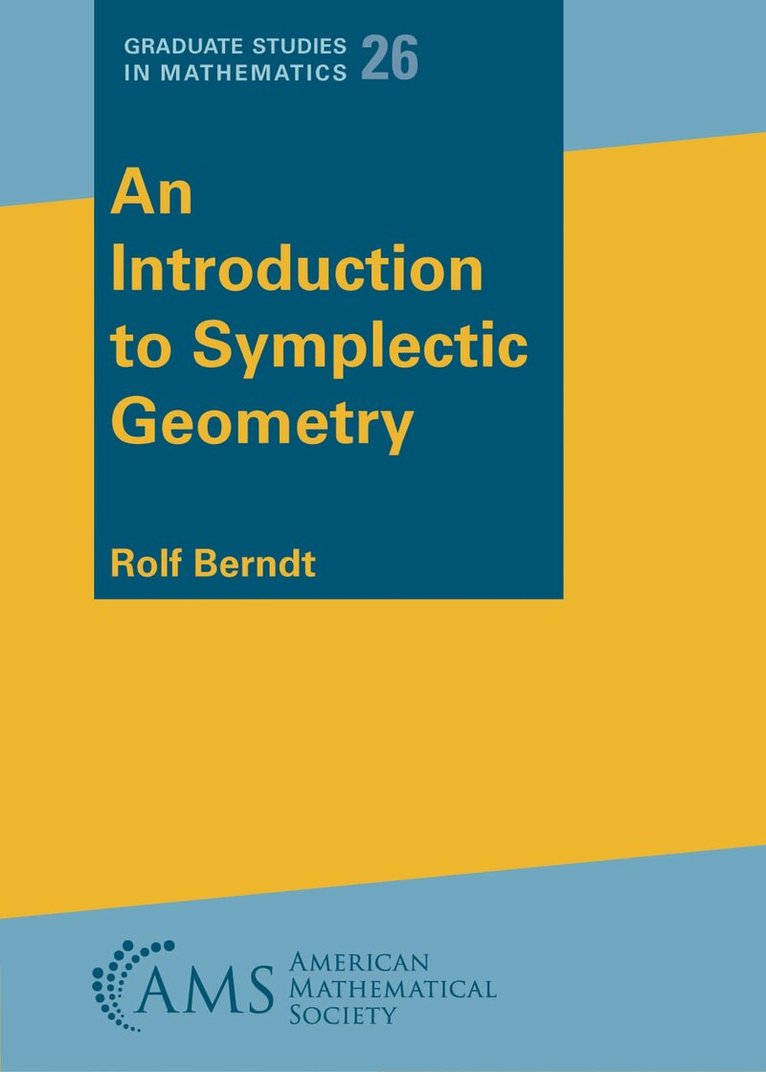
Symplectic geometry is a central topic of current research in mathematics. Indeed, symplectic methods are key ingredients in the study of dynamical systems, differential equations, algebraic geometry, topology, mathematical physics and representations of Lie groups. This book is a true introduction to symplectic geometry, assuming only a general background in analysis and familiarity with linear algebra. It starts with the basics of the geometry of symplectic vector spaces. Then, symplectic manifolds are defined and explored. In addition to the essential classic results, such as Darboux's theorem, more recent results and ideas are also included here, such as symplectic capacity and pseudoholomorphic curves. These ideas have revolutionized the subject. The main examples of symplectic manifolds are given, including the cotangent bundle, Kahler manifolds, and coadjoint orbits. Further principal ideas are carefully examined, such as Hamiltonian vector fields, the Poisson bracket, and connections with contact manifolds.Berndt describes some of the close connections between symplectic geometry and mathematical physics in the last two chapters of the book. In particular, the moment map is defined and explored, both mathematically and in its relation to physics. He also introduces symplectic reduction, which is an important tool for reducing the number of variables in a physical system and for constructing new symplectic manifolds from old. The final chapter is on quantization, which uses symplectic methods to take classical mechanics to quantum mechanics. This section includes a discussion of the Heisenberg group and the Weil (or metaplectic) representation of the symplectic group.Several appendices provide background material on vector bundles, on cohomology, and on Lie groups and Lie algebras and their representations. Berndt's presentation of symplectic geometry is a clear and concise introduction to the major methods and applications of the subject, and requires only a minimum of prerequisites. This book would be an excellent text for a graduate course or as a source for anyone who wishes to learn about symplectic geometry.
536 kr
Skickas inom 10-15 vardagar
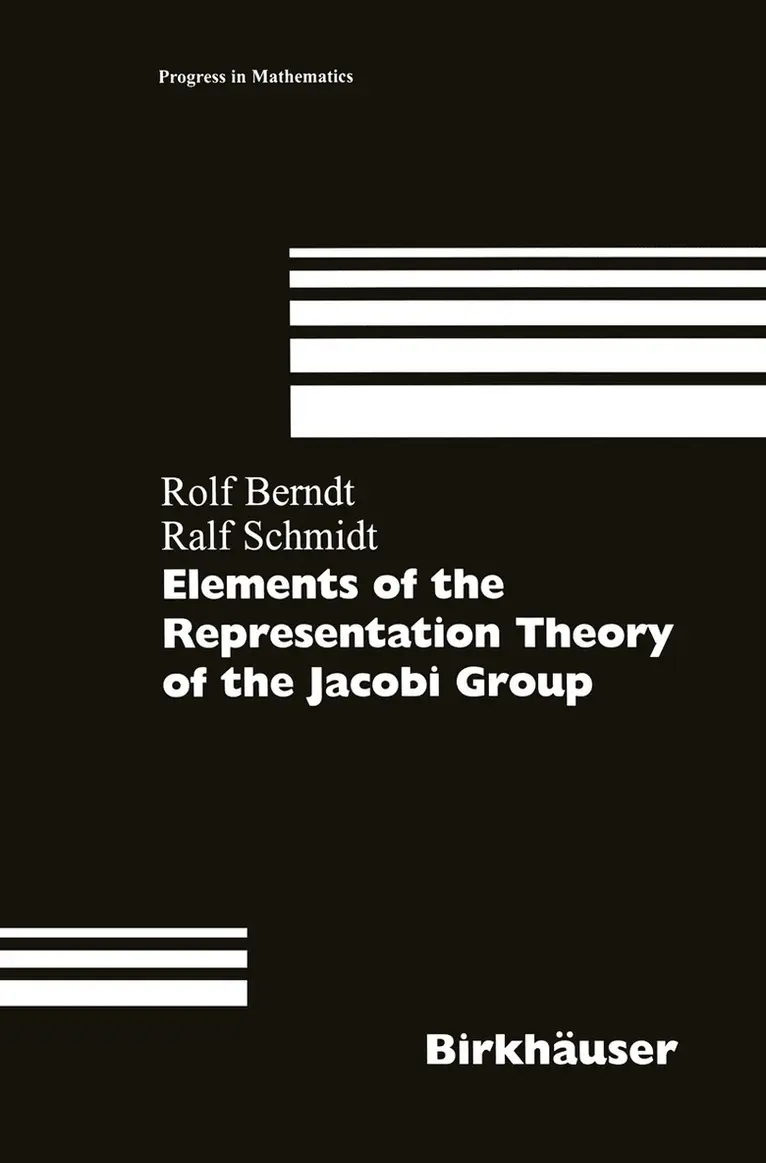
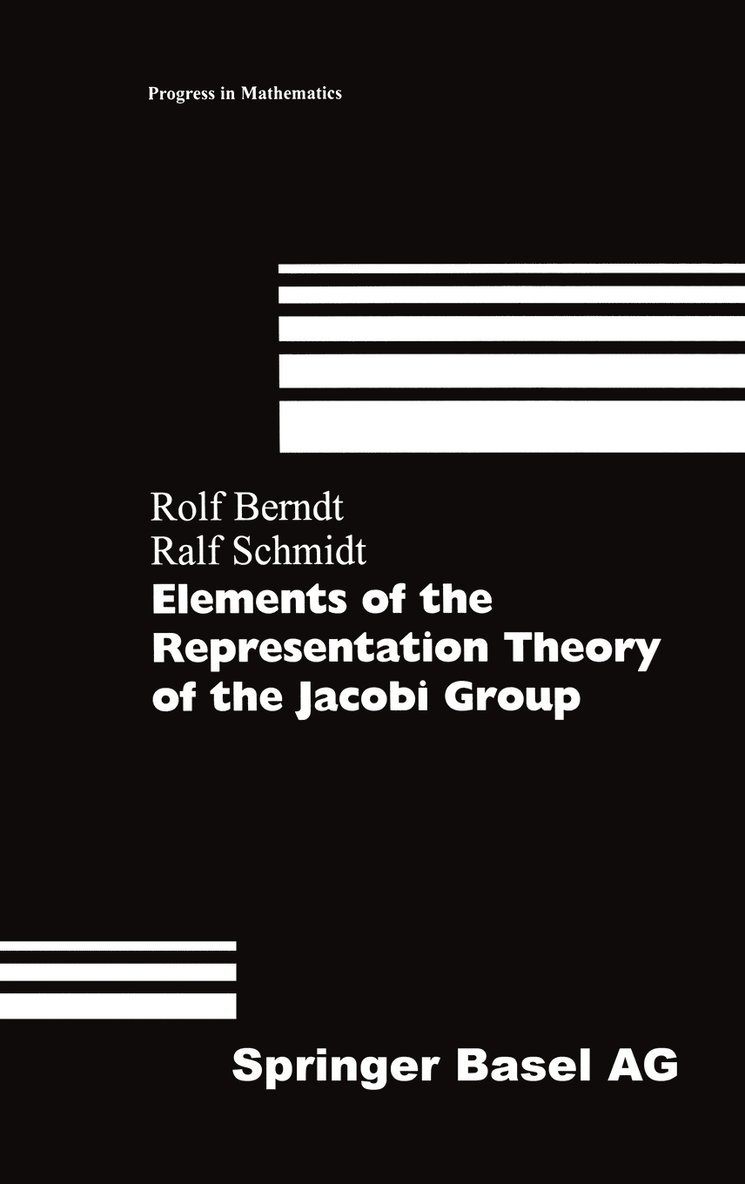
After Pyatetski-Shapiro[PS1] and Satake [Sa1] introduced, independent of one another, an early form of the Jacobi Theory in 1969 (while not naming it as such), this theory was given a de?nite push by the book The Theory of Jacobi Forms by Eichler and Zagier in 1985. Now, there are some overview articles describing the developments in the theory of the Jacobigroupandits autom- phic forms, for instance by Skoruppa[Sk2], Berndt [Be5] and Kohnen [Ko]. We refertotheseformorehistoricaldetailsandmanymorenamesofauthorsactive inthistheory,whichstretchesnowfromnumbertheoryandalgebraicgeometry to theoretical physics. But let us only brie?y indicate several- sometimes very closely related - topics touched by Jacobi theory as we see it: * ?eldsofmeromorphicandrationalfunctionsontheuniversalellipticcurve resp. universal abelian variety * structure and projective embeddings of certain algebraic varieties and homogeneous spaces * correspondences between di?erent kinds of modular forms * L-functions associated to di?erent kinds of modular forms and autom- phic representations * induced representations * invariant di?erential operators * structure of Hecke algebras * determination of generalized Kac-Moody algebras and as a ?nal goal related to the here ?rst mentioned * mixed Shimura varieties and mixed motives. Now, letting completely aside the arithmetical and algebraic geometrical - proach to Jacobi forms developed and instrumentalized by Kramer [Kr], we ix x Introduction will treat here a certain representation theoretic point of view for the Jacobi theory parallel to the theory of Jacquet-Langlands [JL] for GL(2) as reported by Godement [Go2], Gelbart [Ge1] and, recently, Bump [Bu].
Del 163 - Progress in Mathematics
Elements of the Representation Theory of the Jacobi Group
Häftad, Engelska, 2014
536 kr
Skickas inom 10-15 vardagar
After Pyatetski-Shapiro [PSI] and Satake [Sal] introduced, independent of one another, an early form of the Jacobi Theory in 1969 (while not naming it as such), this theory was given a definite push by the book The Theory of Jacobi Forms by Eichler and Zagier in 1985. Now, there are some overview articles describing the developments in the theory of the Jacobi group and its automor- phic forms, for instance by Skoruppa [Sk2], Berndt [Be5] and Kohnen [Ko]. We refer to these for more historical details and many more names of authors active in this theory, which stretches now from number theory and algebraic geometry to theoretical physics. But let us only briefly indicate several - sometimes very closely related - topics touched by Jacobi theory as we see it: * fields of meromorphic and rational functions on the universal elliptic curve resp. universal abelian variety * structure and projective embeddings of certain algebraic varieties and homogeneous spaces * correspondences between different kinds of modular forms * L-functions associated to different kinds of modular forms and autom- phic representations * induced representations * invariant differential operators * structure of Hecke algebras * determination of generalized Kac-Moody algebras and as a final goal related to the here first mentioned * mixed Shimura varieties and mixed motives.
3 779 kr
Skickas inom 7-10 vardagar
For most mathematicians and many mathematical physicists the name Erich Kähler is strongly tied to important geometric notions such as Kähler metrics, Kähler manifolds and Kähler groups. They all go back to a paper of 14 pages written in 1932. This, however, is just a small part of Kähler's many outstanding achievements which cover an unusually wide area: From celestial mechanics he got into complex function theory, differential equations, analytic and complex geometry with differential forms, and then into his main topic, i.e. arithmetic geometry where he constructed a system of notions which is a precursor and, in large parts, equivalent to the now used system of Grothendieck and Dieudonné. His principal interest was in finding the unity in the variety of mathematical themes and establishing thus mathematics as a universal language.In this volume Kähler's mathematical papers are collected following a "Tribute to Herrn Erich Kähler" by S. S. Chern, an overview of Kähler's life data by A. Bohm and R. Berndt, and a Survey of his Mathematical Work by the editors. There are also comments and reports on the developments of the main topics of Kähler's work, starting by W. Neumann's paper on the topology of hypersurface singularities, J.-P. Bourguignon's report on Kähler geometry and, among others by Berndt, Bost, Deitmar, Ekeland, Kunz and Krieg, up to A. Nicolai's essay "Supersymmetry, Kähler geometry and Beyond".As Kähler's interest went beyond the realm of mathematics and mathematical physics, any picture of his work would be incomplete without touching his work reaching into other regions. So a short appendix reproduces three of his articles concerning his vision of mathematics as a universal Theme together with an essay by K. Maurin giving an "Approach to the philosophy of Erich Kähler".
501 kr
Skickas inom 10-15 vardagar
853 kr
Skickas inom 10-15 vardagar
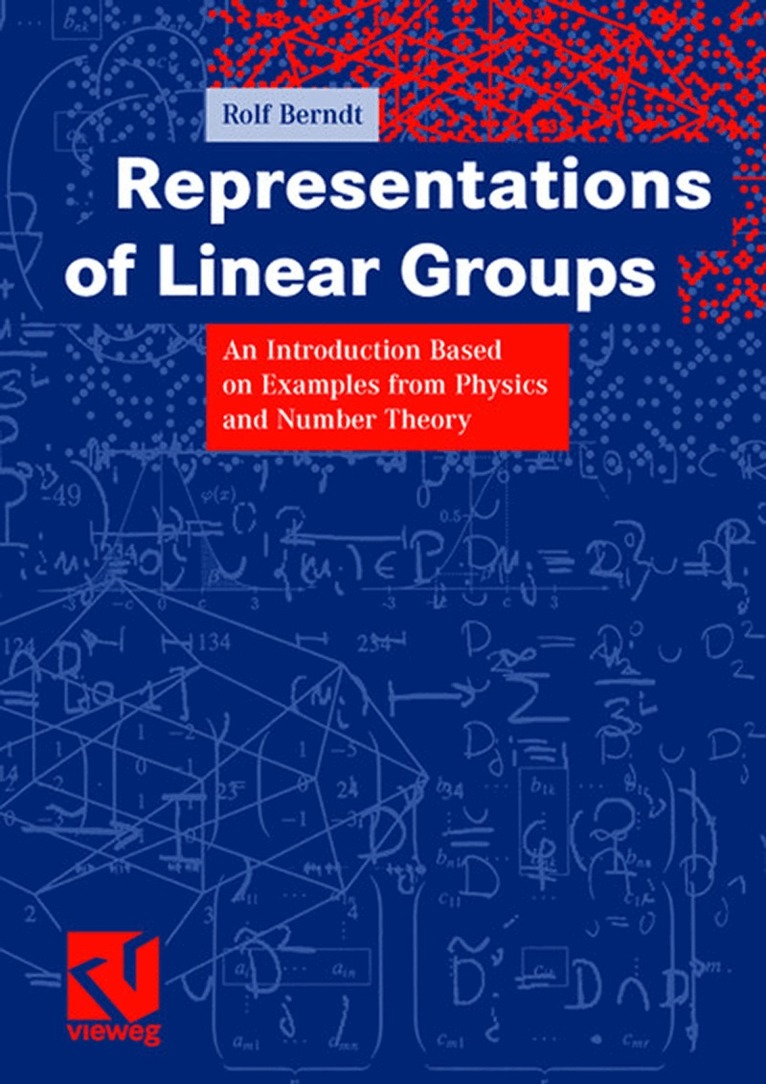
Representations of Linear Groups
An Introduction Based on Examples from Physics and Number Theory
Häftad, Engelska, 2007
641 kr
Skickas inom 10-15 vardagar
This is an elementary introduction to the representation theory of real and complex matrix groups. The text is written for students in mathematics and physics who have a good knowledge of differential/integral calculus and linear algebra and are familiar with basic facts from algebra, number theory and complex analysis. The goal is to present the fundamental concepts of representation theory, to describe the connection between them, and to explain some of their background. The focus is on groups which are of particular interest for applications in physics and number theory (e.g. Gell-Mann's eightfold way and theta functions, automorphic forms). The reader finds a large variety of examples which are presented in detail and from different points of view.