Ronald J. Krotoszynski, Jr. - Böcker
Visar alla böcker från författaren Ronald J. Krotoszynski, Jr.. Handla med fri frakt och snabb leverans.
8 produkter
8 produkter
406 kr
Skickas inom 5-8 vardagar
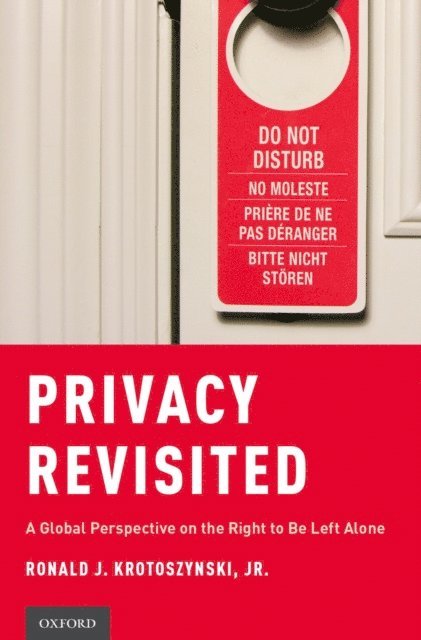
Rapid technological change, the advent of Big Data, and the creation of society-wide government surveillance programs have transformed the accessibility of highly personal information; these developments have highlighted the ambiguous treatment of privacy and personal intimacy. National legal systems vouchsafe and define "privacy," and its first cousin "dignity," in different ways that reflect local legal and cultural values. Yet, in an increasingly globalized world, purely local protection of privacy interests may prove insufficient to safeguard effectively fundamental autonomy interests - interests that lie at the core of self-definition, personal autonomy, and freedom. Privacy Revisited articulates the legal meanings of privacy and dignity through the lens of comparative law, and argues that the concept of privacy requires a more systematic approach if it is to be useful in framing and protecting certain fundamental autonomy interests. The book begins by providing relevant, and reasonably detailed, information about both the substantive and procedural protections of privacy/dignity in the U.S., Canada, South Africa, the United Kingdom, and among Council of Europe member states. Second, the book explores the inherent tension between affording significant legal protection to the right of privacy (or human dignity) and securing expressive freedoms, notably including the freedom of speech and of the press. The author then posits that the protection of privacy helps to illuminate some of the underlying social and political values that lead the U.S. to fail to protect privacy as reliably or as comprehensively as other liberal democracies. Finally, the book establishes that although privacy and speech come into conflict with some regularity, it is both useful and necessary to start thinking about the important ways in which both rights are integral to the maintenance of democratic self-government.
Free Speech as Civic Structure
A Comparative Analysis of How Courts and Culture Shape the Freedom of Speech
Inbunden, Engelska, 2024
892 kr
Skickas inom 5-8 vardagar
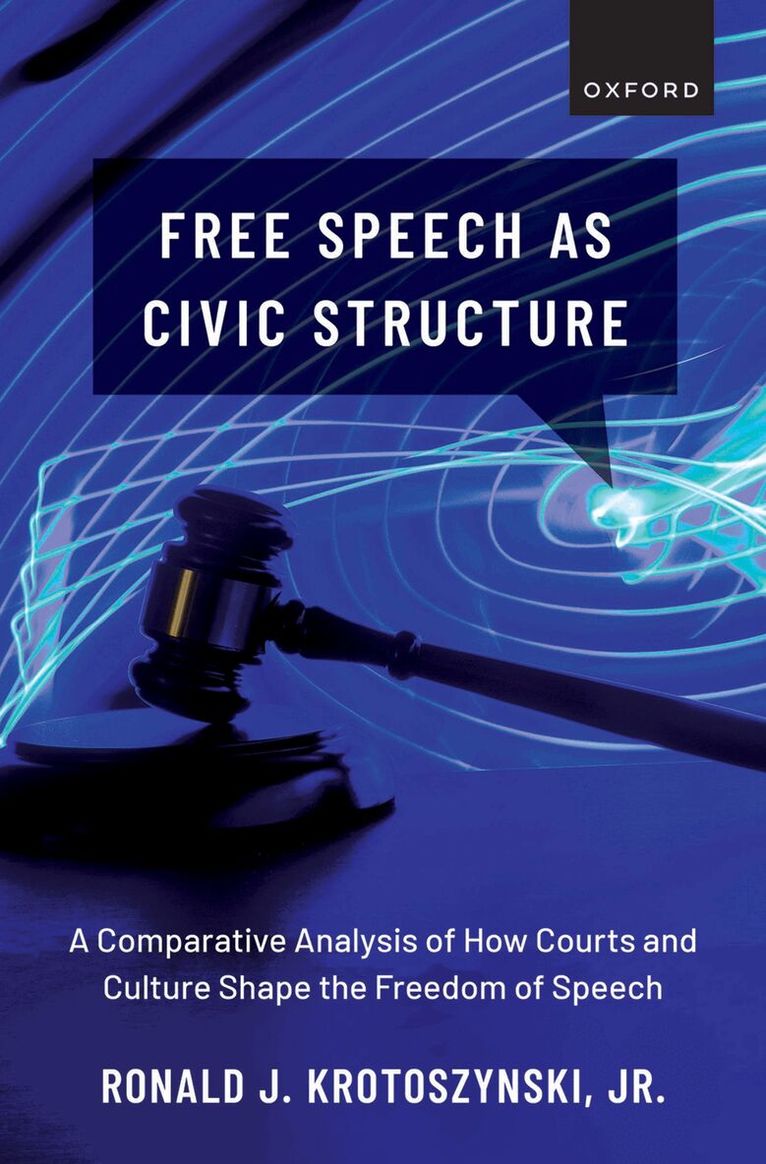
Free Speech as Civic Structure:A Comparative Analysis of How Courts and Culture Shape the Freedom of Speech examines and explains the limited relevance of constitutional text to the scope and vibrancy of free speech rights within a particular national legal system. Across jurisdictions, text or its absence will serve merely as a starting point for judicial efforts to protect speech activity. These judicial efforts, involving an ongoing and dynamic process of common law constitutionalism, will set the precise metes and bounds of expressive freedom within a particular polity. In the United States, the contemporary Supreme Court largely ignores the actual text of the First Amendment in "First Amendment" cases. Moreover, this pattern repeats elsewhere - including Australia, Israel, South Africa, and the United Kingdom. Judges in systems with relevant constitutional text (the United States and South Africa), as well as relevant statutory text (the United Kingdom), will often disregard the precise articulation of the right in favor of deploying a dynamic common law approach to protect speech from self-interested politicians who seek to distort the process of democratic deliberation. Judges also take the laboring oar in countries that lack a written free speech guarantee (Australia) or even a formal constitution as such (Israel). The strength or weakness of free speech protections depends critically on the willingness and ability of judges to police government efforts to censor speech - in conjunction with the salience of speech as a socio-legal value within the body politic. Thus, a legal system featuring independent courts, ideally vested with a power of judicial review, but that lacks a written free speech guarantee will likely feature broader protection of the freedom of expression than a legal system with a written guarantee that lacks independent courts. Across jurisdictions, text or its absence invariably serves as, at best, as a starting point for judicial efforts to protect speech. Judges, engaged in a common law enterprise, matter far more than text and common law constitutionalism constitutes the global rule rather than the exception.
Reclaiming the Petition Clause
Seditious Libel, "Offensive" Protest, and the Right to Petition the Government for a Redress of Grievances
Inbunden, Engelska, 2012
418 kr
Skickas inom 7-10 vardagar
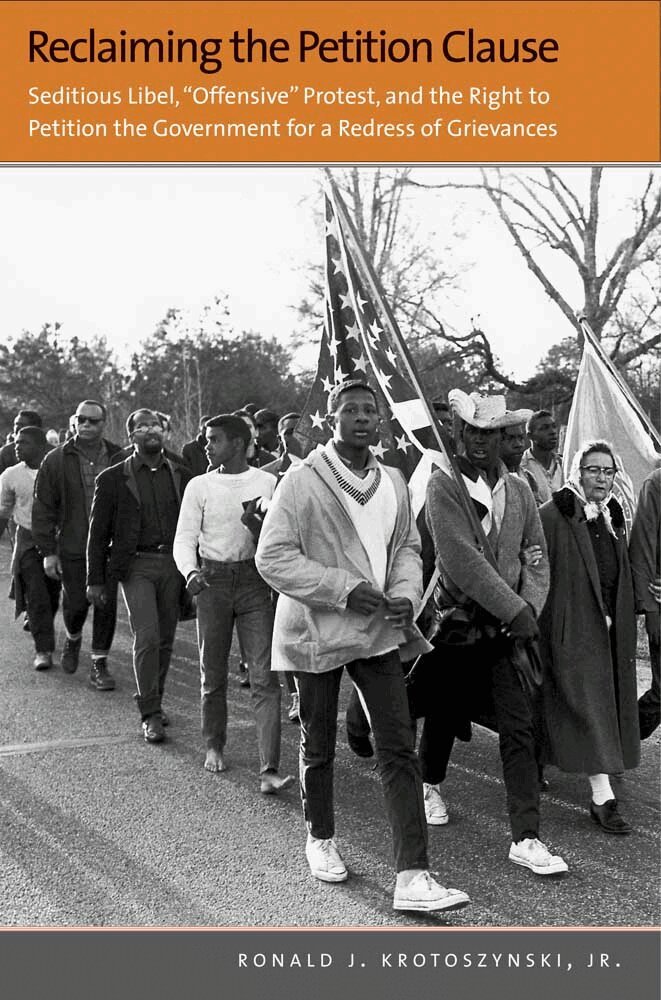
Since the 2004 presidential campaign, when the Bush presidential advance team prevented anyone who seemed unsympathetic to their candidate from attending his ostensibly public appearances, it has become commonplace for law enforcement officers and political event sponsors to classify ordinary expressions of dissent as security threats and to try to keep officeholders as far removed from possible protest as they can. Thus without formally limiting free speech the government places arbitrary restrictions on how, when, and where such speech may occur.
First Amendment in Cross-Cultural Perspective
A Comparative Legal Analysis of the Freedom of Speech
Inbunden, Engelska, 2006
1 059 kr
Skickas inom 10-15 vardagar
The First Amendment—and its guarantee of free speech for all Americans—has been at the center of scholarly and public debate since the birth of the Constitution, and the fervor in which intellectuals, politicians, and ordinary citizens approach the topic shows no sign of abating as the legal boundaries and definitions of free speech are continually evolving and facing new challenges. Such discussions have generally remained within the boundaries of the U.S. Constitution and its American context, but consideration of free speech in other industrial democracies can offer valuable insights into the relationship between free speech and democracy on a larger and more global scale, thereby shedding new light on some unexamined (and untested) assumptions that underlie U.S. free speech doctrine.Ronald J. Krotoszynski, Jr., compares the First Amendment with free speech law in Japan, Canada, Germany, and the United Kingdom—countries that are all considered modern democracies but have radically different understandings of what constitutes free speech. Challenging the popular—and largely American—assertion that free speech is inherently necessary for democracy to thrive, Krotoszynski contends that it is very difficult to speak of free speech in universalist terms when the concept is examined from a framework of comparative law that takes cultural difference into full account.
First Amendment in Cross-Cultural Perspective
A Comparative Legal Analysis of the Freedom of Speech
Häftad, Engelska, 2009
260 kr
Skickas inom 7-10 vardagar
The First Amendment—and its guarantee of free speech for all Americans—has been at the center of scholarly and public debate since the birth of the Constitution, and the fervor in which intellectuals, politicians, and ordinary citizens approach the topic shows no sign of abating as the legal boundaries and definitions of free speech are continually evolving and facing new challenges. Such discussions have generally remained within the boundaries of the U.S. Constitution and its American context, but consideration of free speech in other industrial democracies can offer valuable insights into the relationship between free speech and democracy on a larger and more global scale, thereby shedding new light on some unexamined (and untested) assumptions that underlie U.S. free speech doctrine.Ronald J. Krotoszynski, Jr., compares the First Amendment with free speech law in Japan, Canada, Germany, and the United Kingdom—countries that are all considered modern democracies but have radically different understandings of what constitutes free speech. Challenging the popular—and largely American—assertion that free speech is inherently necessary for democracy to thrive, Krotoszynski contends that it is very difficult to speak of free speech in universalist terms when the concept is examined from a framework of comparative law that takes cultural difference into full account.
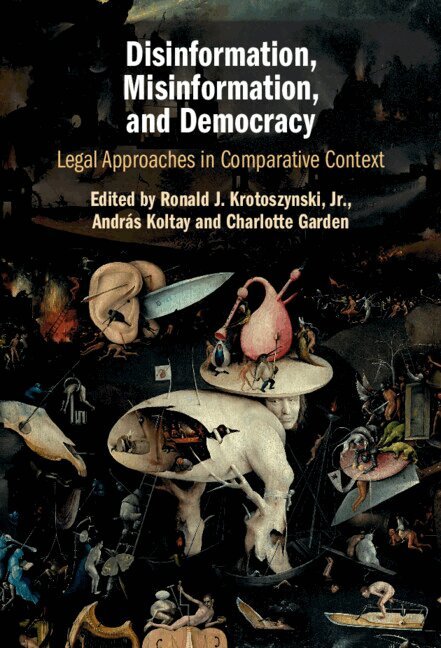
Disinformation, Misinformation, and Democracy
Legal Approaches in Comparative Context
Inbunden, Engelska, 2025
1 339 kr
Skickas inom 7-10 vardagar
In today's digital age, the spread of dis- and misinformation across traditional and social media poses a significant threat to democracy. Yet repressing political speech in the name of truth can also undermine democratic values. This volume brings together prominent legal scholars from democracies worldwide to explore and evaluate different regulatory approaches for addressing this complex problem - all taking into account that the cure must not be worse than the disease. Using a comparative lens, the book offers important and novel insights into methods ranging from national regulation of politicians' speech to empowering civil-society groups that are well-positioned to blunt the effects of disinformation and misinformation. The book also provides solutions-oriented recommendations for policymakers, judges, legal practitioners, and scholars seeking to promote democratic values by encouraging free political speech while combatting disinformation and misinformation. This title is also available as Open Access on Cambridge Core.
1 194 kr
Skickas inom 7-10 vardagar
The standard account of the First Amendment presupposes that the Supreme Court has consistently expanded the scope of free speech rights over time. This account holds true in some areas, but not in others. In this illuminating work, Ronald J. Krotoszynski, Jr acknowledges that the contemporary Supreme Court rigorously enforces the rules against content and viewpoint discrimination for those who possess the wherewithal to speak but when citizens need the government's assistance to speak - for example, access to public property for protest - free speech rights have declined. Instead of using open-ended balancing tests, the Roberts and Rehnquist Courts have opted for bright line, categorical rules that minimize judicial discretion. Opportunities for democratic engagement could be enhanced, however, if the federal courts returned to the Warren Court's balancing approach and vested federal judges with discretionary authority to require government to assist would-be speakers. This book should be read by anyone concerned with free speech and its place in democratic self-government.
377 kr
Skickas inom 7-10 vardagar
The standard account of the First Amendment presupposes that the Supreme Court has consistently expanded the scope of free speech rights over time. This account holds true in some areas, but not in others. In this illuminating work, Ronald J. Krotoszynski, Jr acknowledges that the contemporary Supreme Court rigorously enforces the rules against content and viewpoint discrimination for those who possess the wherewithal to speak but when citizens need the government's assistance to speak - for example, access to public property for protest - free speech rights have declined. Instead of using open-ended balancing tests, the Roberts and Rehnquist Courts have opted for bright line, categorical rules that minimize judicial discretion. Opportunities for democratic engagement could be enhanced, however, if the federal courts returned to the Warren Court's balancing approach and vested federal judges with discretionary authority to require government to assist would-be speakers. This book should be read by anyone concerned with free speech and its place in democratic self-government.