• Fri frakt över 249 kr
  • •
  • Snabba leveranser
  • •
  • Billiga böcker
Kundservice

Du är på sajten för privatpersoner.

Företag, bibliotek eller offentlig verksamhet?

Du handlar på classic.bokus.com, där alla dina funktioner finns intakta.
Till classic.bokus.com
Bokus logotyp. Gå till startsidan.
  • Erbjudanden
  • Nyheter
  • Student
  • Topplistor
  • Barn & ungdom
  • Bokus Play
  • E-böcker
  • Pocketböcker
  • Spel & pussel

10% rabatt på allt med kod: NYSTART10 →

Sidfot

Mina sidor

    Hjälp

    • Kundservice
    • Vanliga frågor och svar
    • Frakt och leverans
    • Retur vid ångerrätt
    • Reklamera vara
    • Betalning
    • Köpvillkor
    • Allmänna villkor
    • Information om webbplatsens tillgänglighet

    Om Bokus

    • Om oss
    • Pressrum
    • För studenter
    • För företag
    • För bibliotek och offentlig verksamhet
    • För leverantörer
    • Hållbarhet

    Populärt

    • Aktuella erbjudanden
    • Presentkort
    • Studentlitteratur
    • Nya böcker
    • Topplistor
    • Signerade böcker
    • Engelska böcker

    Inspiration

    • Boktips
    • BookTok
    • Populära bokserier
    • Barnbokskaraktärer
    • Populära författare
    Logotyp för Bokus
    Följ oss på Facebook (extern länk)Följ oss på Instagram (extern länk)Följ oss på YouTube (extern länk)Följ oss på TikTok (extern länk)
    bokus @ CookiesAnpassa cookiesIntegritetspolicyKöpvillkor
    Till Citymail hemsida (extern länk)Till Budbee hemsida (extern länk)Till Postnord hemsida (extern länk)Till Schenker hemsida (extern länk)Till Early Bird hemsida (extern länk)Till Walleys hemsida (extern länk)
    1. Juridik
    2. Internationell rätt
    3. Folkrätt

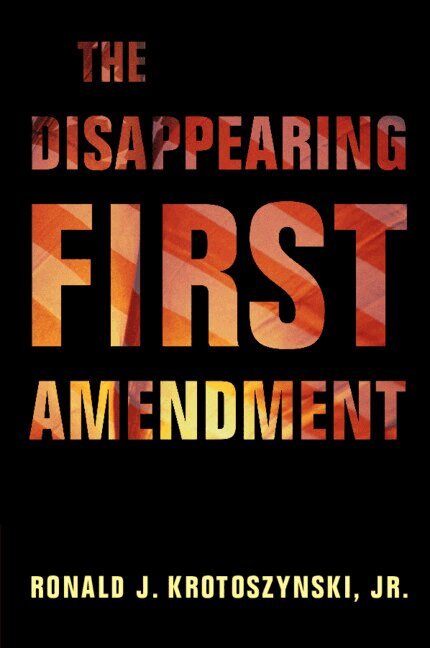
    The Disappearing First Amendment

    AvRonald J. Krotoszynski, Jr.

    Häftad, Engelska, 2019

    408 kr

    Beställningsvara. Skickas inom 10-15 vardagar. Fri frakt över 249 kr.

    Fler format och utgåvor

    Inbunden

    1 277 kr

    Beskrivning

    The standard account of the First Amendment presupposes that the Supreme Court has consistently expanded the scope of free speech rights over time. This account holds true in some areas, but not in others. In this illuminating work, Ronald J. Krotoszynski, Jr acknowledges that the contemporary Supreme Court rigorously enforces the rules against content and viewpoint discrimination for those who possess the wherewithal to speak but when citizens need the government's assistance to speak - for example, access to public property for protest - free speech rights have declined. Instead of using open-ended balancing tests, the Roberts and Rehnquist Courts have opted for bright line, categorical rules that minimize judicial discretion. Opportunities for democratic engagement could be enhanced, however, if the federal courts returned to the Warren Court's balancing approach and vested federal judges with discretionary authority to require government to assist would-be speakers. This book should be read by anyone concerned with free speech and its place in democratic self-government.

    Produktinformation

    • Utgivningsdatum:2019-10-03
    • Mått:152 x 227 x 24 mm
    • Vikt:600 g
    • Format:Häftad
    • Språk:Engelska
    • Antal sidor:408
    • Förlag:Cambridge University Press
    • ISBN:9781108722919

    Utforska kategorier

    • Folkrätt inom Juridik

    Mer om författaren

    Ronald J. Krotoszynski, Jr teaches and writes about constitutional law, administrative law, First Amendment, and comparative constitutional law, with a particular focus on the First Amendment and freedom of expression. He is the author of three books, including Privacy Revisited (2016), Reclaiming the Petition Clause (2012), and The First Amendment in Cross-Cultural Perspective (2006). He has published works in leading law reviews and is the co-author of two casebooks, First Amendment: Cases and Theory (3rd edition, 2017) and Administrative Law (4th edition, 2017).

    Recensioner i media

    'Krotoszynski, Jr. convincingly advances a powerful thesis while at the same time offering the best available comprehensive account of how the freedom of speech has been interpreted and debated during the last few decades. He demonstrates in riveting detail how certain would-be contributors to public debate such as impecunious protestors, whistleblowers within government, and journalists have seen their First Amendment rights confined or rolled back in recent years even as the Supreme Court has recognized dubious new free speech rights which benefit business entities.' Vincent Blasi, Columbia University, New York

    Innehållsförteckning

    • 1. Two steps forward, one step back: on the decline of expressive freedoms under the Roberts and Rehnquist Courts; 2. The public forum doctrine and reduced access to government property for speech activity; 3. The First Amendment as a source of positive rights: the Warren Court and First Amendment easements to private property; 4. Whistleblowing speech and democratic accountability: the growing problem of reduced First Amendment protection for government employee speech; 5. Shedding their constitutional rights at the schoolhouse gate: the decline of freedom of speech for students and teachers in the nation's public schools, colleges, and universities; 6. Transborder speech: using the accident of geography as a makeweight justification for suppressing expressive freedoms; 7. Systemic failures to protect newsgathering activities by professional journalists and amateur citizen-journalists alike; 8. The citizen as government sock-puppet and the state masquerading as a citizen: the problem of coerced and mis-attributed speech; 9. Using constitutionally permissible statutes to impede first amendment activity: the Supreme Court's failure to address the abuse of discretionary authority by police, prosecutors, and other non-judicial actors; 10. Conclusion enhancing speech and promoting democracy: the necessary role of the state in promoting democratic deliberation among citizen-speakers; Index.