• Fri frakt över 249 kr
  • •
  • Snabba leveranser
  • •
  • Billiga böcker
Kundservice

Du är på sajten för privatpersoner.

Företag, bibliotek eller offentlig verksamhet?

Du handlar på classic.bokus.com, där alla dina funktioner finns intakta.
Till classic.bokus.com
Bokus logotyp. Gå till startsidan.
  • Erbjudanden
  • Nyheter
  • Student
  • Topplistor
  • Barn & ungdom
  • Bokus Play
  • E-böcker
  • Pocketböcker
  • Spel & pussel

10% rabatt på allt med kod: NYSTART10 →

Sidfot

Mina sidor

    Hjälp

    • Kundservice
    • Vanliga frågor och svar
    • Frakt och leverans
    • Retur vid ångerrätt
    • Reklamera vara
    • Betalning
    • Köpvillkor
    • Allmänna villkor
    • Information om webbplatsens tillgänglighet

    Om Bokus

    • Om oss
    • Pressrum
    • För studenter
    • För företag
    • För bibliotek och offentlig verksamhet
    • För leverantörer
    • Hållbarhet

    Populärt

    • Aktuella erbjudanden
    • Presentkort
    • Studentlitteratur
    • Nya böcker
    • Topplistor
    • Signerade böcker
    • Engelska böcker

    Inspiration

    • Boktips
    • BookTok
    • Populära bokserier
    • Barnbokskaraktärer
    • Populära författare
    Logotyp för Bokus
    Följ oss på Facebook (extern länk)Följ oss på Instagram (extern länk)Följ oss på YouTube (extern länk)Följ oss på TikTok (extern länk)
    bokus @ CookiesAnpassa cookiesIntegritetspolicyKöpvillkor
    Till Citymail hemsida (extern länk)Till Budbee hemsida (extern länk)Till Postnord hemsida (extern länk)Till Schenker hemsida (extern länk)Till Early Bird hemsida (extern länk)Till Walleys hemsida (extern länk)
    1. Samhälle och politik
    2. Politik och statsskick
    3. Statsskick och politiska processer
    4. Konstitution: stat och regering

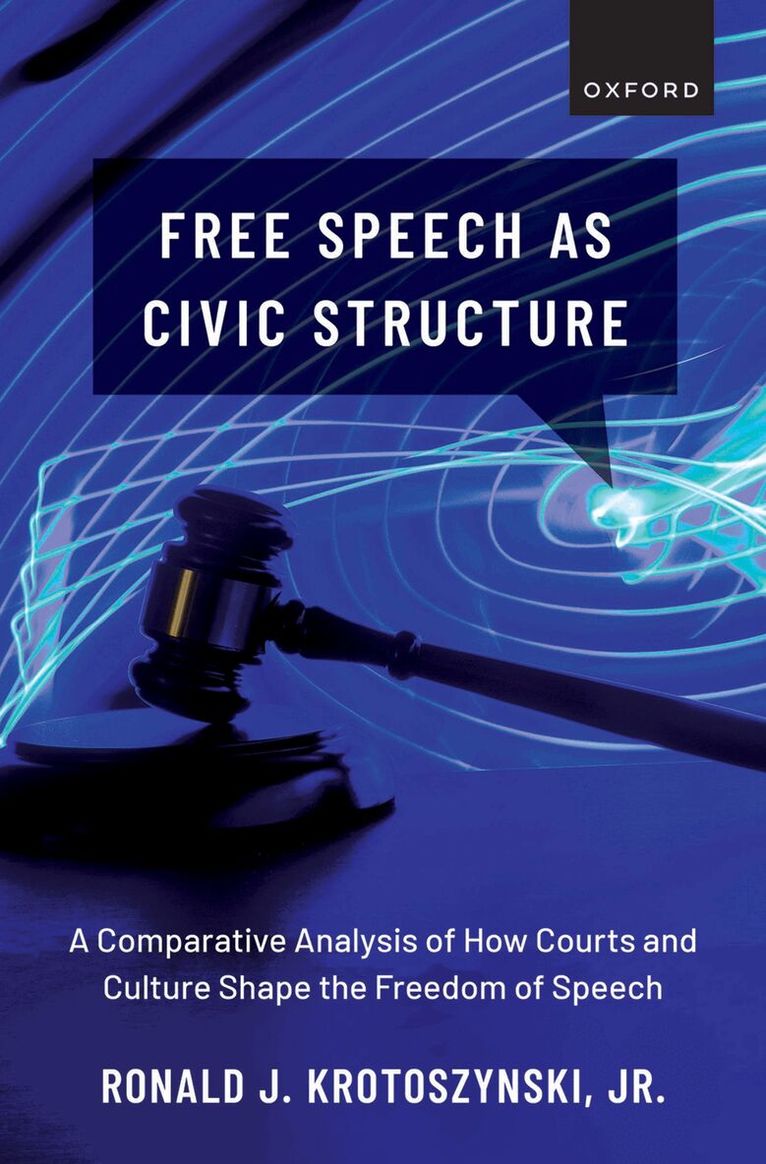
    Free Speech as Civic Structure

    A Comparative Analysis of How Courts and Culture Shape the Freedom of Speech

    AvRonald J. Krotoszynski, Jr.

    Inbunden, Engelska, 2024

    959 kr

    Beställningsvara. Skickas inom 5-8 vardagar. Fri frakt över 249 kr.

    Beskrivning

    Free Speech as Civic Structure:A Comparative Analysis of How Courts and Culture Shape the Freedom of Speech examines and explains the limited relevance of constitutional text to the scope and vibrancy of free speech rights within a particular national legal system. Across jurisdictions, text or its absence will serve merely as a starting point for judicial efforts to protect speech activity. These judicial efforts, involving an ongoing and dynamic process of common law constitutionalism, will set the precise metes and bounds of expressive freedom within a particular polity. In the United States, the contemporary Supreme Court largely ignores the actual text of the First Amendment in "First Amendment" cases. Moreover, this pattern repeats elsewhere - including Australia, Israel, South Africa, and the United Kingdom. Judges in systems with relevant constitutional text (the United States and South Africa), as well as relevant statutory text (the United Kingdom), will often disregard the precise articulation of the right in favor of deploying a dynamic common law approach to protect speech from self-interested politicians who seek to distort the process of democratic deliberation. Judges also take the laboring oar in countries that lack a written free speech guarantee (Australia) or even a formal constitution as such (Israel). The strength or weakness of free speech protections depends critically on the willingness and ability of judges to police government efforts to censor speech - in conjunction with the salience of speech as a socio-legal value within the body politic. Thus, a legal system featuring independent courts, ideally vested with a power of judicial review, but that lacks a written free speech guarantee will likely feature broader protection of the freedom of expression than a legal system with a written guarantee that lacks independent courts. Across jurisdictions, text or its absence invariably serves as, at best, as a starting point for judicial efforts to protect speech. Judges, engaged in a common law enterprise, matter far more than text and common law constitutionalism constitutes the global rule rather than the exception.

    Produktinformation

    • Utgivningsdatum:2024-09-26
    • Mått:152 x 226 x 27 mm
    • Vikt:612 g
    • Format:Inbunden
    • Språk:Engelska
    • Antal sidor:330
    • Förlag:OUP USA
    • ISBN:9780197662199
    • Utmärkelser:Winner of the Ratio et Spes Scientific Award 'Nominated for the 2024 Book of the Year Prize, awarded by the International Forum on the Future of Constitutionalism'

    Utforska kategorier

    • Konstitution: stat och regering inom Samhälle och politik
    • Rättssystem inom Juridik
    • Statsskick: demokrati inom Samhälle och politik

    Mer om författaren

    Ronald J. Krotoszynski, Jr. is the John S. Stone Chair, Director of the Program in Constitutional Studies & Initiative for Civic Engagement , and Professor of Law at the University of Alabama School of Law. His teaching and research focus on constitutional law, First Amendment law, administrative law, telecommunications law, and comparative constitutional law. Professor Krotoszynski frequently writes and lectures on topics related to freedom of expression and how law and culture inform speech and law - particularly from a comparative law perspective. He is the author of numerous law review articles and several books, including The Disappearing First Amendment (2019), Privacy Revisited (2016), and The First Amendment in Cross-Cultural Perspective (2006).

    Recensioner i media

    This is an exceptional learned and thoughtful book. Krotoszynski leaves no doubt that that our comparative constitutional law of free speech is too impoverished to make sense of the realities in the globe, where law is created by judges." - James Q. Whitman, Ford Foundation Professor of Comparative and Foreign Law, Yale Law School

    Innehållsförteckning

    • Chapter 1: Introduction: The Importance of Text to Securing Rights in a Written Constitution (with Particular Attention to Expressive Freedom) Chapter 2: The United States: The Protean First Amendment and the (Very) Limited Relevance of Its Actual Text to the Warp and Weft of Expressive Freedom Chapter 3: South Africa: Reconciling the Freedom of Speech with Dignity, Equality, and Human Freedom in the Long Shadow of Apartheid Chapter 4: The United Kingdom: Free Speech as a Sociolegal Norm Chapter 5: Australia: The Constitutional Protection of Political and Governmental Speech as an "Implied Freedom" Essential to Facilitating Democratic Deliberation, the Electoral Process, and Democracy Itself Chapter 6: Freedom of Expression in Israel: Common Law Constitutionalism, Democracy, and Dignity Chapter 7: Conclusion: Common Law Constitutionalism in the Service of Expressive Freedoms Constitutes the Global Rule Rather than the Exception