Ruth Oldenziel - Böcker
Visar alla böcker från författaren Ruth Oldenziel. Handla med fri frakt och snabb leverans.
12 produkter
12 produkter
583 kr
Skickas inom 3-6 vardagar
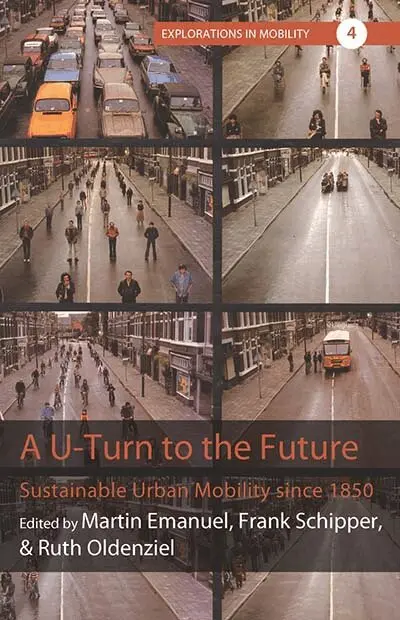
From local bike-sharing initiatives to overhauls of transport infrastructure, mobility is one of the most important areas in which modern cities are trying to realize a more sustainable future. Yet even as politicians and planners look ahead, there remain critical insights to be gleaned from the history of urban mobility and the unsustainable practices that still impact our everyday lives. United by their pursuit of a “usable past,” the studies in this interdisciplinary collection consider the ecological, social, and economic aspects of urban mobility, showing how historical inquiry can make both conceptual and practical contributions to the projects of sustainability and urban renewal.
824 kr
Skickas inom 10-15 vardagar
In this book, historians Ruth Oldenziel and Mikael Hård spotlight the people who 'made' Europe - by appropriating technology, protesting for and against it.
334 kr
Skickas inom 10-15 vardagar
Who has decided how Europeans have dressed and dwelled? Traveled and dined? Worked and played? Who, in fact, can be credited with the shaping of Europe? Certainly inventors, engineers, and politicians played their parts. But in the making of Europe, consumers, tinkerers, and rebels were an unrecognized force - until now. In this book, historians Ruth Oldenziel and Mikael Hård spotlight the people who 'made' Europe - by appropriating technology, protesting for and against it. Using examples from Britain and the Continent, the authors illustrate the conflicts that accompanied the modern technologies, from the sewing machine to the bicycle, the Barbie doll to personal computers. What emerges is a fascinating portrait of how Europeans have lived, from the 1850s to the current century.
373 kr
Skickas inom 5-8 vardagar
503 kr
Skickas inom 5-8 vardagar
For most of human experience, certainly of late, the artifacts of technological civilization have become closely associated with gender, sometimes for physiological reasons (brassieres or condoms, for example) but more often because of social and cultural factors, both obvious and obscure. Because these stereotypes necessarily have economic, social, and political consequences, understanding how gender shapes the ways we view and use technology-and how technology shapes our concept of gender-has emerged as a matter of serious scholarly importance. Gender and Technology brings together leading historians of technology to explore this entwined and reciprocal relationship, focusing on the tools (cars, typewriters, computers, vibrators), industries (dressmaking, steam laundering, cigar making, meat packing) and places (factories, offices, homes) of North America between 1850 and 1950. Together, these essays reveal the ways in which technology and gender-far from being essential, immutable categories-develop historically as social constructions. Contributors: Patricia Cooper, University of Kentucky; Paul N. Edwards, University of Michigan; Wendy Gamber, Indiana University; Carolyn M.Goldstein, Lowell National Historical Park, Lowell, Massachusetts; Rebecca Herzig, Bates College; Roger Horowitz, Hagley Museum and Library, Wilmington, Delaware; Ronald R. Kline, Cornell University; Jennifer Light, Northwestern University; Rachel P. Maines, Cornell University's Hotel School Library; Judith A. McGaw; Joy Parr, Simon Fraser University.
1 314 kr
Skickas inom 10-15 vardagar
Hacking Europe traces the user practices of chopping games in Warsaw, hacking software in Athens, creating chaos in Hamburg, producing demos in Turku, and partying with computing in Zagreb and Amsterdam. Focusing on several European countries at the end of the Cold War, the book shows the digital development was not an exclusively American affair. Local hacker communities appropriated the computer and forged new cultures around it like the hackers in Yugoslavia, Poland and Finland, who showed off their tricks and creating distinct “demoscenes.” Together the essays reflect a diverse palette of cultural practices by which European users domesticated computer technologies. Each chapter explores the mediating actors instrumental in introducing and spreading the cultures of computing around Europe. More generally, the “ludological” element--the role of mischief, humor, and play--discussed here as crucial for analysis of hacker culture, opens new vistas for the study of the historyof technology.
906 kr
Skickas inom 10-15 vardagar
Hacking Europe traces the user practices of chopping games in Warsaw, hacking software in Athens, creating chaos in Hamburg, producing demos in Turku, and partying with computing in Zagreb and Amsterdam. Focusing on several European countries at the end of the Cold War, the book shows the digital development was not an exclusively American affair. Local hacker communities appropriated the computer and forged new cultures around it like the hackers in Yugoslavia, Poland and Finland, who showed off their tricks and creating distinct “demoscenes.” Together the essays reflect a diverse palette of cultural practices by which European users domesticated computer technologies. Each chapter explores the mediating actors instrumental in introducing and spreading the cultures of computing around Europe. More generally, the “ludological” element--the role of mischief, humor, and play--discussed here as crucial for analysis of hacker culture, opens new vistas for the study of the historyof technology.
1 860 kr
Skickas inom 3-6 vardagar
Technology has long been an essential consideration in public discussions of the environment, with the focus overwhelmingly on creating new tools and techniques. In more recent years, however, activists, researchers, and policymakers have increasingly turned to mobilizing older technologies in their pursuit of sustainability. In fascinating case studies ranging from the Early Modern secondhand trade to utopian visions of human-powered vehicles, the contributions gathered here explore the historical fortunes of two such technologies—bicycling and waste recycling—tracing their development over time and providing valuable context for the policy successes and failures of today.
336 kr
Skickas inom 3-6 vardagar
Technology has long been an essential consideration in public discussions of the environment, with the focus overwhelmingly on creating new tools and techniques. In more recent years, however, activists, researchers, and policymakers have increasingly turned to mobilizing older technologies in their pursuit of sustainability. In fascinating case studies ranging from the Early Modern secondhand trade to utopian visions of human-powered vehicles, the contributions gathered here explore the historical fortunes of two such technologies—bicycling and waste recycling—tracing their development over time and providing valuable context for the policy successes and failures of today.
2 014 kr
Skickas inom 3-6 vardagar
From local bike-sharing initiatives to overhauls of transport infrastructure, mobility is one of the most important areas in which modern cities are trying to realize a more sustainable future. Yet even as politicians and planners look ahead, there remain critical insights to be gleaned from the history of urban mobility and the unsustainable practices that still impact our everyday lives. United by their pursuit of a “usable past,” the studies in this interdisciplinary collection consider the ecological, social, and economic aspects of urban mobility, showing how historical inquiry can make both conceptual and practical contributions to the projects of sustainability and urban renewal.
2 021 kr
Skickas inom 10-15 vardagar
Women engineers have been in the public limelight for decades, yet we have surprisingly little historically grounded understanding of the patterns of employment and education of women in this field. Most studies are either policy papers or limited to statistical analyses. Moreover, the scant historical research so far available emphasizes the individual, single and unique character of those women working in engineering, often using anecdotal evidence but ignoring larger issues like the patterns of the labour market and educational institutions.Crossing Boundaries, Building Bridges offers answers to the question why women engineers have required special permits to pass through the male guarded gates of engineering and examines how they have managed this. It explores the differences and similarities between women engineers in nine countries from a gender point of view. Through case studies the book considers the mechanisms of exclusion and inclusion of women engineers.
725 kr
Skickas inom 10-15 vardagar
Women engineers have been in the public limelight for decades, yet we have surprisingly little historically grounded understanding of the patterns of employment and education of women in this field. Most studies are either policy papers or limited to statistical analyses. Moreover, the scant historical research so far available emphasizes the individual, single and unique character of those women working in engineering, often using anecdotal evidence but ignoring larger issues like the patterns of the labour market and educational institutions.Crossing Boundaries, Building Bridges offers answers to the question why women engineers have required special permits to pass through the male guarded gates of engineering and examines how they have managed this. It explores the differences and similarities between women engineers in nine countries from a gender point of view. Through case studies the book considers the mechanisms of exclusion and inclusion of women engineers.