Sofia Torallas Tovar - Böcker
Visar alla böcker från författaren Sofia Torallas Tovar. Handla med fri frakt och snabb leverans.
6 produkter
6 produkter
1 290 kr
Skickas inom 7-10 vardagar
In Greco-Roman Egypt, recipes for magical undertaking, called magical formularies, commonly existed for love potions, curses, attempts to best business rivals—many of the same challenges that modern people might face. In The Greco-Egyptian Magical Formularies: Libraries, Books, and Individual Recipes, volume editors Christopher Faraone and Sofia Torallas Tovar present a series of essays by scholars involved in a multiyear project to reedit and translate the various magical handbooks that were inscribed in the Roman period in the Greek or Egyptian languages. For the first time, the material remains of these papyrus rolls and codices are closely examined, revealing important information about the production of books in Egypt, the scribal culture in which they were produced, and the traffic in single recipes copied from them. Especially important for historians of the book and the Christian Bible are new insights in the historical shift from roll to codex, complicated methods of inscribing the bilingual papyri (in which the Greek script is written left to right and the demotic script right to left), and the new realization that several of the longest extant handbooks are clearly compilations of two or more shorter handbooks, which may have come from different places. The essays also reexamine and rethink the idea that these handbooks came from the personal libraries of practicing magicians or temple scriptoria, in one case going so far as to suggest that two of the handbooks had literary pretensions of a sort and were designed to be read for pleasure rather than for quotidian use in making magical recipes.
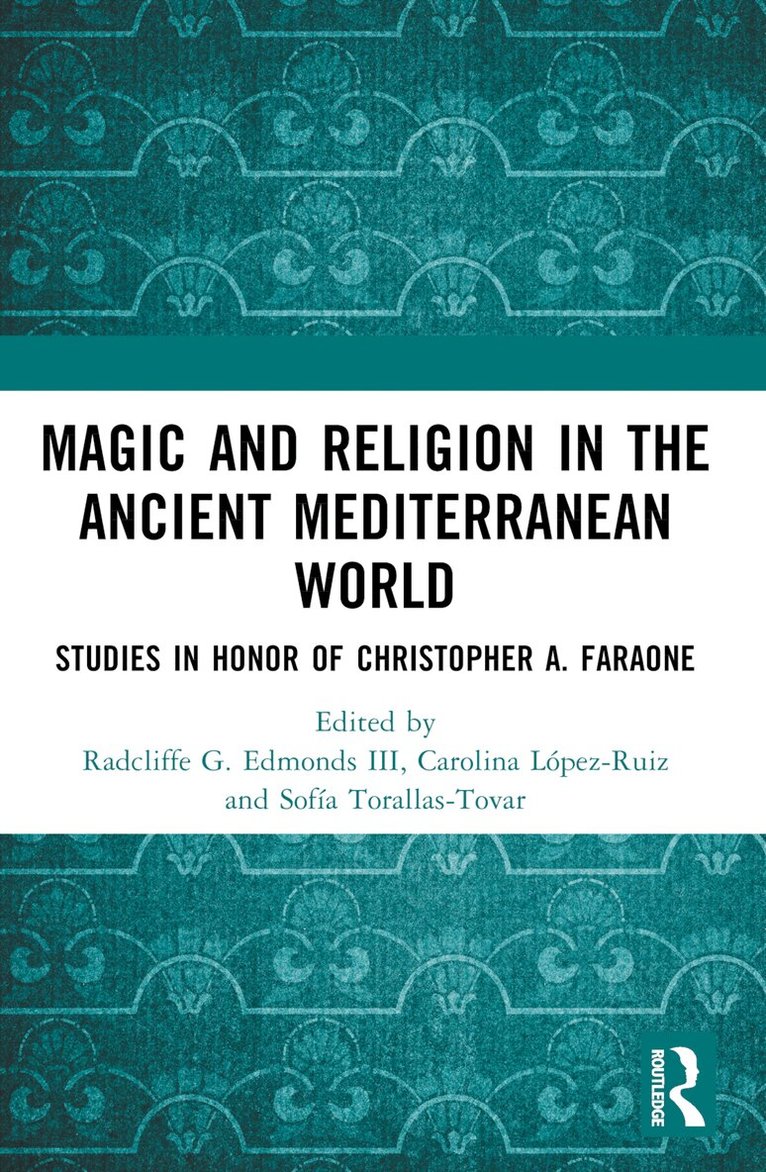
Magic and Religion in the Ancient Mediterranean World
Studies in Honor of Christopher A. Faraone
Inbunden, Engelska, 2023
2 155 kr
Skickas inom 10-15 vardagar
This volume explores aspects of ancient magic and religion in the ancient Mediterranean, specifically ways in which religious and mythical ideas, including the knowledge and practice of magic, were transmitted and adapted through time and across Greco-Roman, Near Eastern, and Egyptian cultures.Offering an original and innovative combination of case studies on the material aspects and cross-cultural transfers of magic and religion, this book brings together a range of contributions that cross and connect sub-fields with a pan-Mediterranean, comparative scope. Section I investigates the material aspects of magical practices, including first editions and original studies on papyri, gems, lamellae containing binding curses and protective texts, and other textual media in ancient book culture. Several chapters feature the Greco-Egyptian Magical Papyri, the compilation of magical recipes in the formularies, and the role of physical book-forms in the transmission of magical knowledge. Section II explores magic and religion as nodes of cultural exchange in the ancient Mediterranean. Case studies range from Egypt to Anatolia and from Syria-Phoenicia to Sicily, with Greco-Roman religion and myth integrated in a diverse and interconnected Mediterranean landscape. Readers encounter studies featuring charismatic figures of Magi and itinerant begging priests, the multiple understandings of deities such as Hekate, Herakles, or Aphrodite, or the perceived exotic origin of cult statues, mummies, amulets, and cursing formulae, which bring to light the rich intercultural networks of the ancient Mediterranean, and the crucial role of magic and religion in the process of cross-cultural adaptation and innovation.Magic and Religion in the Ancient Mediterranean World appeals to both specialized and non-specialized audiences, with expert contributions written in an accessible way. This is a fascinating resource for students and scholars working on magic, religion, and mythology in the ancient Mediterranean.
Magic and Religion in the Ancient Mediterranean World
Studies in Honor of Christopher A. Faraone
Häftad, Engelska, 2025
549 kr
Skickas inom 10-15 vardagar
This volume explores aspects of ancient magic and religion in the ancient Mediterranean, specifically ways in which religious and mythical ideas, including the knowledge and practice of magic, were transmitted and adapted through time and across Greco-Roman, Near Eastern, and Egyptian cultures.Offering an original and innovative combination of case studies on the material aspects and cross-cultural transfers of magic and religion, this book brings together a range of contributions that cross and connect sub-fields with a pan-Mediterranean, comparative scope. Section I investigates the material aspects of magical practices, including first editions and original studies on papyri, gems, lamellae containing binding curses and protective texts, and other textual media in ancient book culture. Several chapters feature the Greco-Egyptian Magical Papyri, the compilation of magical recipes in the formularies, and the role of physical book-forms in the transmission of magical knowledge. Section II explores magic and religion as nodes of cultural exchange in the ancient Mediterranean. Case studies range from Egypt to Anatolia and from Syria-Phoenicia to Sicily, with Greco-Roman religion and myth integrated in a diverse and interconnected Mediterranean landscape. Readers encounter studies featuring charismatic figures of Magi and itinerant begging priests, the multiple understandings of deities such as Hekate, Herakles, or Aphrodite, or the perceived exotic origin of cult statues, mummies, amulets, and cursing formulae, which bring to light the rich intercultural networks of the ancient Mediterranean, and the crucial role of magic and religion in the process of cross-cultural adaptation and innovation.Magic and Religion in the Ancient Mediterranean World appeals to both specialized and non-specialized audiences, with expert contributions written in an accessible way. This is a fascinating resource for students and scholars working on magic, religion, and mythology in the ancient Mediterranean.
625 kr
Skickas inom 5-8 vardagar
2 595 kr
Skickas inom 5-8 vardagar
There is hardly a more controversial issue in the study of ancient religion than Orphism. More than two centuries of debate have not closed the subject, since new evidence and divergent approaches have kept appearing regularly. This volume sheds light on the most relevant pieces of evidence for ancient Orphism, collected in the recent edition by Alberto Bernabé. It contains 65 short new studies on Orphic fragments by leading international scholars who comment one of the most controversial phenomena in Antiquity from a plurality of perspectives. Readers will acquire a global vision of the multiple dimensions of the Orphic tradition, as well as many new insights into particular Orphic fragments.
2 414 kr
Skickas inom 3-6 vardagar
The Bibliothèque Nationale de France preserves an extraordinary document: a fourth-century CE papyrus codex from Upper Egypt. This handbook is over seventy inscribed pages long and is equivalent in length to four or five normal-sized papyrus rolls. But despite its great size, it contains only fifty-three recipes, many of unusual length and complexity. Our research team on the Transmission of Magical Knowledge project has been studying, re-editing and translating all the magical handbooks from Roman Egypt, and in the process, we have realized that the Paris Codex from Upper Egypt, long understood as the "typical" or "model" handbook of the age, is, in fact, a marvelous outlier in the group. The manuscript was probably never used for the preparation of quotidian magical spells, but rather as a book to be read and to fire the imagination of its readers. We propose in this volume a complete re-assessment of GEMF 57, not only of its materiality, scribal production, and its language, but also of its composition in different blocks coming from divergent exemplars. The book is distributed into five sections: 1. Materiality of GEMF 57, including codicology, paleography and scribal practice; 2. Language and Rhetoric; 3. Poetry, on the metrical sections; 4. Special sections, including chapters on the Mithras Liturgy, the collapse of Solomon and the Epistolary section; 5. Special topics, on astrology and Egyptian influence.