Space Studies Board – författare
Visar alla böcker från författaren Space Studies Board. Handla med fri frakt och snabb leverans.
349 produkter
Mars Sample Return
Issues and Recommendations
Av National Research Council, Division on Engineering and Physical Sciences m. fl.
Häftad, 1997
1346 kr
Lägg i varukorg
The Space Studies Board of the National Research Council (NRC) serves as the primary adviser to the National Aeronautics and Space Administration (NASA) on planetary protection policy, the purpose of which is to preserve conditions for future biological and organic exploration of planets and other …
New Science Strategy for Space Astronomy and Astrophysics
Av National Research Council, Division on Engineering and Physical Sciences m. fl.
Häftad, 1997
1205 kr
Lägg i varukorg
Signs of Life
A Report Based on the April 2000 Workshop on Life Detection Techniques
Av National Research Council, Division on Earth and Life Studies m. fl.
Häftad, 2002
497 kr
Lägg i varukorg
A workshop to assess the science and technology of life detection techniques was organized by the Committee on the Origins and Evolution of Life (COEL) of the Board on Life Sciences (BLS) and the Space Studies Board (SSB). Topics discussed in the workshop included the search for extraterrestrial …
Assessment of Directions in Microgravity and Physical Sciences Research at NASA
Av National Research Council, Division on Engineering and Physical Sciences m. fl.
Häftad, 2003
629 kr
Lägg i varukorg
For thirty years the NASA microgravity program has used space as a tool to study fundamental flow phenomena that are important to fields ranging from combustion science to biotechnology. This book assesses the past impact and current status of microgravity research programs in combustion, fluid …
Satellite Observations of the Earth's Environment
Accelerating the Transition of Research to Operations
Av National Research Council, Division on Earth and Life Studies m. fl.
Häftad, 2003
692 kr
Lägg i varukorg
This report addresses the transition of research satellites, instruments, and calculations into operational service for accurately observing and predicting the Eartha (TM)s environment. These transitions, which take place in large part between NASA and NOAA, are important for maintaining the …
Astrophysical Context of Life
Av National Research Council, Division on Earth and Life Studies m. fl.
Häftad, 2005
508 kr
Lägg i varukorg
In 1997, the National Aeronautics and Space Administration (NASA) formed the National Astrobiology Institute to coordinate and fund research into the origins, distribution, and fate of life in the universe. A 2002 NRC study of that program, Life in the Universe: An Assessment of U.S. and …
Assessment of Balance in NASA's Science Programs
Av National Research Council, Division on Engineering and Physical Sciences m. fl.
Häftad, 2006
508 kr
Lägg i varukorg
When the space exploration initiative was announced, Congress asked the NRC to review the science NASA proposed to carryout under the initiative. It also asked the NRC to assess whether this program would provide balanced scientific research across the established disciplines supported by NASA in …
Limits of Organic Life in Planetary Systems
Av National Research Council, Division on Earth and Life Studies m. fl.
Häftad, 2007
618 kr
Lägg i varukorg
The search for life in the solar system and beyond has to date been governed by a model based on what we know about life on Earth (terran life). Most of NASA's mission planning is focused on locations where liquid water is possible and emphasizes searches for structures that resemble cells in …
Decadal Science Strategy Surveys
Report of a Workshop
Av National Research Council, Division on Engineering and Physical Sciences m. fl.
Häftad, 2007
508 kr
Lägg i varukorg
The Workshop on Decadal Science Strategy Surveys was held on November 14-16, 2006, to promote discussions of the use of National Research Council (NRC) decadal surveys for developing and implementing scientific priorities, to review lessons learned from the most recent surveys, and to identify …
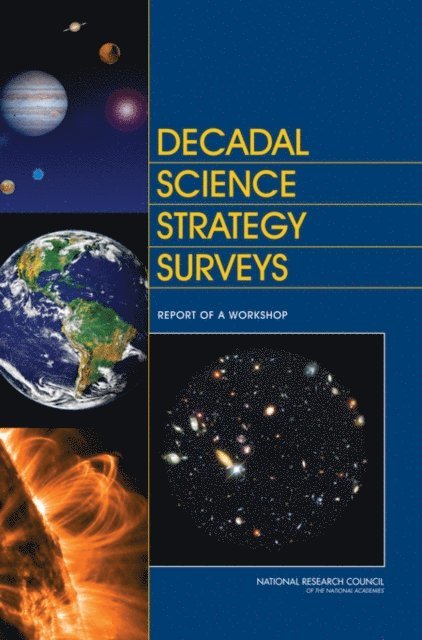
Decadal Science Strategy Surveys
Report of a Workshop
Av Space Studies Board, Division on Engineering and Physical Sciences m. fl.
E-bok, 2007
286 kr
Lägg i varukorg
The Workshop on Decadal Science Strategy Surveys was held on November 14-16, 2006, to promote discussions of the use of National Research Council (NRC) decadal surveys for developing and implementing scientific priorities, to review lessons learned from the most recent surveys, and to identify …
Portals to the Universe
The NASA Astronomy Science Centers
Av National Research Council, Division on Engineering and Physical Sciences m. fl.
Häftad, 2007
508 kr
Lägg i varukorg
The astronomy science centers established by the National Aeronautics and Space Administration (NASA) to serve as the interfaces between astronomy missions and the community of scientists who utilize the data have been enormously successful in enabling space-based astronomy missions to achieve …
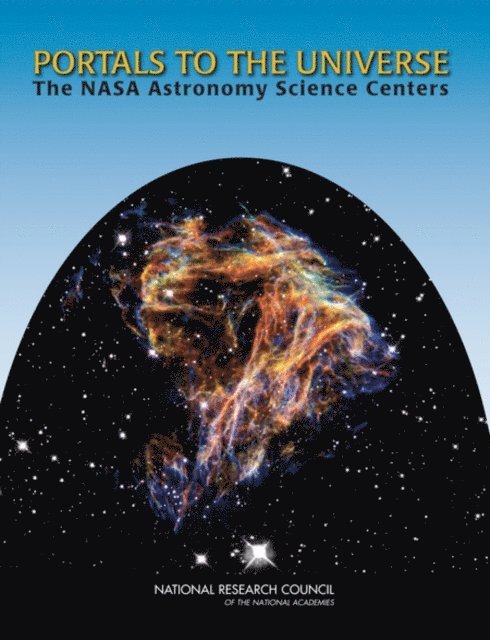
Portals to the Universe
The NASA Astronomy Science Centers
Av Committee on NASA Astronomy Science Centers, Space Studies Board m. fl.
E-bok, 2007
286 kr
Lägg i varukorg
The astronomy science centers established by the National Aeronautics and Space Administration (NASA) to serve as the interfaces between astronomy missions and the community of scientists who utilize the data have been enormously successful in enabling space-based astronomy missions to achieve …
Building a Better NASA Workforce
Meeting the Workforce Needs for the National Vision for Space Exploration
Av National Research Council, Division on Engineering and Physical Sciences m. fl.
Häftad, 2007
508 kr
Lägg i varukorg
The Vision for Space Exploration (VSE) announced by President George W. Bush in 2004 sets NASA and the nation on a bold path to return to the Moon and one day put a human on Mars. The long-term endeavor represented by the VSE is, however, subject to the constraints imposed by annual funding. Given …
Building a Better NASA Workforce
Meeting the Workforce Needs for the National Vision for Space Exploration
Av Committee on Meeting the Workforce Needs for the National Vision for Space Exploration, Space Studies Board m. fl.
E-bok, 2007
278 kr
Lägg i varukorg
The Vision for Space Exploration (VSE) announced by President George W. Bush in 2004 sets NASA and the nation on a bold path to return to the Moon and one day put a human on Mars. The long-term endeavor represented by the VSE is, however, subject to the constraints imposed by annual funding. Given …
Astrobiology Strategy for the Exploration of Mars
Av Committee on an Astrobiology Strategy for the Exploration of Mars, Space Studies Board m. fl.
E-bok, 2007
432 kr
Lägg i varukorg
Three recent developments have greatly increased interest in the search for life on Mars. The first is new information about the Martian environment including evidence of a watery past and the possibility of atmospheric methane. The second is the possibility of microbial viability on Mars. Finally, …
Satellite Observations to Benefit Science and Society
Recommended Missions for the Next Decade
Av Committee on Earth Science and Applications from Space: A Community Assessment and Strategy for the Future, Space Studies Board m. fl.
E-bok, 2008
200 kr
Lägg i varukorg
Satellite Observations to Benefit Science and Society: Recommended Missions for the Next Decade brings the next ten years into focus for the Earth and environmental science community with a prioritized agenda of space programs, missions, and supporting activities that will best serve scientists in …
Scientific Context for Exploration of the Moon
Av National Research Council, Division on Engineering and Physical Sciences m. fl.
Häftad, 2007
802 kr
Lägg i varukorg
Because of the Moona (TM)s unique place in the evolution of rocky worlds, it is a prime focus of NASAa (TM)s space exploration vision. Currently NASA is defining and implementing a series of robotic orbital and landed missions to the Moon as the initial phase of this vision. To realize the benefits …
Scientific Context for Exploration of the Moon
Av Committee on the Scientific Context for Exploration of the Moon, Space Studies Board m. fl.
E-bok, 2007
416 kr
Lägg i varukorg
Because of the Moon''s unique place in the evolution of rocky worlds, it is a prime focus of NASA''s space exploration vision. Currently NASA is defining and implementing a series of robotic orbital and landed missions to the Moon as the initial phase of this vision. To realize the benefits of this …
NASA's Beyond Einstein Program
An Architecture for Implementation
Av Committee on NASA's Beyond Einstein Program: An Architecture for Implementation, Space Studies Board m. fl.
E-bok, 2007
563 kr
Lägg i varukorg
"Beyond Einstein science" is a term that applies to a set of new scientific challenges at the intersection of physics and astrophysics. Observations of the cosmos now have the potential to extend our basic physical laws beyond where 20th-century research left them. Such observations can provide …
Options to Ensure the Climate Record from the NPOESS and GOES-R Spacecraft
A Workshop Report
Av Panel on Options to Ensure the Climate Record from the NPOESS and GOES-R Spacecraft, Space Studies Board m. fl.
E-bok, 2008
238 kr
Lägg i varukorg
In 2000, the nation’s next-generation National Polar-orbiting Operational Environmental Satellite System (NPOESS) program anticipated purchasing six satellites for $6.5 billion, with a first launch in 2008. By November 2005, however, it became apparent that NPOESS would overrun its cost estimates …
Grading NASA's Solar System Exploration Program
A Midterm Report
Av Committee on Assessing the Solar System Exploration Program, Space Studies Board m. fl.
E-bok, 2008
278 kr
Lägg i varukorg
The NASA Authorization Act of 2005 directed the agency to ask the NRC to assess the performance of each division in the NASA Science directorate at five-year intervals. In this connection, NASA requested the NRC to review the progress the Planetary Exploration Division has made in implementing …
Assessment of the NASA Astrobiology Institute
Av Committee on the Review of the NASA Astrobiology Institute, Space Studies Board m. fl.
E-bok, 2008
286 kr
Lägg i varukorg
Astrobiology is a scientific discipline devoted to the study of life in the universe - its origin, evolution, distribution, and future. In 1997, NASA established an Astrobiology program (the NASA Astrobiology Institute - NAI) as a result of a series of new results from solar system exploration and …
Space Science and the International Traffic in Arms Regulations
Summary of a Workshop
Av National Research Council, Division on Engineering and Physical Sciences m. fl.
Häftad, 2008
435 kr
Lägg i varukorg
ITAR, which controls defense trade, includes the U.S. Munitions List (USML) which specifies categories of defense articles and services covered by the regulations. In 1999, space satellites were added to the USML. In 2002 ITAR was amended to exclude U.S. universities from having to obtain ITAR …
Space Science and the International Traffic in Arms Regulations
Summary of a Workshop
Av Space Studies Board, Division on Engineering and Physical Sciences m. fl.
E-bok, 2008
195 kr
Lägg i varukorg
ITAR, which controls defense trade, includes the U.S. Munitions List (USML) which specifies categories of defense articles and services covered by the regulations. In 1999, space satellites were added to the USML. In 2002 ITAR was amended to exclude U.S. universities from having to obtain ITAR …
Launching Science
Science Opportunities Provided by NASA's Constellation System
Av National Research Council, Division on Engineering and Physical Sciences m. fl.
Häftad, 2009
701 kr
Lägg i varukorg
In January 2004 NASA was given a new policy direction known as the Vision for Space Exploration. That plan, now renamed the United States Space Exploration Policy, called for sending human and robotic missions to the Moon, Mars, and beyond. In 2005 NASA outlined how to conduct the first steps in …
Launching Science
Science Opportunities Provided by NASA''s Constellation System
Av Committee on Science Opportunities Enabled by NASA's Constellation System, Space Studies Board m. fl.
E-bok, 2009
494 kr
Lägg i varukorg
In January 2004 NASA was given a new policy direction known as the Vision for Space Exploration. That plan, now renamed the United States Space Exploration Policy, called for sending human and robotic missions to the Moon, Mars, and beyond. In 2005 NASA outlined how to conduct the first steps in …
Opening New Frontiers in Space
Choices for the Next New Frontiers Announcement of Opportunity
Av Committee on New Opportunities in Solar System Exploration: An Evaluation of the New Frontiers Announcement of Opportunity, Space Studies Board m. fl.
E-bok, 2008
286 kr
Lägg i varukorg
The New Frontiers Program was created by NASA in 2002 at the recommendation of the NRC''s decadal survey for solar system research. In order to optimize solar system research, the NRC recommended a series of principal-investigator missions that encourage innovation and accomplish the main …
Science Opportunities Enabled by NASA's Constellation System
Interim Report
Av Committee on Science Opportunities Enabled by NASA's Constellation System, Space Studies Board m. fl.
E-bok, 2008
286 kr
Lägg i varukorg
To begin implementation of the Vision for Space Exploration (recently renamed “United States Space Exploration Policy”), NASA has begun development of new launch vehicles and a human-carrying spacecraft that are collectively called the Constellation System. In November 2007, NASA asked the NRC to …
United States Civil Space Policy
Summary of a Workshop
Av Space Studies Board, Aeronautics and Space Engineering Board m. fl.
E-bok, 2008
200 kr
Lägg i varukorg
In 2004, the NRC released a workshop report about the future direction of the U.S. civil space program. At the same time, the Administration announced the Vision for Space Exploration, and in June 2004, it issued a report that articulated a balanced space program for human and robotic exploration …
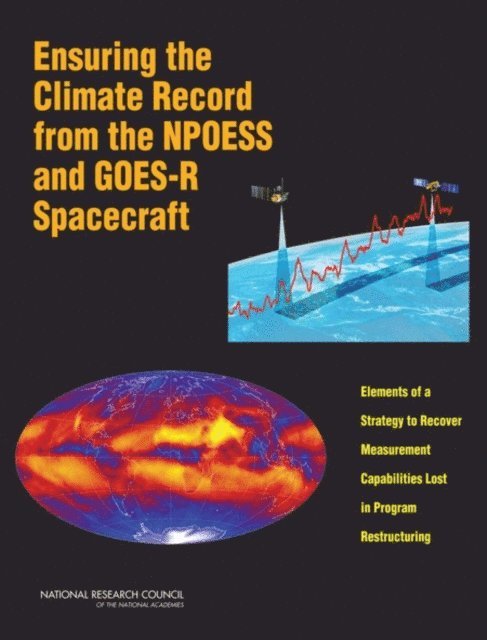
Ensuring the Climate Record from the NPOESS and GOES-R Spacecraft
Elements of a Strategy to Recover Measurement Capabilities Lost in Program Restructuring
Av Committee on a Strategy to Mitigate the Impact of Sensor Descopes and Demanifests on the NPOESS and GOES-R Spacecraft, Space Studies Board m. fl.
E-bok, 2008
572 kr
Lägg i varukorg
In 2000, the nation''s next-generation National Polar-orbiting Operational Environmental Satellite System (NPOESS) program anticipated purchasing six satellites for $6.5 billion, with a first launch in 2008. By November 2005, however, it became apparent that NPOESS would overrun its cost estimates …