
Committee On New Opportunities In Solar System Exploration An Evaluation Of The New Frontiers Announcement Of Opportunity – författare & böcker | Bokus
Committee on New Opportunities in Solar System Exploration: An Evaluation of the New Frontiers Announcement of Opportunity – författare
Visar alla böcker från författaren Committee on New Opportunities in Solar System Exploration: An Evaluation of the New Frontiers Announcement of Opportunity. Handla med fri frakt och snabb leverans.
2 produkter
Information om vår produktsortering
Lär dig mer om vår produktsortering och varför vissa produkter visas och prioriteras framför andra.
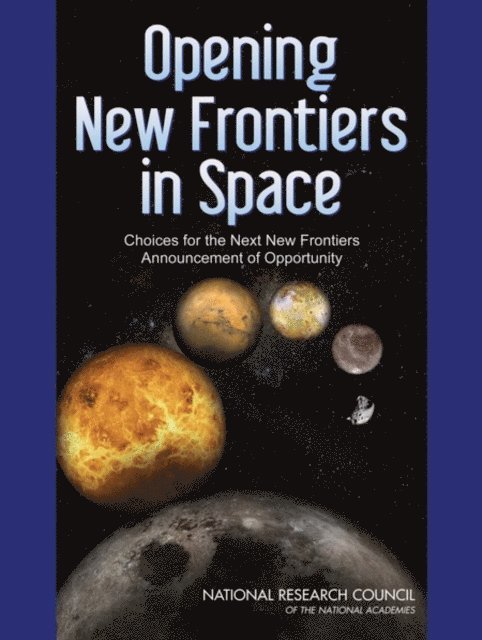
The New Frontiers Program was created by NASA in 2002 at the recommendation of the NRC''s decadal survey for solar system research. In order to optimize solar system research, the NRC recommended a series of principal-investigator missions that encourage innovation and accomplish the main scientific objectives presented in the survey. Two of the five recommended missions have been selected and, as was also recommended in the survey, the NRC was asked in 2007 to provide criteria and guiding principles to NASA for determining the list of candidate missions. This book presents a review of eight missions: the three remaining from the original list of five from the survey plus five missions considered by the survey committee but which were not recommended. Included in the review of each mission is a discussion of relevant science and technology developments since the survey and set of recommended science goals.
Committee on New Opportunities in Solar System Exploration: An Evaluation of the New Frontiers Announcement of Opportunity – författare
Visar alla böcker från författaren Committee on New Opportunities in Solar System Exploration: An Evaluation of the New Frontiers Announcement of Opportunity. Handla med fri frakt och snabb leverans.
2 produkter
Information om vår produktsortering
Lär dig mer om vår produktsortering och varför vissa produkter visas och prioriteras framför andra.
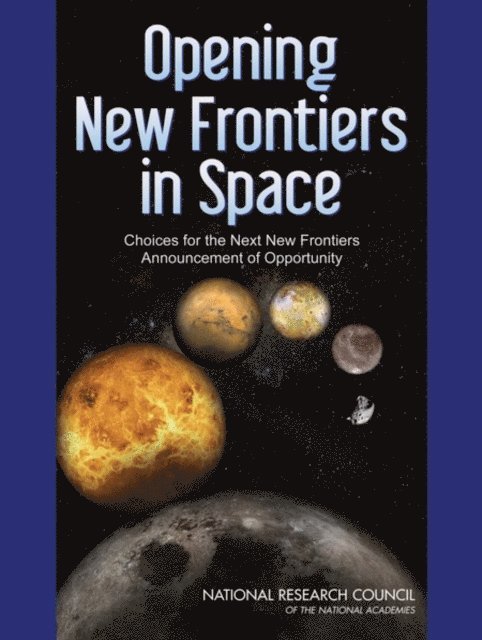
The New Frontiers Program was created by NASA in 2002 at the recommendation of the NRC''s decadal survey for solar system research. In order to optimize solar system research, the NRC recommended a series of principal-investigator missions that encourage innovation and accomplish the main scientific objectives presented in the survey. Two of the five recommended missions have been selected and, as was also recommended in the survey, the NRC was asked in 2007 to provide criteria and guiding principles to NASA for determining the list of candidate missions. This book presents a review of eight missions: the three remaining from the original list of five from the survey plus five missions considered by the survey committee but which were not recommended. Included in the review of each mission is a discussion of relevant science and technology developments since the survey and set of recommended science goals.