Stefan Leible – författare
Visar alla böcker från författaren Stefan Leible. Handla med fri frakt och snabb leverans.
15 produkter
Der Schutz der Persönlichkeit im Internet
Av Torsten Kutschke, Stefan Leible
E-bok, 2014
399 kr
Lägg i varukorg
Die Werke der Reihe "Recht und Neue Medien" zeichnen sich durch kompetente Autoren aus Wissenschaft und Praxis, große Aktualität und eine leicht verständliche Darstellung aus. Jeder Band enthält zahlreiche Beiträge zu ausgewählten Teilbereichen des Informationsrechts. Durch die interdisziplinäre …
Innovation und Recht im Internet
E-bok, 2014
434 kr
Lägg i varukorg
Die Werke der Reihe "Recht und Neue Medien" zeichnen sich durch kompetente Autoren aus Wissenschaft und Praxis, große Aktualität und eine leicht verständliche Darstellung aus. Jeder Band enthält zahlreiche Beiträge zu ausgewählten Teilbereichen des Informationsrechts. Durch die interdisziplinäre …
Europäisches Zivilprozess- und Kollisionsrecht EuZPR/EuIPR, Band I
Brüssel Ia-VO
Av Ansgar Staudinger, Steffen Pabst m. fl.
E-bok, 2015
2971 kr
Lägg i varukorg
Europäisches Zivilprozess- und Kollisionsrecht EuZPR/EuIPR, Kommentar, Band I
Brüssel Ia-Verordnung
Av Ansgar Staudinger, Steffen Pabst m. fl.
E-bok, 2020
3457 kr
Lägg i varukorg
Europäisches Rechtsschutz- und Verfahrensrecht
Zugleich Band 3 der Enzyklopädie Europarecht
Av Jorg Philipp Terhechte, Stefan Leible
E-bok, 2021
2176 kr
Lägg i varukorg
Rechtsschutz und Verfahren sind zentrale Bausteine der unionalen Rechtsordnung. Nur derjenige, der die strukturellen Parallelen und Gemeinsamkeiten der verschiedenen Verfahrensordnungen kennt, kann konkrete Lösungen für unionsrechtlich gelagerte Fälle anbieten. Das Handbuch zum EU-Rechtsschutz …
Rome I Regulation
The Law Applicable to Contractual Obligations in Europe
Av Stefan Leible, Franco Ferrari
E-bok, 2009
820 kr
Lägg i varukorg
Will the new Rome I Regulation meet its goals - to improve the predictability of the outcome of litigation? - to bring certainty as to the law applicable and the free movement of judgments? - to designate the same national law irrespective of the country of the court in which an action is brought? …
European Contract Law and German Law
Av Matthias Lehmann, Stefan Leible
E-bok, 2014
3781 kr
Lägg i varukorg
The newest volume in Kluwer’s series of comparative analyses of Member State law and the Principles of European Contract Law (PECL), this book not only provides an introduction to German law for lawyers familiar with the PECL but also serves as a model for “reconnecting” the contract law of the …
General Principles of European Private International Law
E-bok, 2016
2670 kr
Lägg i varukorg
European private international law, as it stands in the Rome I, II, and III Regulations and the recent Succession Regulation, presents manifold risks of diverging judgments despite seemingly harmonised conflict of law rules. There is now a real danger, in light of the rapid increase in the number …
General Principles of European Private International Law
E-bok, 2016
2670 kr
Lägg i varukorg
European private international law, as it stands in the Rome I, II, and III Regulations and the recent Succession Regulation, presents manifold risks of diverging judgments despite seemingly harmonised conflict of law rules. There is now a real danger, in light of the rapid increase in the number …
Die Sicherung der Energieversorgung auf globalisierten Märkten
Av Christian Walter, Stefan Leible m. fl.
Häftad, 2007
964 kr
Tillfälligt slut
Die Sicherung der Energieversorgung im weltweiten Maßstab wird in Zukunft zentrale Bedeutung erlangen. Nach der Einschätzung des Generalsekretärs der Organisation Erdölexportierender Länder (OPEC) werden 4/5 des Wachstums der Ölnachfrage in den nächsten zwei Dekaden aus Entwicklungsländern kommen, …
Wissen - Märkte - Geistiges Eigentum
Av Stefan Leible, Ansgar Ohly m. fl.
Häftad, 2010
1465 kr
Tillfälligt slut
Seit der Zeit, in der die Rechte des geistigen Eigentums ihre heutige Form gewonnen haben, haben sich die Rahmenbedingungen für die Entstehung und Verbreitung von Wissen und Information verändert. Neben "vertikale" Innovation, die in einem Unternehmen oder einer Forschergruppe stattfindet, tritt …
Unkörperliche Güter im Zivilrecht
Av Matthias Lehmann, Stefan Leible m. fl.
Häftad, 2011
1215 kr
Tillfälligt slut
Unkörperliche, das heißt sinnlich nicht wahrnehmbare Güter bestimmen zunehmend unsere Welt. Zu ihnen zählen nicht nur die klassischen Immaterialgüter, wie etwa patentierbare Erfindungen oder urheberrechtlich schutzfähige Werke, sondern auch Energie, Informationen in Form von Daten oder Software und …
Der Schutz des Geistigen Eigentums im Internet
Häftad, 2013
1465 kr
Tillfälligt slut
Das Internet ermöglicht den Nutzern einen schnellen und unkomplizierten Zugriff auf urheberrechtlich geschützte Inhalte. Aufgrund der weit verbreiteten 'Gratis-Kultur' wird allerdings freier Zugang oft mit kostenfreiem Zugang verwechselt. Regierungen und Kulturschaffende betonen daher immer wieder …
Die Kollision von Urheberrecht und Nutzerverhalten
Av Michael Grünberger, Stefan Leible
Häftad, 2014
1465 kr
Tillfälligt slut
Ausschließlichkeitsrechte kontrollieren den Zugang zu immateriellen Gütern. Damit kollidieren sie mit dem Kommunikationsverhalten in sozialen Systemen. Deutlich sichtbar wird das in Abmahnfällen, die die Kommunikationsstrukturen der familiären Sphäre betreffen. Ähnliches gilt für Wissenschaft und …
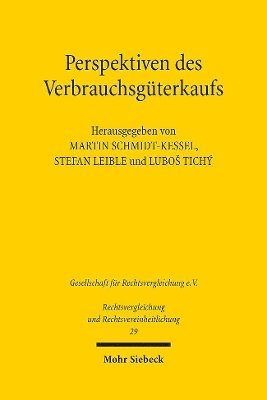
Perspektiven des Verbrauchsgüterkaufs
Richtlinienumsetzung und Gemeinsames Europäisches Kaufrecht in Deutschland und Tschechien
Av Stefan Leible, Martin Schmidt-Kessel m. fl.
Häftad, 2015
1100 kr
Tillfälligt slut
In der Tradition der Gesellschaft für Rechtsvergleichung (GfR) stehen bilaterale Juristentreffen zum Austausch wissenschaftlicher Erkenntnisse und zum Vergleich der Rechtstheorie und -praxis der jeweiligen Rechtssysteme. Der vorliegende Sammelband enthält die Beiträge der Vortragenden der Tagung …