Susie Katt - Böcker
Figuring Out Fluency--Ten Foundations for Reasoning Strategies With Whole Numbers
A Classroom Companion
410 kr
Skickas inom 5-8 vardagar
Because fluency practice is not a worksheet.
Fluency in mathematics is more than basic facts or using algorithms. It is not about recall or speed. Real fluency is about choosing strategies that are efficient, flexible, lead to accurate solutions, and are appropriate for the given situation. Developing fluency is a matter of equity and access for all learners.
The landmark book Figuring Out Fluency in Mathematics Teaching and Learning offered educators the inspiration to develop a deeper understanding of procedural fluency. It explained the seven Significant Strategies for fluency and offered a plethora of pragmatic tools for shifting classrooms toward a greater fluency approach. However, in order to become truly adept with these strategies, children must first have certain underlying foundational concepts and skills in place.
Figuring Out Fluency-Ten Underlying Foundations for Reasoning Strategies with Whole Numbers explores the ideas that are essential to reasoning: Number Relationships; Subitizing and Decomposing; Distance to 10, 100, and 1,000; Counting and Skip-Counting; Properties of Addition and Its Inverse Relationship with Subtraction; Properties of Multiplication and Its Inverse Relationship with Division; Multiplying by 10s and 100s; Multiples and Factors; Doubling and Halving; and Computational Estimation. With this book, elementary teachers can
Help children develop these foundational understandings, critical to reasoning and number sense.Leverage over 100 classroom-ready routines, centers, and games to develop these concepts both in first instruction, practice, and intervention.Download all of the needed support tools, game boards, and other resources from the companion website for immediate implementationDevelop each and every students’ knowledge and power to become skilled and confident mathematical thinkers and doers.
386 kr
Skickas inom 5-8 vardagar
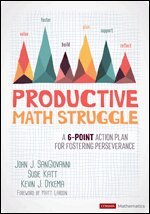
“Seldom has a book been as timely or as necessary as Productive Math Struggle is today. . . One of the remarkable accomplishments of SanGiovanni, Katt, and Dykema’s work lies in how they seamlessly connect the research on high-quality tasks, high expectations, identity, and equity to productive math struggle. This is perhaps their greatest contribution. The authors see productive math struggle as a critical feature of mathematics classrooms that support access, equity, and empowerment, specifically arguing that every student is ‘worthy of struggle.’”
From the Foreword by Matt Larson, Ph.D. Past President (2016-2018), National Council of Teachers of Mathematics Associate Superintendent for Instruction, Lincoln Public Schools, Nebraska
Struggle is hard. Productive struggle is power.
All students face struggle, and they should—it is how they learn and grow. The teacher’s job is not to remove struggle, but rather to value and harness it, helping students develop good habits of productive struggle. But what’s missing for many educators is an action plan for how to achieve this, especially when it comes to math.
Persevering through difficult challenges to reach new learning is the core of Productive Math Struggle. When left unsupported, struggle can become unproductive and demoralizing, negatively influencing students’ mathematical identities. The authors guide teachers through six specific actions—including valuing, fostering, building, planning, supporting, and reflecting on struggle—to create a game plan for overcoming obstacles by sharing
Actionable steps, activities, and tools for implementation Instructional tasks and vignettes representative of each grade level Real-world examples showcasing classroom photos and student work samplesA book study guide is available under the Free Resources tab that helps math educators to learn together on how to incorporate productive math struggle in their classrooms. Revolving around the idea that math is a way of thinking and understanding, and not just the pursuit of answers and procedures, this book empowers students to embrace productive struggle to build essential skills for learning and living—both inside and outside the classroom.