Jennifer M. Bay-Williams – författare
379 kr
Skickas inom 5-8 vardagar
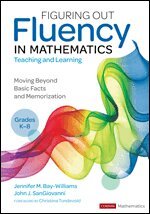
Figuring Out Fluency in Mathematics Teaching and Learning, Grades K-8
Moving Beyond Basic Facts and Memorization
384 kr
Skickas inom 5-8 vardagar
Because fluency practice is not a worksheet.
Fluency in mathematics is more than adeptly using basic facts or implementing algorithms. Real fluency involves reasoning and creativity, and it varies by the situation at hand.
Figuring Out Fluency in Mathematics Teaching and Learning offers educators the inspiration to develop a deeper understanding of procedural fluency, along with a plethora of pragmatic tools for shifting classrooms toward a fluency approach. In a friendly and accessible style, this hands-on guide empowers educators to support students in acquiring the repertoire of reasoning strategies necessary to becoming versatile and nimble mathematical thinkers. It includes:
“Seven Significant Strategies” to teach to students as they work toward procedural fluency. Activities, fluency routines, and games that encourage learning the efficiency, flexibility, and accuracy essential to real fluency. Reflection questions, connections to mathematical standards, and techniques for assessing all components of fluency. Suggestions for engaging families in understanding and supporting fluency.Fluency is more than a toolbox of strategies to choose from; it’s also a matter of equity and access for all learners. Give your students the knowledge and power to become confident mathematical thinkers.
Figuring Out Fluency - Addition and Subtraction With Whole Numbers
A Classroom Companion
384 kr
Skickas inom 5-8 vardagar
Figuring Out Fluency – Operations With Rational Numbers and Algebraic Equations
A Classroom Companion
395 kr
Skickas inom 5-8 vardagar
“This book is awesome! What stood out to me was the deep understanding I was able to have about what fluency actually means. Too often the message has been fluency and accuracy, especially at the middle school level. By providing teachers with tools for building fluency with integers, expressions, and algebra, this book shifts that message to also focus on flexibility and strategy selection.”
Lindsey Henderson Secondary Mathematics Specialist, Utah State Board of Education Salt Lake City, UT
Because fluency practice is not a worksheet.
Fluency in mathematics is more than adeptly using basic facts or implementing algorithms. It is not about speed or recall. Real fluency is about choosing strategies that are efficient, flexible, lead to accurate solutions, and are appropriate for the given situation. Developing fluency is also a matter of equity and access for all learners.
The landmark book Figuring Out Fluency in Mathematics Teaching and Learning offered educators the inspiration to develop a deeper understanding of procedural fluency, along with a plethora of pragmatic tools for shifting classrooms toward a fluency approach. Now, teachers have the chance to apply that inspiration through explicit instruction and practice every day with the classroom companion Figuring Out Fluency—Operations With Rational Numbers and Algebraic Equations. With this book, teachers can
Dive deeper into the Significant Strategies for fluency explained in the anchor book as they apply to rational number operations Explore how these strategies can be applied for proportional reasoning, solving equations for unknowns, and solving systems of linear equations Access over 100 classroom-ready activities, including worked examples, routines, and games. Find activities to explicitly teach students how to use and choose strategies to operate on rational numbers and solve algebraic equations Download all of the needed support tools, game boards, and other resources from the companion website for immediate implementationGive each and every student the knowledge and power to become skilled and confident mathematical thinkers and doers.
Figuring Out Fluency - Multiplication and Division With Fractions and Decimals
A Classroom Companion
436 kr
Skickas
Because fluency practice is not a worksheet. Fluency in mathematics is more than adeptly using basic facts or implementing algorithms. It is not about speed or recall. Real fluency is about choosing strategies that are efficient, flexible, lead to accurate solutions, and are appropriate for the given situation. Developing fluency is also a matter of equity and access for all learners. The landmark book Figuring Out Fluency in Mathematics Teaching and Learning offered educators the inspiration to develop a deeper understanding of procedural fluency, along with a plethora of pragmatic tools for shifting classrooms toward a fluency approach. Now, teachers have the chance to apply that inspiration through explicit instruction and practice every day with the classroom companion Figuring Out Fluency: Multiplication and Division with Fractions and Decimals. With this book, teachers can:
Dive deeper into the Significant Strategies for fluency explained in the anchor book Learn how these strategies grow from and relate to the basic fact strategies children learn Access over 100 strategy-aligned and classroom-ready activities for fluency instruction and practice in multiplying and dividing fractions and decimals, including worked examples, routines, games, and centers Find activities for assessing all components of multiplication and division fluency for fractions and decimals, plus support for engaging families Download all of the needed support tools, game boards, and other resources from the companion website for immediate implementation.Give each and every student the knowledge and power to become skilled and confident mathematical thinkers and doers.
Figuring Out Fluency - Addition and Subtraction With Fractions and Decimals
A Classroom Companion
436 kr
Skickas inom 11-20 vardagar
Because fluency practice is not a worksheet.
Fluency in mathematics is more than adeptly using basic facts or implementing algorithms. It is not about speed or recall. Real fluency is about choosing strategies that are efficient, flexible, lead to accurate solutions, and are appropriate for the given situation. Developing fluency is also a matter of equity and access for all learners.
The landmark book Figuring Out Fluency in Mathematics Teaching and Learning offered educators the inspiration to develop a deeper understanding of procedural fluency, along with a plethora of pragmatic tools for shifting classrooms toward a fluency approach. Now, teachers have the chance to apply that inspiration through explicit instruction and practice every day with the classroom companion Figuring Out Fluency: Addition and Subtraction with Fractions and Decimals. With this book, teachers can:
Dive deeper into the Significant Strategies for fluency explained in the anchor book Learn how these strategies grow from and relate to the basic fact strategies children learn Access over 100 strategy-aligned and classroom-ready activities for fluency instruction and practice in adding and subtracting fractions and decimals, including worked examples, routines, games, and centers Find activities for assessing all components of addition and subtraction fluency for fractions and decimals, plus support for engaging families Download all of the needed support tools, game boards, and other resources from the companion website for immediate implementation.Give each and every student the knowledge and power to become skilled and confident mathematical thinkers and doers.
Figuring Out Fluency--Ten Foundations for Reasoning Strategies With Whole Numbers
A Classroom Companion
410 kr
Skickas inom 5-8 vardagar
Because fluency practice is not a worksheet.
Fluency in mathematics is more than basic facts or using algorithms. It is not about recall or speed. Real fluency is about choosing strategies that are efficient, flexible, lead to accurate solutions, and are appropriate for the given situation. Developing fluency is a matter of equity and access for all learners.
The landmark book Figuring Out Fluency in Mathematics Teaching and Learning offered educators the inspiration to develop a deeper understanding of procedural fluency. It explained the seven Significant Strategies for fluency and offered a plethora of pragmatic tools for shifting classrooms toward a greater fluency approach. However, in order to become truly adept with these strategies, children must first have certain underlying foundational concepts and skills in place.
Figuring Out Fluency-Ten Underlying Foundations for Reasoning Strategies with Whole Numbers explores the ideas that are essential to reasoning: Number Relationships; Subitizing and Decomposing; Distance to 10, 100, and 1,000; Counting and Skip-Counting; Properties of Addition and Its Inverse Relationship with Subtraction; Properties of Multiplication and Its Inverse Relationship with Division; Multiplying by 10s and 100s; Multiples and Factors; Doubling and Halving; and Computational Estimation. With this book, elementary teachers can
Help children develop these foundational understandings, critical to reasoning and number sense.Leverage over 100 classroom-ready routines, centers, and games to develop these concepts both in first instruction, practice, and intervention.Download all of the needed support tools, game boards, and other resources from the companion website for immediate implementationDevelop each and every students’ knowledge and power to become skilled and confident mathematical thinkers and doers.
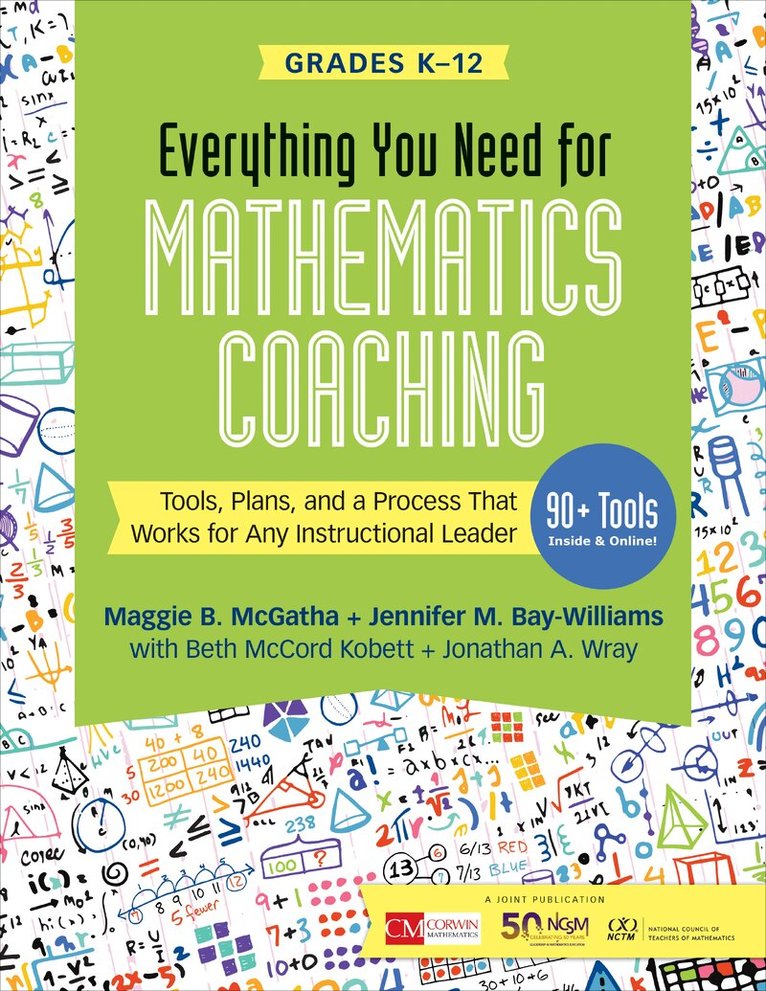
Everything You Need for Mathematics Coaching
Tools, Plans, and a Process That Works for Any Instructional Leader, Grades K-12
408 kr
Skickas inom 5-8 vardagar
Math coaches wear many hats. You think on your feet and have to invent, react, and respond—often without time to prepare—in a myriad of professional contexts. What’s your go-to resource for support?
Plan, focus, and lead: Your toolkit for inspiring math teachers
Meet Everything You Need For Mathematics Coaching: Tools, Plans, and a Process That Works for Any Instructional Leader. This one-stop, comprehensive toolkit for improving mathematics instruction and learning is designed for busy math coaches and teacher leaders who often have to rely on their own competencies. Using the Leading for Mathematical Proficiency Framework, the authors position student outcomes as the focus of all professional work and connect the Eight Mathematical Practices for students with NCTM’s Eight Effective Teaching Practices to help you guide teachers toward growing mathematics proficiency in their classrooms.
This hands-on resource details critical coaching and teaching actions, and offers nearly a hundred tools for:
Shifting classroom practice in a way that leads to student math proficiency and understanding of mathematical concepts. Honing in on key areas, including content knowledge and worthwhile tasks, student engagement, questioning and discourse, analysis of student work, formative assessment, support for emergent language learners and students with special needs, and more. Navigating a coaching conversation. Planning and facilitating professional learning communities. Finding a focus for professional development or a learning cycle. Making connections between professional learning activities, teaching, and student learning. Using the coaching cycle—plan, gather data, reflect—to build trust and rapport with teachers.With examples from the field, a comprehensive list of resources for effective coaching, and a plethora of tools you can download and share with teachers, this toolkit is your must-have guide to designing a professional learning plan and leading with clarity and purpose.