Valpy Fitzgerald - Böcker
Visar alla böcker från författaren Valpy Fitzgerald. Handla med fri frakt och snabb leverans.
10 produkter
10 produkter
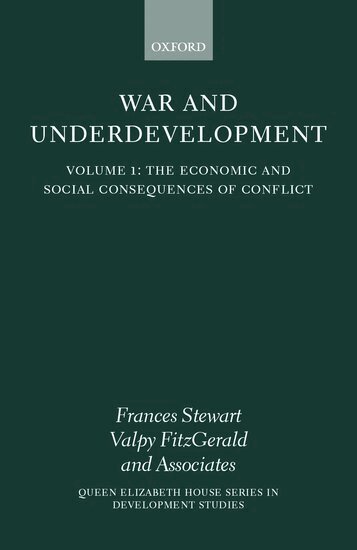
War and Underdevelopment: Volume 1: The Economic and Social Consequences of Conflict
Inbunden, Engelska, 2000
948 kr
Skickas inom 5-8 vardagar
Wars, especially civil wars, are among the most serious causes of human suffering and underdevelopment. Yet economic analysis of developing countries at war is relatively rare. These volumes aim to reverse this neglect, tracing the economic and social consequences of conflict both theoretically and through empirical investigations, including seven country case studies. A major objective is to identify policies which may reduce the heavy human and economic costs. Volume One provides a general framework for the analysis, examines the political economy of countries at war, and provides an empirical overview of the costs of war for the poor countries worst affected by conflict.The approach is multidisciplinary: political and sociological analysis is needed in order to understand motivations and behaviour during conflict; while economic analysis is necessary to evaluate how poor people are affected. The analysis includes an investigation of how the international system, including food aid, affects the war economies, and identifies international as well as domestic policies which may reduce the human and economic costs of conflict.The subject is particularly important in view of the high incidence of wars in poor countries. Between 1950 and 1990, around 15 million deaths were caused (directly or indirectly) by war in developing countries. The end of the Cold War led to a transition to peace in many of the areas in which conflict had been fuelled by East-West antagonism, but new wars erupted. From 1989 to 1995, between 34 and 51 armed conflicts were waged each year, the great majority in poor developing countries.These volumes investigate economic and social consequences at macro-, meso- and micro- levels, aiming to identify the indirect costs (e.g. via inflation and reduced entitlements) as well as direct costs of military operations. The in-depth country case studies published in Volume Two (Afghanistan, Mozambique, Nicaragua, Sierra Leone, Sri Lanka, Sudan and Uganda) are summarized in Volume One. These explore the main economic mechanisms operating during war and the policy responses of governments and international actors, showing how each can enlarge the costs and further fuel the conflicts. The large variations in this response and in the consequent costs point to domestic and international policies which can reduce the human and economic costs even before peace is restored.
War and Underdevelopment: Volume 1: The Economic and Social Consequences of Conflict
Häftad, Engelska, 2000
1 043 kr
Skickas inom 5-8 vardagar
Wars, especially civil wars, are among the most serious causes of human suffering and underdevelopment. Yet economic analysis of developing countries at war is relatively rare. These volumes aim to reverse this neglect, tracing the economic and social consequences of conflict both theoretically and through empirical investigations, including seven country case studies. A major objective is to identify policies which may reduce the heavy human and economic costs. Volume One provides a general framework for the analysis, examines the political economy of countries at war, and provides an empirical overview of the costs of war for the poor countries worst affected by conflict.The approach is multidisciplinary: political and sociological analysis is needed in order to understand motivations and behaviour during conflict; while economic analysis is necessary to evaluate how poor people are affected. The analysis includes an investigation of how the international system, including food aid, affects the war economies, and identifies international as well as domestic policies which may reduce the human and economic costs of conflict.The subject is particularly important in view of the high incidence of wars in poor countries. Between 1950 and 1990, around 15 million deaths were caused (directly or indirectly) by war in developing countries. The end of the Cold War led to a transition to peace in many of the areas in which conflict had been fuelled by East-West antagonism, but new wars erupted. From 1989 to 1995, between 34 and 51 armed conflicts were waged each year, the great majority in poor developing countries.These volumes investigate economic and social consequences at macro-, meso- and micro- levels, aiming to identify the indirect costs (e.g. via inflation and reduced entitlements) as well as direct costs of military operations. The in-depth country case studies published in Volume Two (Afghanistan, Mozambique, Nicaragua, Sierra Leone, Sri Lanka, Sudan and Uganda) are summarized in Volume One. These explore the main economic mechanisms operating during war and the policy responses of governments and international actors, showing how each can enlarge the costs and further fuel the conflicts. The large variations in this response and in the consequent costs point to domestic and international policies which can reduce the human and economic costs even before peace is restored.
2 890 kr
Skickas inom 5-8 vardagar
Wars, especially civil wars, are among the most serious causes of human suffering and underdevelopment. Yet economic analysis of developing countries at war is relatively rare. These volumes aim to reverse this neglect, tracing the economic and social consequences of conflict both theoretically and through empirical investigations, including seven country case studies. A major objective is to identify policies which may reduce the heavy human and economic costs. Volume One provides a general framework for the analysis, examines the political economy of countries at war, and provides an empirical overview of the costs of war for the poor countries worst affected by conflict.The approach is multidisciplinary: political and sociological analysis is needed in order to understand motivations and behaviour during conflict; while economic analysis is necessary to evaluate how poor people are affected. The analysis includes an investigation of how the international system, including food aid, affects the war economies, and identifies international as well as domestic policies which may reduce the human and economic costs of conflict.The subject is particularly important in view of the high incidence of wars in poor countries. Between 1950 and 1990, around 15 million deaths were caused (directly or indirectly) by war in developing countries. The end of the Cold War led to a transition to peace in many of the areas in which conflict had been fuelled by East-West antagonism, but new wars erupted. From 1989 to 1995, between 34 and 51 armed conflicts were waged each year, the great majority in poor developing countries.These volumes investigate economic and social consequences at macro-, meso- and micro- levels, aiming to identify the indirect costs (e.g. via inflation and reduced entitlements) as well as direct costs of military operations. The in-depth country case studies published in Volume Two (Afghanistan, Mozambique, Nicaragua, Sierra Leone, Sri Lanka, Sudan and Uganda) are summarized in Volume One. These explore the main economic mechanisms operating during war and the policy responses of governments and international actors, showing how each can enlarge the costs and further fuel the conflicts. The large variations in this response and in the consequent costs point to domestic and international policies which can reduce the human and economic costs even before peace is restored.
1 060 kr
Skickas inom 5-8 vardagar
Wars, especially civil wars, are among the most serious causes of human suffering and underdevelopment. Yet economic analysis of developing countries at war is relatively rare. These volumes aim to reverse this neglect, tracing the economic and social consequences of conflict both theoretically and through empirical investigations, including seven country case studies. A major objective is to identify policies which may reduce the heavy human and economic costs. Volume One provides a general framework for the analysis, examines the political economy of countries at war, and provides an empirical overview of the costs of war for the poor countries worst affected by conflict.The approach is multidisciplinary: political and sociological analysis is needed in order to understand motivations and behaviour during conflict; while economic analysis is necessary to evaluate how poor people are affected. The analysis includes an investigation of how the international system, including food aid, affects the war economies, and identifies international as well as domestic policies which may reduce the human and economic costs of conflict.The subject is particularly important in view of the high incidence of wars in poor countries. Between 1950 and 1990, around 15 million deaths were caused (directly or indirectly) by war in developing countries. The end of the Cold War led to a transition to peace in many of the areas in which conflict had been fuelled by East-West antagonism, but new wars erupted. From 1989 to 1995, between 34 and 51 armed conflicts were waged each year, the great majority in poor developing countries.These volumes investigate economic and social consequences at macro-, meso- and micro- levels, aiming to identify the indirect costs (e.g. via inflation and reduced entitlements) as well as direct costs of military operations. The in-depth country case studies published in Volume Two (Afghanistan, Mozambique, Nicaragua, Sierra Leone, Sri Lanka, Sudan and Uganda) are summarized in Volume One. These explore the main economic mechanisms operating during war and the policy responses of governments and international actors, showing how each can enlarge the costs and further fuel the conflicts. The large variations in this response and in the consequent costs point to domestic and international policies which can reduce the human and economic costs even before peace is restored.
535 kr
Skickas inom 10-15 vardagar
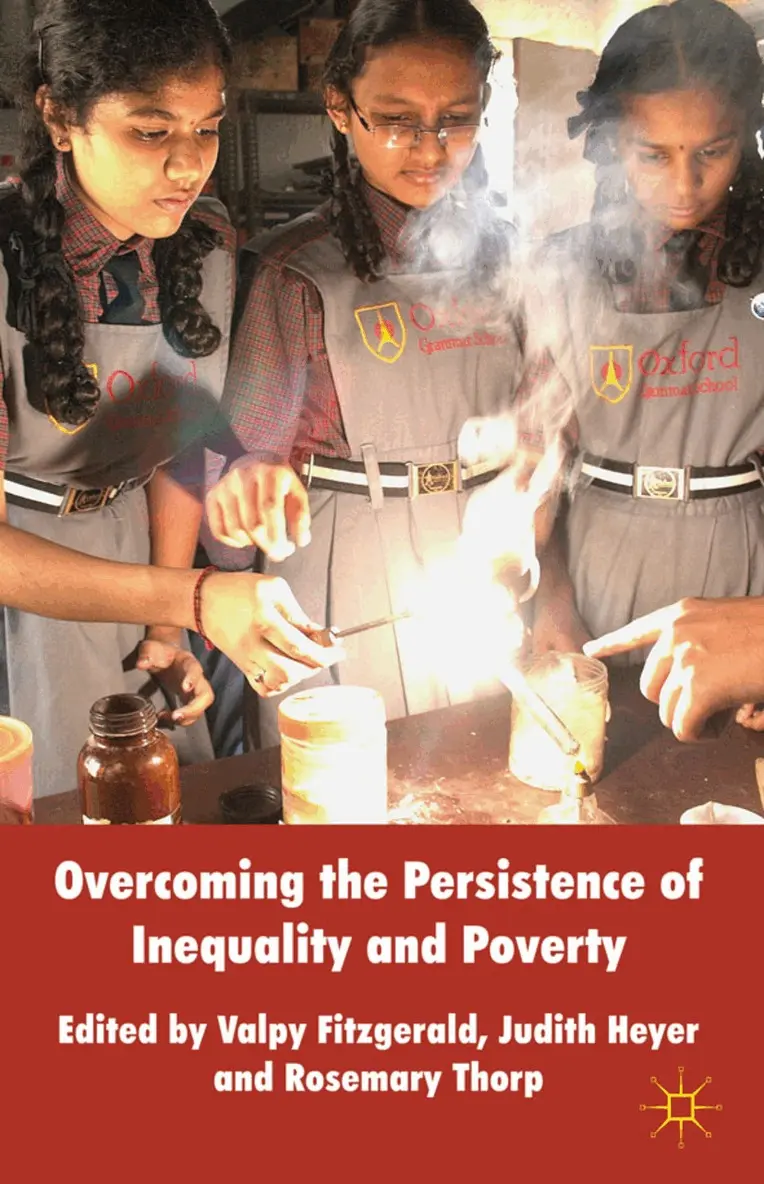
International experts evaluate new policy directions in economic development and poverty reduction, building on the ideas of a pioneer in the new discipline of Development Studies, Frances Stewart. Combing ideas and evidence on technological change, human development and conflict prevention to address the issue of the persistence of inequality
Macroeconomics of Development Finance
A Kaleckian Analysis of the Semi-Industrial Economy
Inbunden, Engelska, 1992
1 624 kr
Skickas inom 10-15 vardagar
This book provides vital theoretical underpinnings for the emerging 'neo-structuralist' reading of macroeconomics based on the heterogeneous accumulation behaviour of public and private sectors.
535 kr
Skickas inom 10-15 vardagar
International experts evaluate new policy directions in economic development and poverty reduction, building on the ideas of a pioneer in the new discipline of Development Studies, Frances Stewart. Combing ideas and evidence on technological change, human development and conflict prevention to address the issue of the persistence of inequality
1 095 kr
Skickas inom 10-15 vardagar
This book celebrates the modern relevance of one of the founding fathers of development economics, Kurt Martin. His thoughts, drawn from the central conflict of the 20th century between collective action and individual enterprise, have influenced a generation of scholars at one of Europe's foremost development studies faculties, the Institute of Social Studies (ISS) in The Hague. In this tribute to Kurt Martin, leading world thinkers, including Richard Nelson, Jose Antonio Ocampo, Frances Stewart, and Ben Ndulu, discuss the role of social institutions in economic development. They are complemented by leading ISS faculty, all contributing to the debate that will define the policy research agenda well into the next decade. This is a text for economic scholars, postgraduate students and development practitioners alike.
1 095 kr
Skickas inom 10-15 vardagar
Why it is so difficult for liberal economic ideas to become generally accepted (that is socially 'embedded') in industrialising countries despite the universal support for liberal political ideas and a single global market system?
1 095 kr
Skickas inom 10-15 vardagar
This book celebrates the modern relevance of one of the founding fathers of development economics - Kurt Martin. His thought - drawn from the central conflict of the twentieth century between collective action and individual enterprise - has influenced a generation of scholars at one of Europe's foremost development studies faculties, the Institute of Social Studies (ISS) in The Hague. In this tribute to Kurt Martin, leading world thinkers, including Richard Nelson, Jose Antonio Ocampo, Frances Stewart, and Ben Ndulu, discuss the role of social institutions in economic development. They are complemented by leading ISS faculty, all contributing to the debate that will define the policy research agenda well into the next decade. This is an essential text for economic scholars, postgraduate students, and development practitioners alike.