W Magnus – författare
Visar alla böcker från författaren W Magnus. Handla med fri frakt och snabb leverans.
16 produkter
Exponential Solution for the Homogeneous Linear Differential Equation of the Second Order
Inbunden, 2015
423 kr
Lägg i varukorg
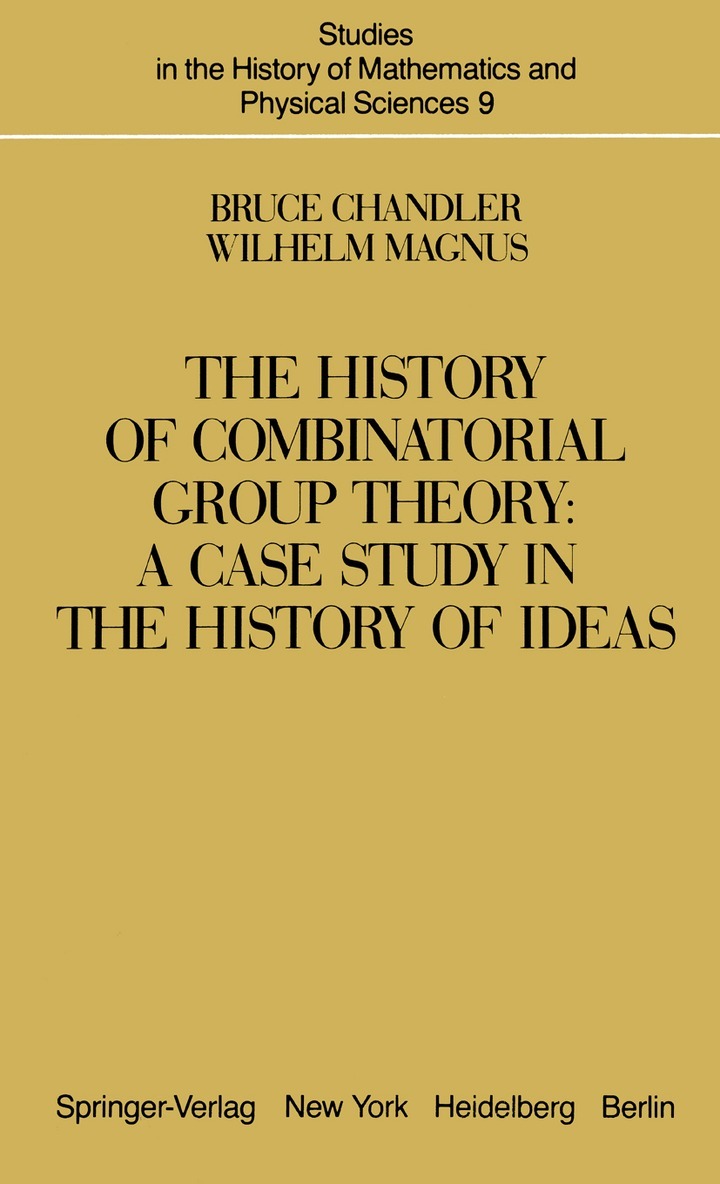
History of Combinatorial Group Theory
A Case Study in the History of Ideas
Av W. Magnus, B. Chandler
E-bok, 2012
1214 kr
Lägg i varukorg
One of the pervasive phenomena in the history of science is the development of independent disciplines from the solution or attempted solutions of problems in other areas of science. In the Twentieth Century, the creation of specialties witqin the sciences has accelerated to the point where a large …
History of Combinatorial Group Theory
A Case Study in the History of Ideas
Av B. Chandler, W. Magnus
Häftad, 2011
932 kr
Lägg i varukorg
One of the pervasive phenomena in the history of science is the development of independent disciplines from the solution or attempted solutions of problems in other areas of science. In the Twentieth Century, the creation of specialties witqin the sciences has accelerated to the point where a large …
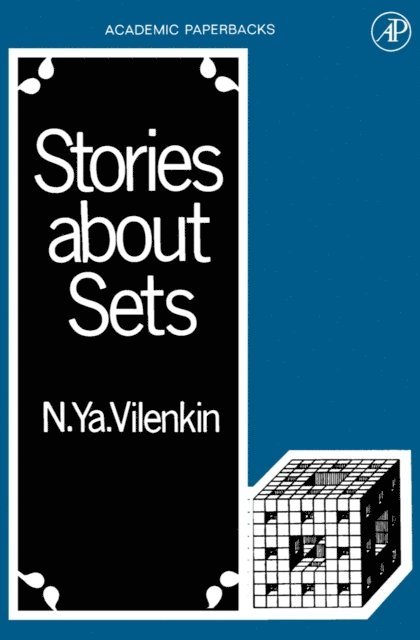
Stories About Sets
Av N. Ya. Vilenkin, W. Magnus m. fl.
E-bok, 2014
367 kr
Lägg i varukorg
Stories About Sets discusses the cardinality of sets and mathematical concepts, such as function, curve, surface, dimensions, and the paradoxical properties of curves and surfaces. The book reviews sets, operations on sets, the empty set, subsets, the universal sets, intersection of sets, union of …
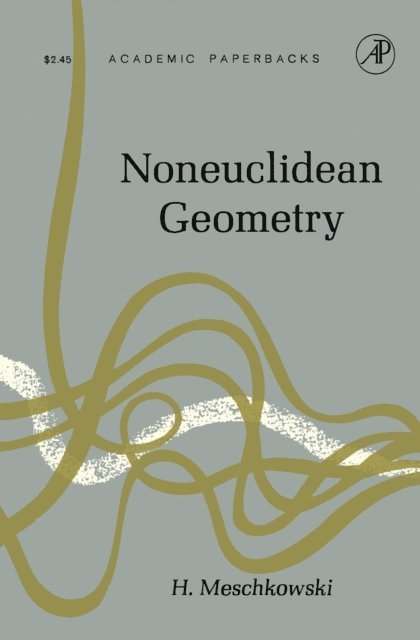
NonEuclidean Geometry
Av Herbert Meschkowski, W. Magnus m. fl.
E-bok, 2014
359 kr
Lägg i varukorg
Noneuclidean Geometry focuses on the principles, methodologies, approaches, and importance of noneuclidean geometry in the study of mathematics. The book first offers information on proofs and definitions and Hilbert''s system of axioms, including axioms of connection, order, congruence, and …
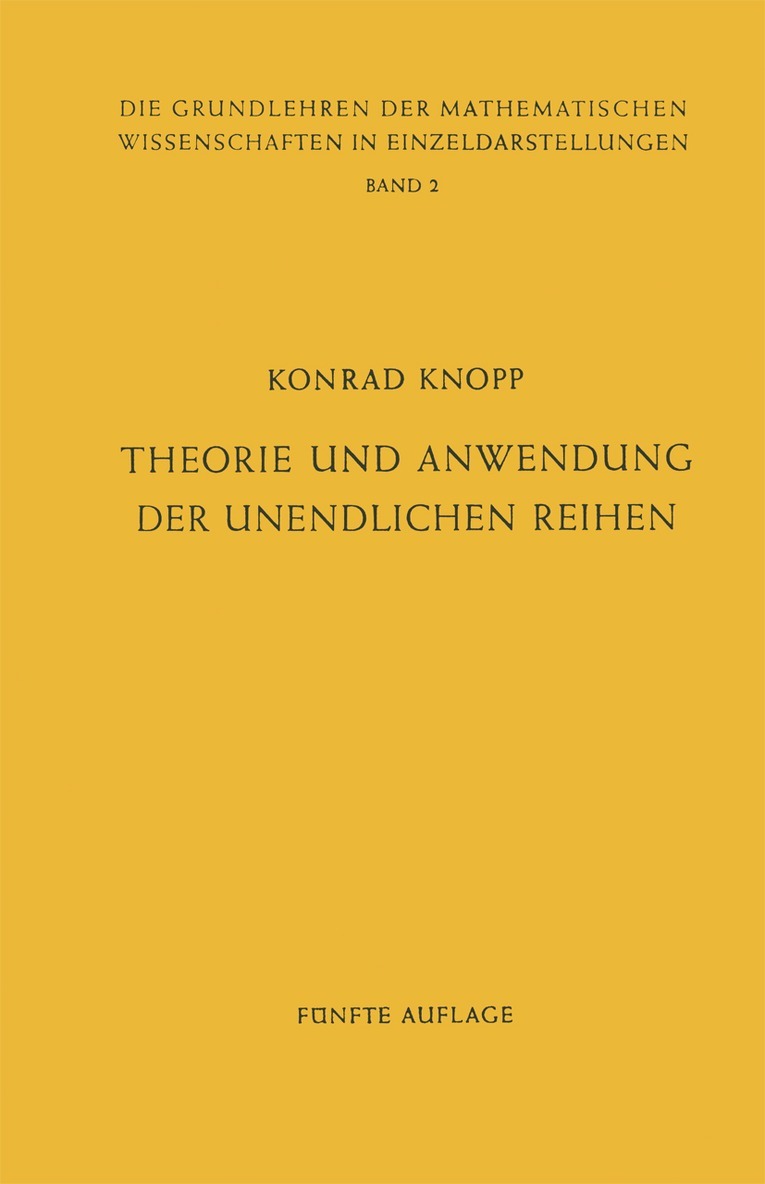
Theorie und Anwendung der Unendlichen Reihen
Av Konrad Knopp, J. L. Doob m. fl.
Häftad, 1964
568 kr
Lägg i varukorg
Vorlesungen Über allgemeine Funktionentheorie und elliptische Funktionen
Av Adolf Hurwitz, Richard Courant m. fl.
Häftad, 1964
823 kr
Lägg i varukorg
Markov Chains with Stationary Transition Probabilities
Av Kai Lai Chung, R. Grammel m. fl.
Häftad, 1960
552 kr
Lägg i varukorg
The theory of Markov chains, although a special case of Markov processes, is here developed for its own sake and presented on its own merits. In general, the hypothesis of a denumerable state space, which is the defining hypothesis of what we call a "chain" here, generates more clear-cut questions …
Theorie und Anwendung der Unendlichen Reihen
Av Konrad Knopp, B. L. van der Waerden m. fl.
E-bok, 2013
587 kr
Lägg i varukorg
Markov Chains with Stationary Transition Probabilities
Av Kai Lai Chung, B. L. van der Waerden m. fl.
E-bok, 2013
734 kr
Lägg i varukorg
The theory of Markov chains, although a special case of Markov processes, is here developed for its own sake and presented on its own merits. In general, the hypothesis of a denumerable state space, which is the defining hypothesis of what we call a "chain" here, generates more clear-cut questions …