William Jankowiak - Böcker
Visar alla böcker från författaren William Jankowiak. Handla med fri frakt och snabb leverans.
9 produkter
9 produkter
1 261 kr
Skickas inom 7-10 vardagar
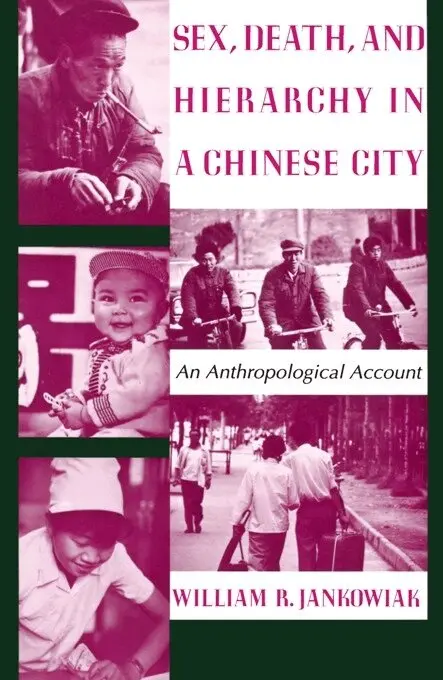
The first contemporary enthnographic account of urban life in China, Sex, Death, and Hierarchy in a Chinese City studies both public and private life, including such aspects as religious belief, gender images, family life, and sexual attraction.
695 kr
Skickas inom 3-6 vardagar
The first contemporary enthnographic account of urban life in China, Sex, Death, and Hierarchy in a Chinese City studies both public and private life, including such aspects as religious belief, gender images, family life, and sexual attraction.
561 kr
Skickas inom 3-6 vardagar
Observers from the West, the book contends, have incorrectly projected rigid ethnocentric notions of love and marriage onto cultures around the world. Contributors look beyond each society's "official" institutions to explore expressions of love. They find, for instance, that arranged marriages and polygamy do not necessarily indicate a lack of romantic passion but rather that people in such cultures may expect to look elsewhere for love. Contributors also look at the other side of the equation: rejection and grief.
1 104 kr
Skickas inom 7-10 vardagar
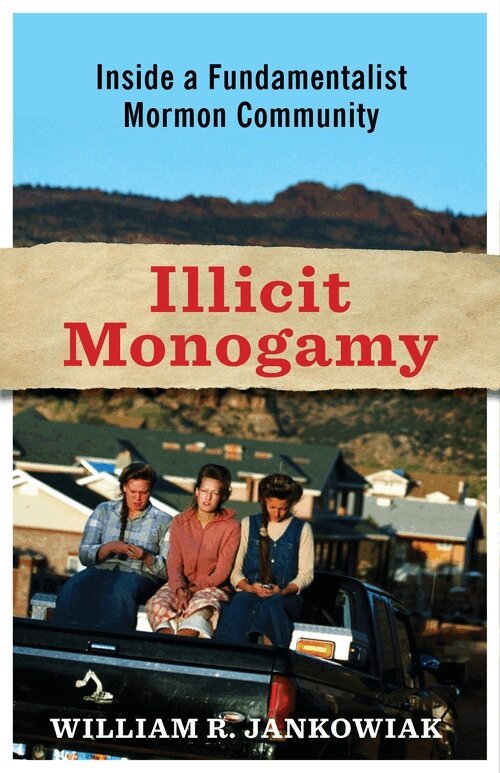
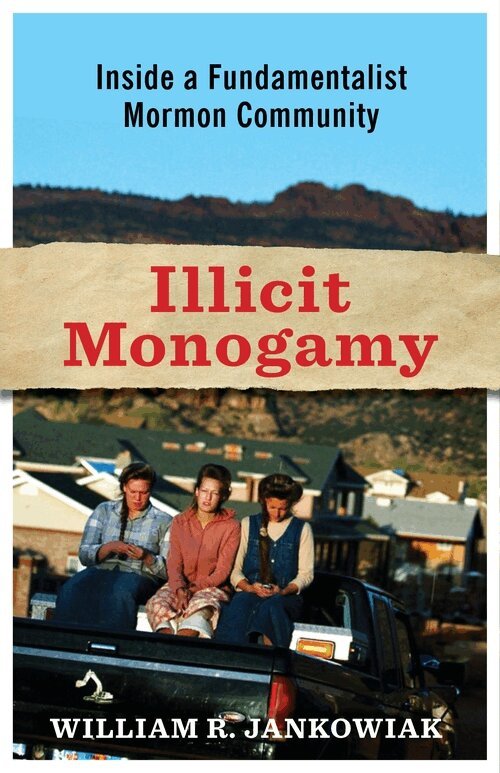
Angel Park is a Mormon fundamentalist polygamous community where plural marriages between one man and multiple women are common. In contrast to mainstream America’s idealization of the nuclear family and romantic love, its residents esteem notions of harmonious familial love, a spiritual bond that unites all family members. In their view, polygyny is not only righteous and sanctified—it is also conducive to communal life and social stability.Based on many years of in-depth ethnographic research in Angel Park, this book explores daily life in a polygamous community. William R. Jankowiak considers the plural family from the points of view of husbands, wives, and children, giving a balanced account of its complications and conflicts. He finds that people in polygynous marriages, especially cowives, experience an ongoing struggle to balance the longing for romantic intimacy with the obligation to support the larger family. They feel tension between deeply held religious convictions and the desire for emotional exclusivity, which can threaten the stability and harmony of the polygamous family. Men and women often form exclusive romantic pairs within plural marriages, which are tolerated if not openly acknowledged, showing the limits of the community’s beliefs. Jankowiak also challenges stereotypes of polygamous families as bastions of patriarchal power, showing the weight that interpersonal and social expectations place on men.Offering an unparalleled look at the complexity of a polygamous religious community, Illicit Monogamy also helps us reconsider relationships, love, and family dynamics across cultures and settings.
281 kr
Skickas inom 7-10 vardagar
Angel Park is a Mormon fundamentalist polygamous community where plural marriages between one man and multiple women are common. In contrast to mainstream America’s idealization of the nuclear family and romantic love, its residents esteem notions of harmonious familial love, a spiritual bond that unites all family members. In their view, polygyny is not only righteous and sanctified—it is also conducive to communal life and social stability.Based on many years of in-depth ethnographic research in Angel Park, this book explores daily life in a polygamous community. William R. Jankowiak considers the plural family from the points of view of husbands, wives, and children, giving a balanced account of its complications and conflicts. He finds that people in polygynous marriages, especially cowives, experience an ongoing struggle to balance the longing for romantic intimacy with the obligation to support the larger family. They feel tension between deeply held religious convictions and the desire for emotional exclusivity, which can threaten the stability and harmony of the polygamous family. Men and women often form exclusive romantic pairs within plural marriages, which are tolerated if not openly acknowledged, showing the limits of the community’s beliefs. Jankowiak also challenges stereotypes of polygamous families as bastions of patriarchal power, showing the weight that interpersonal and social expectations place on men.Offering an unparalleled look at the complexity of a polygamous religious community, Illicit Monogamy also helps us reconsider relationships, love, and family dynamics across cultures and settings.
297 kr
Kommande
Polygamy: The Basics is an accessible and engaging introduction to the kinship structure known as plural marriage or polygamy. Tailored for general readers and non-specialists, this book distils research findings from evolutionary anthropology, history, economics, political science, and cultural anthropology to survey polygamy’s place in human cultural, economic, and demographic developments from prehistory to the present. It addresses questions such as:How have perceptions of plural marriage have changed over time?Where does polygamy fit within human reproduction and family organization?What is the pair bond and is it universal or learned?Is polygamy a choice and, if so, for whom?Is polygamy inherently harmful?Drawing on global case studies, it endeavors to help readers aside their own cultural prisms and preconceived notions in order to examine plural marriage in its proper complexity.
2 258 kr
Kommande
Polygamy: The Basics is an accessible and engaging introduction to the kinship structure known as plural marriage or polygamy. Tailored for general readers and non-specialists, this book distils research findings from evolutionary anthropology, history, economics, political science, and cultural anthropology to survey polygamy’s place in human cultural, economic, and demographic developments from prehistory to the present. It addresses questions such as:How have perceptions of plural marriage have changed over time?Where does polygamy fit within human reproduction and family organization?What is the pair bond and is it universal or learned?Is polygamy a choice and, if so, for whom?Is polygamy inherently harmful?Drawing on global case studies, it endeavors to help readers aside their own cultural prisms and preconceived notions in order to examine plural marriage in its proper complexity.
435 kr
Kommande
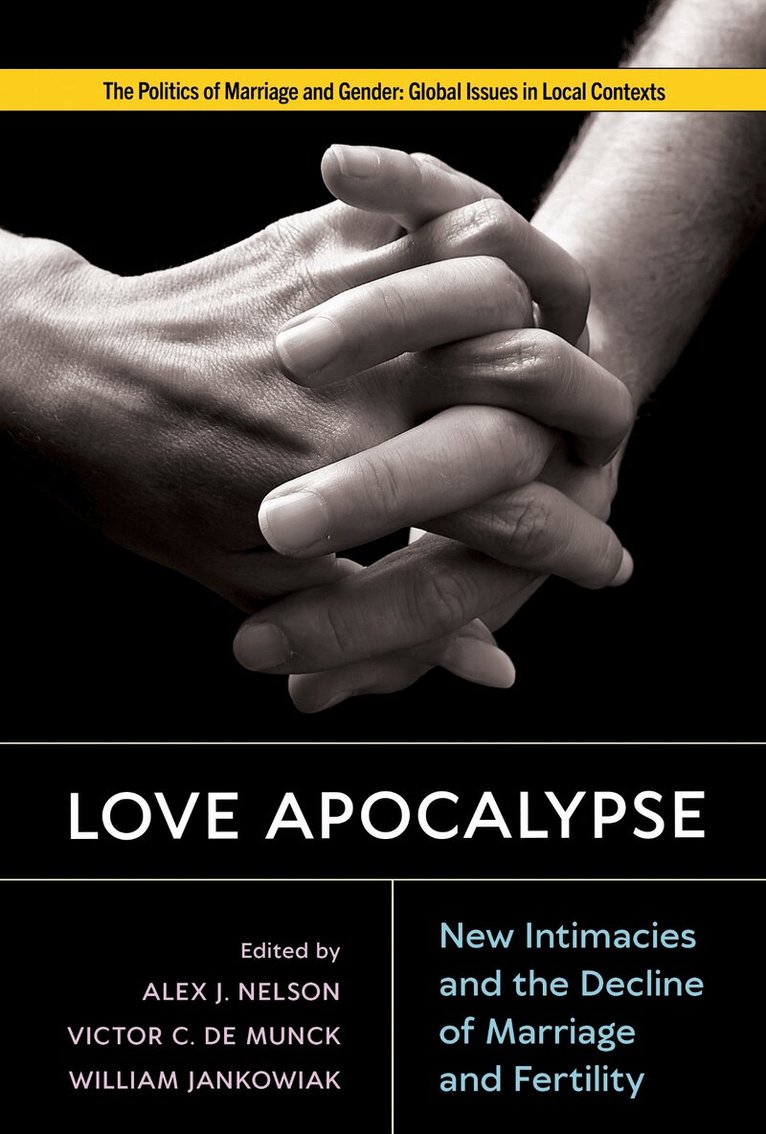
Marriage and fertility rates are falling around the world, upending social security planning and threatening economic growth. In Love Apocalypse, anthropologists present their insights into this society-altering demographic shift, drawing on their research into the ways love, romantic relationships, and family are being transformed by cultural, social, and economic forces. Each case study in this volume examines a unique cultural context from either Asia (China, South Korea, Japan, India), Europe (Germany, Lithuania), or Latin America (Cuba, Peru), grounded in years of ethnographic research into how communities' experiences and perceptions of love, marriage, and family are changing in response to economic precarity, shifting gender relations, status competition, and diversifying cultural norms. It is increasingly clear that marriage and two-parent nuclear families will not be the universal norm of the twenty-first century even if this arrangement was largely idealized a mere generation ago. However, this does not mean the end of love, intimacy, or family but rather its transformation and the emergence of new intimate relationships and adaptations to the challenges and opportunities of life in the twenty-first century.
1 271 kr
Kommande
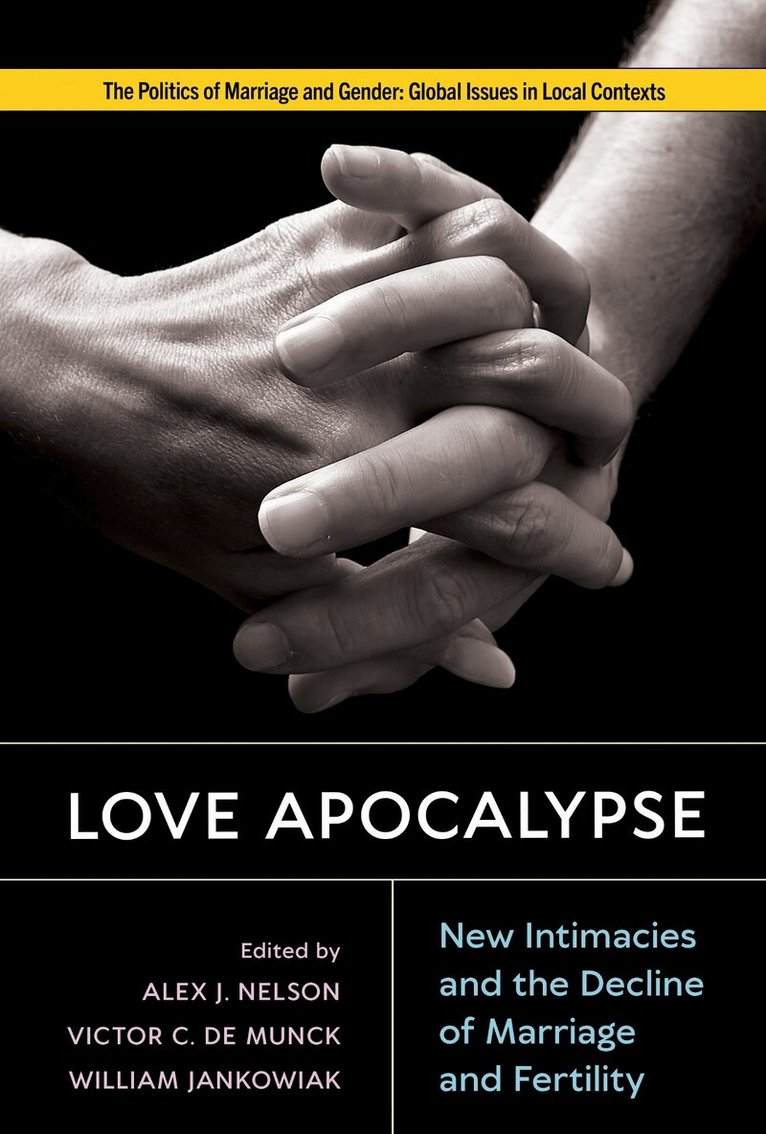
Marriage and fertility rates are falling around the world, upending social security planning and threatening economic growth. In Love Apocalypse, anthropologists present their insights into this society-altering demographic shift, drawing on their research into the ways love, romantic relationships, and family are being transformed by cultural, social, and economic forces. Each case study in this volume examines a unique cultural context from either Asia (China, South Korea, Japan, India), Europe (Germany, Lithuania), or Latin America (Cuba, Peru), grounded in years of ethnographic research into how communities' experiences and perceptions of love, marriage, and family are changing in response to economic precarity, shifting gender relations, status competition, and diversifying cultural norms. It is increasingly clear that marriage and two-parent nuclear families will not be the universal norm of the twenty-first century even if this arrangement was largely idealized a mere generation ago. However, this does not mean the end of love, intimacy, or family but rather its transformation and the emergence of new intimate relationships and adaptations to the challenges and opportunities of life in the twenty-first century.