Zachary M. Schrag - Böcker
Visar alla böcker från författaren Zachary M. Schrag. Handla med fri frakt och snabb leverans.
3 produkter
3 produkter
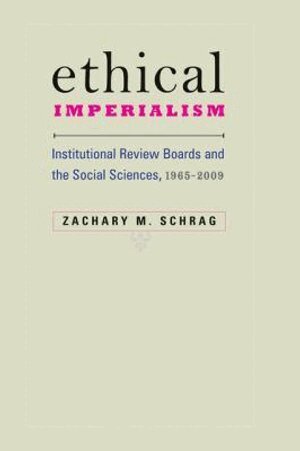
Ethical Imperialism
Institutional Review Boards and the Social Sciences, 1965–2009
Inbunden, Engelska, 2010
561 kr
Skickas inom 7-10 vardagar
University researchers in the United States seeking to observe, survey, or interview people are required first to complete ethical training courses and to submit their proposals to an institutional review board (IRB). Under current rules, IRBs have the power to deny funding, degrees, or promotion if their recommended modifications to scholars' proposals are not followed. This volume explains how this system of regulation arose and discusses its chilling effects on research in the social sciences and humanities. Zachary M. Schrag draws on original research and interviews with the key shapers of the institutional review board regime to raise important points about the effect of the IRB process on scholarship. He explores the origins and the application of these regulations and analyzes how the rules-initially crafted to protect the health and privacy of the human subjects of medical experiments-can limit even casual scholarly interactions such as a humanist interviewing a poet about his or her writing.In assessing the issue, Schrag argues that biomedical researchers and bioethicists repeatedly excluded social scientists from rule making and ignored the existing ethical traditions in nonmedical fields. Ultimately, he contends, IRBs not only threaten to polarize medical and social scientists, they also create an atmosphere wherein certain types of academics can impede and even silence others. The first work to document the troubled emergence of today's system of regulating scholarly research, Ethical Imperialism illuminates the problems caused by simple, universal rule making in academic and professional research. This short, smart analysis will engage scholars across academia.
376 kr
Skickas inom 7-10 vardagar
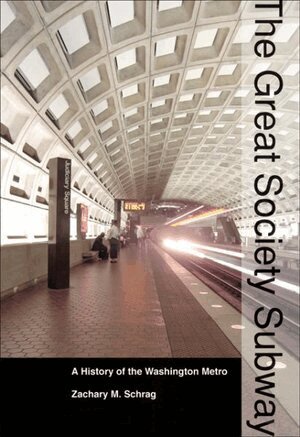
Drivers in the nation's capital face a host of hazards: high-speed traffic circles, presidential motorcades, jaywalking tourists, and bewildering signs that send unsuspecting motorists from the Lincoln Memorial into suburban Virginia in less than two minutes. And parking? Don't bet on it unless you're in the fast lane of the Capital Beltway during rush hour. Little wonder, then, that so many residents and visitors rely on the Washington Metro, the 106-mile rapid transit system that serves the District of Columbia and its inner suburbs. In the first comprehensive history of the Metro, Zachary M. Schrag tells the story of the Great Society Subway from its earliest rumblings to the present day, from Arlington to College Park, Eisenhower to Marion Barry. Unlike the pre-World War II rail systems of New York, Chicago, and Philadelphia, the Metro was built at a time when most American families already owned cars, and when most American cities had dedicated themselves to freeways, not subways. Why did the nation's capital take a different path? What were the consequences of that decision?Using extensive archival research as well as oral history, Schrag argues that the Metro can be understood only in the political context from which it was born: the Great Society liberalism of the Kennedy, Johnson, and Nixon administrations. The Metro emerged from a period when Americans believed in public investments suited to the grandeur and dignity of the world's richest nation. The Metro was built not merely to move commuters, but in the words of Lyndon Johnson, to create "a place where the city of man serves not only the needs of the body and the demands of commerce but the desire for beauty and the hunger for community." Schrag scrutinizes the project from its earliest days, including general planning, routes, station architecture, funding decisions, land-use impacts, and the behavior of Metro riders. The story of the Great Society Subway sheds light on the development of metropolitan Washington, postwar urban policy, and the promises and limits of rail transit in American cities.
Ethical Imperialism
Institutional Review Boards and the Social Sciences, 1965–2009
Häftad, Engelska, 2017
255 kr
Tillfälligt slut
University researchers in the United States seeking to observe, survey, or interview people are required first to complete ethical training courses and to submit their proposals to an institutional review board (IRB). Under current rules, IRBs have the power to deny funding, degrees, or promotion if their recommended modifications to scholars' proposals are not followed. This volume explains how this system of regulation arose and discusses its chilling effects on research in the social sciences and humanities. Zachary M. Schrag draws on original research and interviews with the key shapers of the institutional review board regime to raise important points about the effect of the IRB process on scholarship. He explores the origins and the application of these regulations and analyzes how the rules-initially crafted to protect the health and privacy of the human subjects of medical experiments-can limit even casual scholarly interactions such as a humanist interviewing a poet about his or her writing.In assessing the issue, Schrag argues that biomedical researchers and bioethicists repeatedly excluded social scientists from rule making and ignored the existing ethical traditions in nonmedical fields. Ultimately, he contends, IRBs not only threaten to polarize medical and social scientists, they also create an atmosphere wherein certain types of academics can impede and even silence others. The first work to document the troubled emergence of today's system of regulating scholarly research, Ethical Imperialism illuminates the problems caused by simple, universal rule making in academic and professional research. This short, smart analysis will engage scholars across academia.