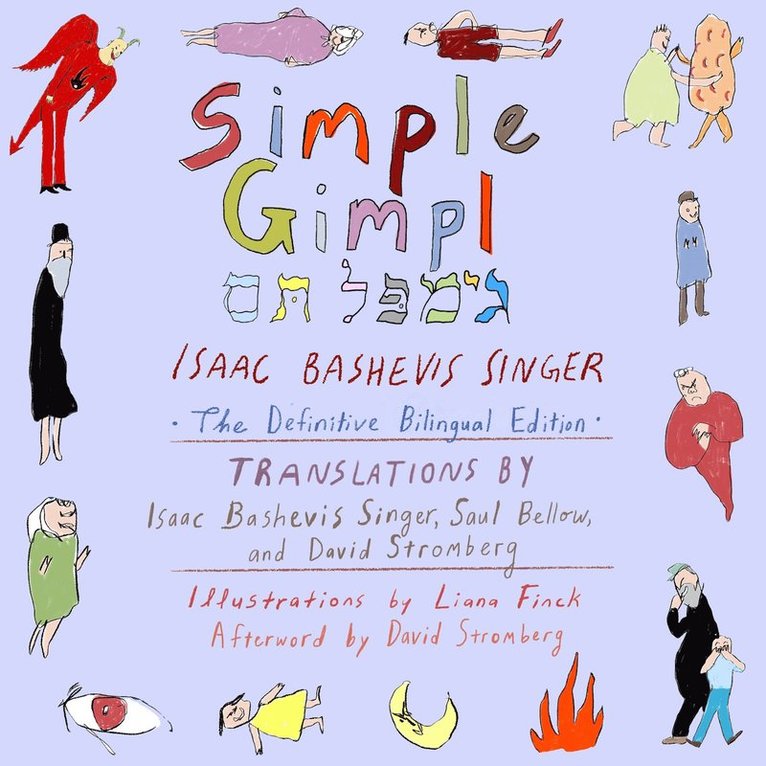
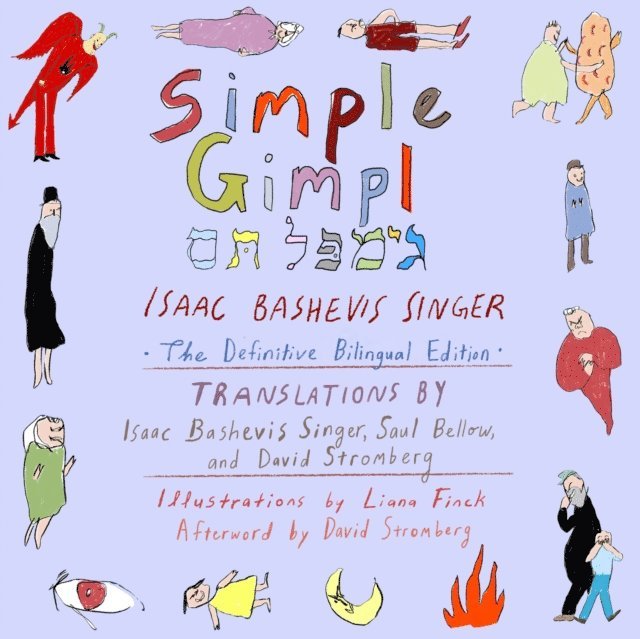
A gorgeously produced, bilingual edition of Nobel Prize laureate Isaac Bashevis Singer''s canonical story about a hapless yet charmingly resilient baker named Gimpl, who resists taking revenge on the town that makes him the butt of every joke. Singer''s original Yiddish appears alongside his own partial translation, now completed and edited by writer and scholar David Stromberg, and the 1953 translation by fellow Nobel laureate Saul Bellow. With illustrations by Liana Finck and an afterword by David Stromberg.
Isaac Bashevis Singer’s “Gimpl tam” was published on March 30, 1945, in the Yiddish-language journal Idisher kempfer, about a month before the Nazi surrender. It tells the deathbed confession of an orphaned baker from the town of Frampol who is targeted by his community for ridicule and practical jokes. About seven years later, Singer was invited by Irving Howe and Eliezer Greenberg to include “Gimpl tam” in their Treasury of Yiddish Tales, and Howe asked Saul Bellow to help with the translation. It was finished in a single sitting and published in 1953 in The Partisan Review as “Gimpel the Fool”—the version that has since been canonized. Yet, unlike every other major work of Singer’s published in his lifetime, the author had no involvement in the English translation.
In 2006, Joseph Landis, editor of Yiddish, published a draft play script titled “Simple Gimpl,” made by Singer directly from the Yiddish original—the closest extant rendition of the story in the author’s own translation, and covering a majority of the tale. Now, writer, translator, and literary scholar David Stromberg has completed Singer’s translation with an aim to address some of the criticism directed at Bellow’s version. Strikingly, the story’s title and opening sentence make a distinction between the Yiddish “tam,” or simpleton, and the “nar,” or fool. Gimpl may be considered simple by others, but he is nobody’s fool. Through Singer’s lightly ironic tone, we see that “Simple Gimpl” is not the story of a fool, but rather one of self-deception and of the personal cost of blind faith. By the end, Gimpl is no longer a simple man, but someone who has accepted the complexity of his life and faith.