3 905 kr
Beställningsvara. Skickas inom 3-6 vardagar. Fri frakt över 249 kr.
Beskrivning
Produktinformation
- Utgivningsdatum:2015-02-16
- Höjd:100 x 100 x 100 mm
- Vikt:100 g
- Språk:Engelska
- Antal sidor:816
- Upplaga:6
- Förlag:Pearson Education (US)
- EAN:9780133741636
Utforska kategorier
Mer om författaren
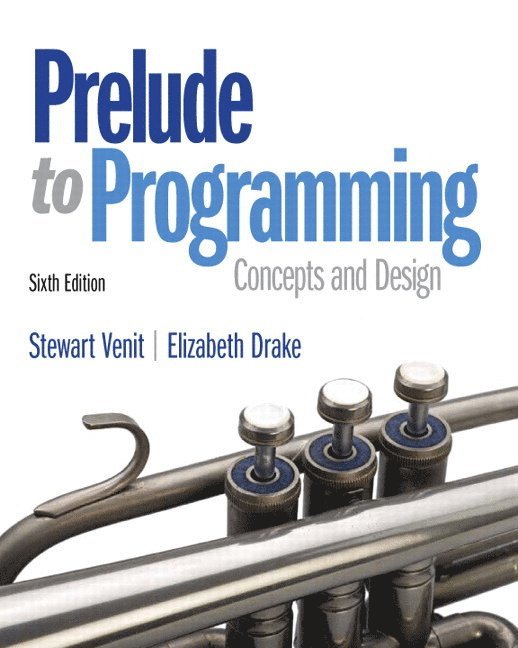
Stewart Venit received a PhD in mathematics from the University of California, Berkeley in 1971. For the past two decades, he has taught mathematics at California State University in Los Angeles. Professor Venit is a past department Chair and recipient of the University’s Outstanding Professor Award. He has authored numerous journal articles and ten textbooks for mathematics or computer science. Elizabeth Drake has worked full time as a professor in the ITE and Math Departments at Santa Fe CC since 1999. Before that, she was an adjunct professor and lecturer in Math, Computer Science, Physics, and Anthropology at SFC, UF, Three Rivers Community College in Connecticut, and the University of Connecticut. She has earned Master's degrees in Anthropology (A.B.D.) and Counseling, a B.S.E.E. in Electrical Engineering, a B.S. in Physics, B.A. in Sociology, and A.S. in Computer Information Technology.
Innehållsförteckning
- 0 Introduction 10.1 A Brief History of Computers 2What Is a Computer? 2Personal Computers 4The Internet 70.2 Computer Basics 8The Central Processing Unit 9Internal Memory 9Mass Storage Devices 10Input Devices 12Output Devices 120.3 Software and Programming Languages 14Types of Software 14Types of Programming and Scripting Languages 15Chapter Review and Exercises 19 1 An Introduction to Programming 25In the Everyday World: You Are Already a Programmer! 261.1 What Is Programming? 26A General Problem-Solving Strategy 27Creating Computer Programs: The Program Development Cycle 281.2 Basic Programming Concepts 29A Simple Program 29Data Input 32Program Variables and Constants 341.3 Data Processing and Output 37Processing Data 37Data Output 411.4 Data Types 45The Declare Statement 45Character and String Data 451.5 Integer Data 48Operations on Integers 491.6 Floating Point Data 50The Declare Statement Revisited 51Types of Floating Point Numbers 531.7 Running With RAPTOR (Optional) 58Chapter Review and Exercises 60 2 Data Representation 67In the Everyday World: It Isn’t Magic–It’s Just Computer Code 682.1 Decimal and Binary Representation 68Bases and Exponents 68The Binary System 702.2 The Hexadecimal System 73Hexadecimal Digits 73Using Hexadecimal Notation 772.3 Integer Representation 80Unsigned Integer Format 80Sign-and-Magnitude Format 81One’s Complement Format 84Two’s Complement Format 862.4 Floating Point Representation 91Floating Point Numbers: the Integer Part 91Floating Point Numbers: the Fractional Part 91Converting a Decimal Fraction to Binary 93Putting the Two Parts Together 962.5 Putting it All Together 97Scientific Notation 97Exponential Notation 98Base 10 Normalization 99Normalizing Binary Floating Point Numbers 100The Excess_127 System 100Base 2 Normalization 101Single- and Double-Precision Floating Point Numbers 101Hexadecimal Representation 104Chapter Review and Exercises 106 3 Developing a Program 113In the Everyday World: Planning to Program? You Needa Plan 1143.1 The Program Development Cycle 115The Process of Developing a Program 115Additional Steps in the Cycle 1183.2 Program Design 122Modular Programming 1223.3 Coding, Documenting, and Testing a Program 131Coding and Documenting a Program 131Testing a Program 133Types of Errors 1343.4 Commercial Programs: Testing and Documenting 135The Testing Phase Revisited 136External Documentation 1363.5 Structured Programming 138Flowcharts 138Control Structures 143Programming Style 1463.6 Running With RAPTOR (Optional) 147Getting Started 148Introduction to RAPTOR Symbols 149Variables 151RAPTOR Symbols 155Run It: The Sign-In Program 164Developing the Program 165Creating the Program in RAPTOR: Input 165Creating the Program in RAPTOR: Processing 168Creating the Program in RAPTOR: Output 169Check It Out 170Chapter Review and Exercises 172 4 Selection Structures: Making Decisions 179In the Everyday World: Decisions, Decisions, Decisions . . . 1804.1 An Introduction to Selection Structures 181Types of Selection Structures 181Single- and Dual-Alternative Structures 1824.2 Relational and Logical Operators 188Relational Operators 188Logical Operators 191Hierarchy of Operations 1964.3 ASCII Code and Comparing Strings 199Representing Characters With Numbers 1994.4 Selecting from Several Alternatives 203Using If Structures 203Using Case-Like Statements 2064.5 Applications of Selection Structures 210Defensive Programming 210Menu-Driven Programs 2144.6 Focus on Problem Solving: A New Car Price Calculator 216Problem Statement 216Problem Analysis 217Program Design 217Program Code 220Program Test 2204.7 Running With RAPTOR (Optional) 221The Selection Symbol 221The Call Symbol and Subcharts 224An Example 226Run It: The New Car Price Calculator 232Developing the Program 232Check It Out 242Chapter Review and Exercises 243 5 Repetition Structures: Looping 255In the Everyday World: Doing the Same Thing Over and Over and Knowing When to Stop 2565.1 An Introduction to Repetition Structures: Computers NeverGet Bored! 257Loop Basics 257Relational and Logical Operators 2615.2 Types of Loops 263Pre-Test and Post-Test Loops 263Counter-Controlled Loops 2685.3 The For Loop 274The For Statement 275The For Loop in Action 278The Careful Bean Counter 2815.4 Applications of Repetition Structures 286Using Sentinel-Controlled Loops to Input Data 286Data Validation 290The Floor() and Ceiling() Functions 294Computing Sums and Averages 2975.5 Focus on Problem Solving: A Cost, Revenue, and Profit Problem 302Problem Statement 302Problem Analysis 302Program Design 304Program Code 307Program Test 3075.6 Running With RAPTOR (Optional) 308Repetition: The Loop Symbol 308A Short Example 310Run It: Encryption: The Secret Message Encoder 312What is Encryption? 313Problem Statement 313Developing the Program 313Developing the Encrypting Algorithms 314Check It Out 320Chapter Review and Exercises 321 6 More about Loops and Decisions 331In the Everyday World: Loops Within Loops 3326.1 Combining Loops with If-Then Statements 332Exiting a Loop 3336.2 Combining Loops and Decisions in Longer Programs 343The Length_Of() Function 348The Print Statement and the New Line Indicator 3496.3 Random Numbers 353The Random() Function 353Not Really Random: The Pseudorandom Number 3586.4 Nested Loops 359Nested For Loops 359Nesting Other Kinds of Loops 364A Mental Workout: Mind Games 3696.5 Focus on Problem Solving: A Guessing Game 376Problem Statement 377Problem Analysis 377Program Design 378Program Code 383Program Test 3836.6 Running With RAPTOR (Optional) 385Two Short Examples 385Run It: Validating a Password 389Problem Statement 389Developing the Program 389Check the length of the password (4—8 characters) 391Check the first character of the password (cannot be a number) 393Check that the password contains one of the special characters (#, *, or $) 394Chapter Review and Exercises 401 7 Arrays: Lists and Tables 407In the Everyday World: Organize It with Lists and Tables 4087.1 One-Dimensional Arrays 409Array Basics 4097.2 Parallel Arrays 416Some Advantages of Using Arrays 420A Word About Databases 4237.3 Strings as Arrays of Characters 424Concatenation Revisited 424String Length versus Array Size 4267.4 Two-Dimensional Arrays 429An Introduction to Two-Dimensional Arrays 430Using Two-Dimensional Arrays 4317.5 Focus on Problem Solving: The Magic Square 436Problem Statement 436Problem Analysis 437Program Design 438Program Code 444Program Test 4447.6 Running With RAPTOR (Optional) 445A Short Example 448Run It: Self-Grading Math Test 450Problem Statement 450Developing and Creating the Program 450Check It Out 456Chapter Review and Exercises 459 8 Searching and Sorting Arrays 465In the Everyday World: Searching and Sorting 4668.1 Introduction to Searching and Sorting 466The Serial Search Technique 466Basic Steps in a Serial Search 467Pseudocode for a Serial Search 4688.2 The Bubble Sort Technique 471Swapping Values 472Using the Bubble Sort Algorithm 4748.3 The Binary Search 480Use the Binary Search for Large Arrays 4818.4 The Selection Sort 486General Selection Sort Technique 486Applying the Selection Sort Technique 4888.5 Focus on Problem Solving: A Grade Management Program 491Problem Statement 491Problem Analysis 491Program Design 493Program Code 499Program Test 5008.6 Running With RAPTOR (Optional) 500The Serial Search 500The Bubble Sort 503The Binary Search 505The Selection Sort 507Run It: Soccer Camp 509Problem Statement 509Developing and Creating the Program 509Check It Out 515Revise and Improve 516Check It Out 517Chapter Review and Exercises 519 9 Program Modules, Subprograms, and Functions 527In the Everyday World: Living and Programming in ManageablePieces: Subprograms 5289.1 Data Flow Diagrams, Arguments, and Parameters 529A Big Sale: The Sale Price Computation Program 529Data Flow Diagrams 530An Introduction to Arguments and Parameters 5319.2 More about Subprograms 537Value and Reference Parameters 537How to Tell the Difference between Value and ReferenceParameters 539Two Helpful Functions: ToUpper() and ToLower() 542The Scope of a Variable 5459.3 Functions 550Built-in Functions 550User-Defined Functions 5539.4 Recursion 558The Recursive Process 5589.5 Focus on Problem Solving: A Fitness Plan 563Problem Statement 563Problem Analysis 563Program Design 564Program Code 570Program Test 5709.6 Running With RAPTOR (Optional) 573RAPTOR Built-In Functions (Procedures) 573Creating a New Procedure 576Run It: The Fitness Plan 581Problem Statement 581Developing and Creating the Program 582Check It Out 590Chapter Review and Exercises 592 10 Sequential Data Files 599In the Everyday World: Keeping it On File 60010.1 An Introduction to Data Files 601File Basics 601Creating and Reading Sequential Files 60310.2 Modifying a Sequential File 608Deleting Records 609Modifying Records 612Inserting Records 613Using Arrays in File Maintenance 61510.3 Merging Sequential Files 61710.4 Focus on Problem Solving: Control Break Processing 620Problem Statement 620Problem Analysis 621Program Design 622Coding and Testing the Program 62510.5 Focus on Problem Solving: The Invoice PreparationProgram 625Problem Statement 626Problem Analysis 626Program Design 627Program Code 631Program Test 63110.6 Running With RAPTOR: (Optional) 632Creating Data Files with the Redirect_Output() Procedure 632Displaying Data Files with the Redirect_Input() Procedure 633The Limitations 636Run It: Professor Weisheit’s Semester Grades 637Check It Out 645Chapter Review and Exercises 647 11 Object-Oriented and Event-Driven Programming 655In the Everyday World: Objects are Everywhere 65611.1 Classes and Objects 656Classes 656Defining Classes and Creating Objects 659Creating Objects 661The Constructor 66311.2 More Features of Object-Oriented Programming 664Benefits of Object-Oriented Languages 664Inheritance and Polymorphism 66511.3 Object-Oriented Program Design and Modeling 675Modeling Languages 678Unified Modeling Language (UML) 67811.4 Graphical User Interfaces and Event-DrivenProgramming 681Window Components 681Creating GUI Objects in a Program 682Event-Driven Programming 684Handling Events 684Event-Driven Program Design 68711.5 Focus on Problem Solving: Another Grade ManagementProgram 689Problem Statement 689Problem Analysis 689Program Design 690Program Code 695Program Test 69611.6 Running With RAPTOR (Optional) 697Object-Oriented Mode 697Creating a Class 697The main Program 704Inheritance and Polymorphism 704Run It: Monster Evasion 705Problem Statement 705Developing and Creating the Program 705The main program 709Using the Classes 713Check It Out 716Chapter Review and Exercises 718 Appendix A:A Study Skills 727A.1 Achieving Success in the Course 727A.2 Using the Textbook 728A.3 Doing the Homework 729A.4 Writing Programs 730A.5 Preparing for Tests 731A.6 More about Preparing for Tests 732A.7 Taking Tests 733A.8 Overcoming Test Anxiety 734Appendix B:The ASCII Character Set: Printable Characters 735Appendix C:Answers to Self Checks 739Index 779
Du kanske också är intresserad av
- -21%
Hjärnans akilleshälar : hur din hjärna lurar dig, och vad du kan göra åt det
Anders Hansen
229 kr289 kr
Clinical Handbook of Marriage and Couples Interventions
Halford, Markman, W. Kim Halford, Howard J. Markman
3 905 kr