
Visar resultat för..."V A Publications"

Women's Case #5 - Empty Wedding Dress (Grekiska)
610 kr
Skickas inom 5-8 vardagar
228 kr
Skickas inom 3-6 vardagar
220 kr
Skickas inom 3-6 vardagar
239 kr
Skickas inom 5-8 vardagar

286 kr
Skickas inom 3-6 vardagar

264 kr
Skickas inom 3-6 vardagar
240 kr
Skickas inom 3-6 vardagar
285 kr
Skickas inom 3-6 vardagar

144 kr
Skickas inom 3-6 vardagar

153 kr
Skickas inom 3-6 vardagar

Cities in a Global Society
2 242 kr
Skickas inom 3-6 vardagar

Improving Children's Lives
Global Perspectives on Prevention
3 850 kr
Skickas inom 3-6 vardagar
234 kr
Skickas inom 5-8 vardagar

9 020 kr
Skickas inom 3-6 vardagar

367 kr
Skickas inom 5-8 vardagar
181 kr
Skickas inom 3-6 vardagar
225 kr
Skickas inom 3-6 vardagar

316 kr
Skickas inom 3-6 vardagar

Pitbulls In A Skirt 5
The Fall From Grace (The Cartel Publications Presents)
280 kr
Skickas inom 5-8 vardagar

386 kr
Skickas inom 5-8 vardagar
262 kr
Skickas inom 5-8 vardagar
238 kr
Skickas inom 5-8 vardagar
1 084 kr
Skickas inom 3-6 vardagar
1 134 kr
Skickas inom 3-6 vardagar
625 kr
Skickas inom 3-6 vardagar
376 kr
Skickas inom 3-6 vardagar
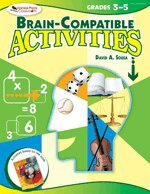
Practical, brain-compatible activities every elementary teacher can use!
Brain research has provided a tremendous opportunity to develop instructional techniques that facilitate the brain's innate learning capacity. As educators, we can take this knowledge and apply it to the strategies we use in our classrooms.
This essential resource, based on David A. Sousa's best-seller How the Brain Learns, Third Edition, provides ready-to-use, brain-compatible activities that feature some of the following strategies:
Graphic organizersMnemonic devicesCooperative learningMovement to enhance retentionMusic to stimulate brain activity and creativityThese activities, correlated with national standards, cover all the content areas in grades 3–5 and include topics such as word selection, poetry, reading fluency, geometry, negative numbers, modes of exchange, animal habits, clouds, and much more!
The more we understand how the brain learns, the more instructional options we have. This unique resource helps you make the most of the brain's learning potential and transform your teaching practices to engage every student in your classroom.For other grade-specific Corwin Press Classroom books, please see:
Brain-Compatible Activities, Grades K-2 Brain-Compatible Activities, Grades 6-8 About the AuthorDavid A. Sousa, an international educational consultant, has served at all levels of education in New Jersey public schools, including superintendent, supervisor of instruction, K–12 director of science, and junior and senior high school science instructor. Sousa has also been an adjunct professor of education at Seton Hall University, and a visiting lecturer at Rutgers University.
Sousa has presented at national conventions of educational organizations and has conducted workshops on brain research and science education in hundreds of school districts and at colleges and universities across the United States, Canada, Europe, and Asia. He has edited science books and published numerous books and articles in leading educational journals on staff development, science education, and brain research. Sousa has a bachelor of science degree in chemistry from Massachusetts State College at Bridgewater, a master of arts in teaching degree in science from Harvard University, and a doctorate from Rutgers University.
1 360 kr
Skickas inom 3-6 vardagar
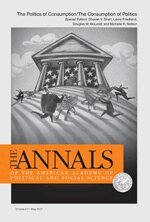
In recent years American and European societies have confronted increasing concerns over the effects of globalization, environmental degradation, and excessive consumption, as well as questions about the ability of civic society to address these concerns. As citizens are pushed to consume more and to celebrate the individual to the detriment of civic engagement, the interplay between consumption, markets, media, politics, and the citizen-consumer remains a complex and provocative topic. Has civil society declined in favor of consumer society?
Can we separate civic culture from consumer culture? Some scholars argue that the rise of political consumerism or lifestyle politics – where socially conscious consumers support or boycott products and corporations in ways that demonstrate their political views – illustrates just how tightly interwoven consumption and civic duty have become. Furthermore, political campaigns as well as social movements and initiatives have become steeped in marketing tactics using branding, staged media events, and market segmentation strategies. What are the effects of socially conscious consumerism on civil society?
In October 2006, an international conference titled "The Politics of Consumption/The Consumption of Politics" drew leading scholars from Europe and North America to discuss these challenging questions and issues. Using theory and research, the conference spurred lively discussion as well as the insightful papers included in this special volume of The ANNALS.
Central themes included in this volume:
The relations between consumers, citizens, and the stateConsumer and citizen responses to the marketThe branding of politicians and social movementsPolitical consumerism as a form of activismScholars and students will find that while these essays address crucial issues, they also shed light on the levels of complexity of this important topic, serving as a springboard for further research on the politics of consumption.
Drawing from a myriad of disciplines, including political science, sociology, communication, media studies, and economics, this volume is a must-have for scholars, professionals, and policymakers who want to better understand modern consumer society and its implications for the political and civic arena.
551 kr
Skickas inom 3-6 vardagar
"The real-world connection and use of manipulatives, games, and items from home will hook 21st-century learners. I spend a considerable amount of time searching for appropriate lesson ideas. No more! This collection of lessons—across all math standards—provides more than enough resources to enhance my teaching."—Rachel Hull, Fifth-Grade TeacherGeorge Washington Elementary School, Eleanor, WV
"This well-organized resource enriches any math curriculum with easy-to-follow and abundant 'out of your seat' activities to engage a variety of learners. The best components are quick formative assessments within each activity that provide an immediate perspective on each child's understanding and progress."—Jennifer Harper, Fourth-Grade TeacherCavendish Town Elementary School, Proctorsville, VT
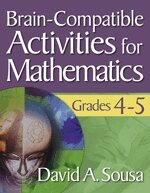
Imaginative mathematics activities that maximize the brain's learning potential!
Demonstrating instructional principles discussed in David A. Sousa's bestseller, How the Brain Learns Mathematics, this resource provides brain-friendly, ready-to-use mathematics lessons for Grades 4-5. Teachers will find step-by-step guidance and all the necessary reproducibles for mathematics instruction that involves group work, reflection, movement, and visualization. Through activities such as Scuba Division, Party Planners, Sunken Treasure, and Parachute Drop, intermediate learners will enjoy developing skills connected with multiplication and division, fractions and decimals, geometry and measurement, algebra, data analysis, and more.
Aligned with NCTM standards and focal points, the instructional strategies enhance motivation and content retention, address individual intelligences, and:
Promote writing as an important learning tool Use concrete models to make concepts meaningfulConnect mathematical ideas to the real world Incorporate graphic organizers to help students organize their thinkingTeach creative problem solvingDeepen and revitalize instruction using Sousa's proven brain-compatible approach for helping every student develop self-confidence in mathematics!
550 kr
Skickas inom 3-6 vardagar
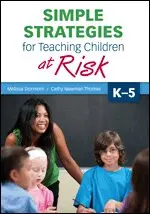
Easy to implement strategies teachers can use right now
While opinions differ on how to define students who are “at risk.” most teachers agree that they are seeing more children hit roadblocks due to limited academic experiences, challenging environments, ADHD, or behavioral problems. Teachers often feel underprepared to connect with these students and improve their learning experiences.
In their latest work, Melissa Stormont and Cathy Newman Thomas draw upon their field experiences within special education and psychology to offer K–5 teachers practical tools for building relationships with these children. Readers will discover simple strategies for developing students’ academic aptitude and social behavior as well as how to
Identify who is at risk for failure and why Build positive teacher-student relationships and establish supportive groups among children Use data-based decision making Provide students with increased time to practice with feedback Incorporate technology supports Know when and how to involve professionals and familiesMoving well beyond mere theory, teachers who are working amid reforms and sweeping cuts can implement these strategies immediately and make a real difference in children's lives. Get started today!
“This is a great book with which to start because it covers the basics—the foundation that needs to be in place before the academics can take hold for a student at risk. The ideas are easy to follow and could be implemented with little or, in some cases, no additional prep—that’s a bonus for an already busy teacher.” —Barbara L. Townsend, Reading Specialist West Side Elementary School, Elkhorn, WI
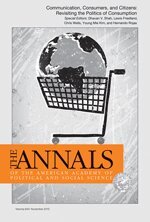
Communication, Consumers, and Citizens: Revisiting the Politics of Consumption
1 232 kr
Skickas inom 3-6 vardagar