ACRL Publications in Librarianship - Böcker
Visar alla böcker i serien ACRL Publications in Librarianship. Handla med fri frakt och snabb leverans.
10 produkter
10 produkter
Cultural Heritage and the Campus Community: Volume 80
Academic Libraries and Museums in Collaboration
Häftad, Engelska, 2023
903 kr
Skickas inom 7-10 vardagar
Academic libraries and museums foster many outstanding collaborations supporting teaching, learning, and research within their respective institutions. These collaborations, like other progressive activities, require significant invisible labor, caretaking, and resources that have not always been documented. Cultural Heritage and the Campus Community collects examples of successful academic library-museum collaborations and serves as critical knowledge for the cultural heritage sector. Authors from libraries and museums across the United States demonstrate how to develop and execute partnerships and bring forth new dimensions of transdisciplinary objects-based pedagogy, research, and learning centered on inclusive educational practices. Chapters explore visual thinking strategies and the Framework for Information Literacy in Higher Education in the undergraduate classroom; restoring Indigenous heritage through tribal partnerships; using object-based teaching to motivate student research; and much more. The collaborative approaches highlighted here demonstrate the power of possibility when two collections-centric entities unite to enrich our collective understanding of materiality, instructional approaches, and the importance of provenance. Cultural Heritage and the Campus Community also illustrates why interrogating past practices and value assignments within academic library and museum collections is essential to advancing culturally relevant approaches to knowledge sharing in physical and digital spaces.
Intersections of Open Educational Resources and Information Literacy Volume 79
Häftad, Engelska, 2022
1 193 kr
Skickas inom 7-10 vardagar
The present volume is timely not only because it models creative and effective strategies to advance both open education and information literacy, but especially because it poses critical questions and urges practitioners to go well beyond questions of access to and the use of information. It demands reflection on what is being accessed (and what is not), who is gaining access (and who is not), who is providing access (and who is not), and what the goal is of this access (and what lies beyond access).—from the Foreword by Rajiv S. JhangianiInformation literacy skills are key when finding, using, adapting, and producing open educational resources (OER). Educators who wish to include OER for their students need to be able to find these resources and use them according to their permissions. When open pedagogical methods are employed, students need to be able to use information literacy skills as they compile, reuse, and create open resources.Intersections of Open Educational Resources and Information Literacy captures current open education and information literacy theory and practice and provides inspiration for the future. Chapters include practical applications, theoretical musings, literature reviews, and case studies and discuss social justice issues, collaboration, open pedagogy, training, and advocacy. The book is divided into six parts: FoundationsTeaching Info Lit with OERLibrarian Support of Open Pedagogy/OERSocial Justice/Untold StoriesStudent AdvocacySpreading the Love: Training Future Advocates and PractitionersChapters cover topics including library-led OER creation; digital cultural heritage and the intersections of primary source literacy and information literacy; situated learning and open pedagogy; critical librarianship and open education; and developing student OER leaders.Intersections of Open Educational Resources and Information Literacy—which went through an open peer review process—informs and inspires on OER, info lit, and their many iterative convergences.
735 kr
Skickas inom 7-10 vardagar
Stories of Open: Opening Peer Review through Narrative Inquiry examines the methods and processes of peer review, as well as the stories of those who have been through it. Eleven chapters are divided into three parts:Part 1: Orientation. This section offers a conceptual frame for the book, providing details about narrative inquiry as a methodology and the author's worldview and research approach.Part 2: The Stories (The Story Middle). What is the standard experience of peer review in our field? This section shares stories told from a variety of viewpoints and roles—author, editor, and referee—and explores how these roles interact, the tension between them, and the duality and sometimes multiplicity of roles experienced by any one individual.Part 3: Coda. These four chapters tie the stories to the idea of open and look in detail at the research method, as well as imagine how we might move forward—reflecting on our past stories to create future ones.When we open ourselves to others' experiences, we reflect on our own. Stories of Open offers questions for reflection at the end of many chapters in order to assist in the continued exploration of your own experiences with peer review, and encourages the use of these reflections in creating new and improved peer review methods.
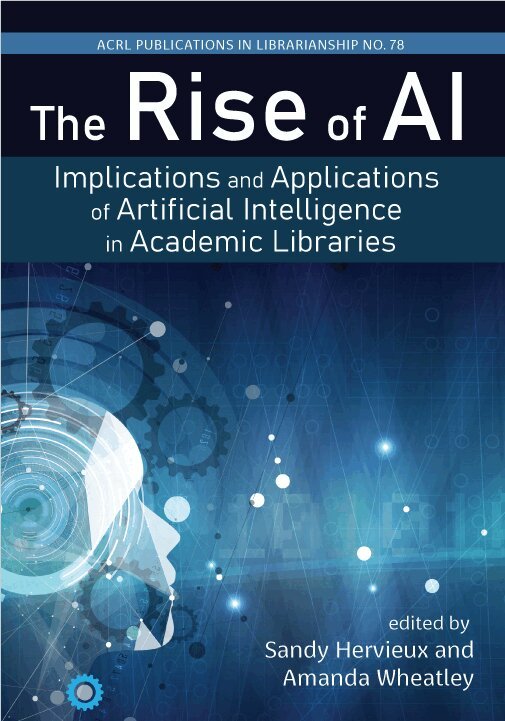
Rise of AI: Volume 78
Implications and Applications of Artificial Intelligence in Academic Libraries
Häftad, Engelska, 2022
876 kr
Skickas inom 7-10 vardagar
Librarians are uniquely positioned to rise to the challenge that artificial intelligence (AI) presents to the field. Libraries and their like have existed for millennia; they progress with society, altering and adapting their services to meet the information needs of their communities. The Rise of AI collects projects, collaborations, and future uses from academic librarians who have begun to embrace AI in their work. In three parts—User Services, Collections and Discovery, and Toward Future Applications—it explores: machine translationcreating incubation spacesroboticscombining information literacy initiatives with AI literacyfostering partnerships with other on-campus groupsintegrating AI technology into collections to enhance discoverabilityusing AI to refine metadata for images, articles, and thesesmachine learning The Rise of AI introduces implications and applications of artificial intelligence in academic libraries and hopes to provoke conversations and inspire new ways of engaging with the technology. As the discussion surrounding ethics, bias, and privacy in AI continues to grow, librarians will be called to make informed decisions and position themselves as leaders in this discourse.
Developing the Next Generation of Library Leaders
(ACRL Publications in Librarianship No. 75)
Häftad, Engelska, 2019
713 kr
Skickas inom 7-10 vardagar
Developing the Next Generation of Library Leaders examines how the library profession can foster this skill development for new leaders through the leadership stories and development of twenty-two assistant/associate deans. Ten big ideas emerged through this research: Developing a career ladderMitigating identity crisisLearning theory, applying to practiceSupportFind your peopleLeadership pause pointsAlternative leadership and management modelsDemystifying leadership and managementSuccession planningBattling gender-based doubtsEach of these ideas include questions as well as recommendations that, when taken together, offer a holistic approach to shrinking the leadership gap in our profession and preparing the next generation of library leaders to move the profession forward and meet the evolving challenges of higher education.
Academic Library Centrality
User Success Through Service, Access, and Tradition
Häftad, Engelska, 2001
345 kr
Skickas inom 7-10 vardagar
929 kr
Skickas inom 7-10 vardagar
Not Just Where to Click: Teaching Students How to Think about Information explores how librarians and faculty work together to teach students about the nature of expertise, authority, and credibility. It provides practical approaches for motivating students to explore their beliefs, biases, and ways of interpreting the world.This book also includes chapters that bridge the gap between the epistemological stances and threshold concepts held by librarians and faculty, and those held by students, focusing on pedagogies that challenge students to evaluate authority, connect to prior knowledge and construct new knowledge in a world of information abundance. Authors draw from a deep pool of perspectives including social psychology, critical theory, and various philosophical traditions.Contributors to the nineteen chapters in this volume offer a balance of theoretical and applied approaches to teaching information literacy, supplying readers with accessible and innovative ideas ready to be put into practice.Not Just Where to Click is appropriate for all types of academic libraries, and is also suitable for library and information science curricula and collections.
557 kr
Skickas inom 11-20 vardagar
What’s the place of fun in education? When students learn something new, they reach a learning edge, a threshold, where learning becomes uncomfortable because the material is difficult or beyond their understanding. To avoid this discomfort, some students can simply fall back on what they already know. This is a critical point, because if they do not move beyond the edge, they are stuck with both limited knowledge and a negative feeling about learning. Fun can be used as a motivating technique to help students get past this learning edge, and to meet an established goal or learning objective. The Fun of Motivation: Crossing the Threshold Concepts is organized into two parts—Part I examines the theories behind motivation and fun in the classroom, and offers three instructional techniques that highlight their benefits. Part II is the application of the theories explored in Part I, and its six chapters each address one of the threshold concepts provided in ACRL’s Framework for Information Literacy for Higher Education. Each chapter contains three lesson plans addressing the threshold concept, one for each of the three fun instructional techniques. Assessment opportunities are provided throughout, with formative assessment strategies as well as summative assessments, including sample rubrics to apply to a range of student work. Each lesson plan ends with a section on possible modifications and accommodations and additional ideas on how to adapt the lesson for different student populations.The threshold concepts within the Framework need to be facilitated with deliberation by librarians integrating them into their instruction sessions. Students must be motivated to learn these concepts that help them master skills across disciplines. The Fun of Motivation can help you explore, implement, and assess this powerful means of motivation.
1 202 kr
Skickas inom 7-10 vardagar
Predatory publishing is a complex problem that harms a broad array of stakeholders and concerns across the scholarly communications system. It shines a light on the inadequacies of scholarly assessment and related rewards systems, contributes to the marginalization of scholarship from less developed countries, and negatively impacts the acceptance of open access. To fix what is broken in scholarly communications, academic librarians must act as both teachers and advocates and partner with other stakeholders who have the agency to change how scholarship is produced, assessed, and rewarded. Predatory Publishing and Global Scholarly Communications is a unique and comprehensive exploration of predatory publishing in four parts. Background Characteristics and Research The Geopolitics of Scholarly Publishing Responses and Solutions It examines the history of predatory publishing and basics of scholarly assessment; identifies types of research misconduct and unethical scholarly behaviors; provides critical context to predatory publishing and scholarly communications beyond the Global North; and offers structural and pedagogical solutions and teaching materials for librarians to use in their work with authors, students, faculty, and other stakeholders. Predatory Publishing and Global Scholarly Communications gives powerful insight into predatory publishing across the world, inside and outside of the library community, and provides tools for understanding and teaching its impact and contributing to its improvement.
944 kr
Skickas inom 3-6 vardagar
Pedagogy impacts all parts of library work and culture. It changes the way we interact with learners regardless of setting and however we name or define the teaching moment, from research help to outreach to leading meetings. Pedagogy is a praxis of relation, and studying it can improve all aspects of our work and organizations. In two volumes, Training Library Instructors collects examples of how we train our colleagues to teach, whether they’re student workers, non-librarian staff, new or experienced librarians, or something else entirely. In Volume 2, A Guide to Training Librarians, librarians share their knowledge about teaching, learning, and pedagogy through a variety of replicable activities: formal and informal workshops, courses, communities of practice, peer observation, and more. Programs include mock instruction, nano-teaching, and other feedback and homework mechanisms; happen at the individual, institutional, or consortial level; and can involve collaborations across library or university departments. So many librarians value lifelong learning and the opportunity to learn from each other. A Guide to Training Librarians provides a starting point for readers considering their own teach-the-teacher programs and various approaches to learning together, exploring library instruction for the first time, or expanding existing knowledge through continued education.