Arden Encyclopedia of Shakespeare's Language – Serie
Visar alla böcker i serien Arden Encyclopedia of Shakespeare's Language. Handla med fri frakt och snabb leverans.
3 produkter
3 produkter
8 012 kr
Skickas inom 7-10 vardagar
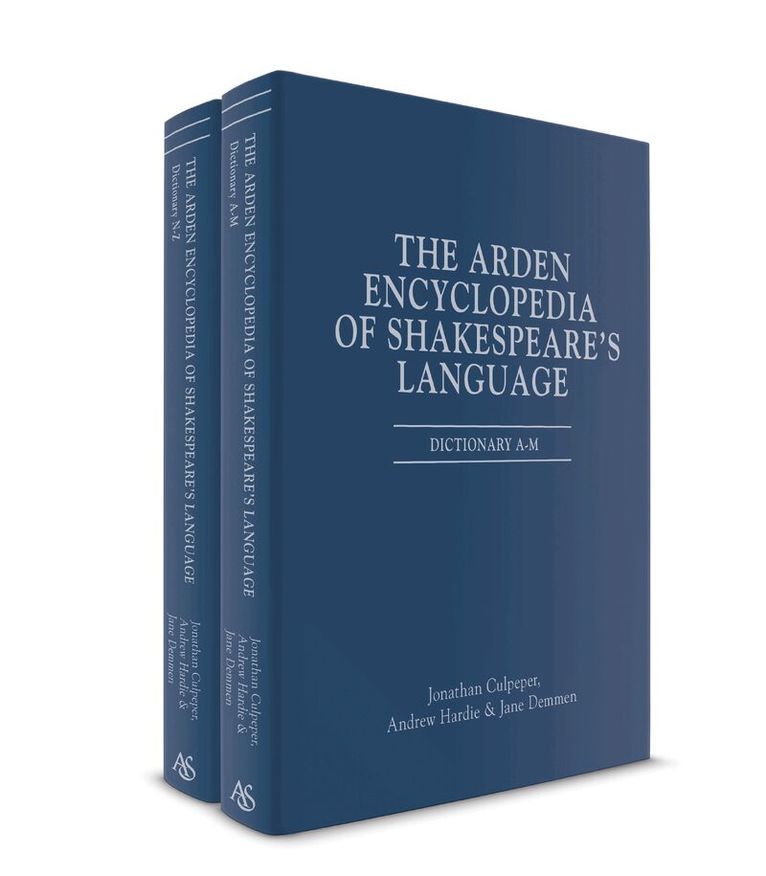
The Arden Encyclopedia of Shakespeare’s Language is the first comprehensive account of Shakespeare’s language to use computational methods derived from corpus linguistics – methods of choice for today’s lexicographer.These first two volumes in this growing encyclopedia together provide a non-etymological A-Z ‘dictionary’ that works through the frequency of word usage to reveal patterns of meaning and usage, and to examine what Shakespeare’s words actually do in the environments they inhabit.All words from all of Shakespeare’s plays are included – not just words judged to be ‘difficult’ – only leaving out proper names. The dictionary also covers words whose first known use is in Shakespeare (e.g. ear-piercing).Entries focus on the use and meanings of Shakespeare’s words, both in the context of what he wrote and in the context in which he wrote.Every word is compared with a 321 million word corpus comprising the work of Shakespeare’s contemporaries.Internal comparisons reveal how Shakespeare’s language varies dynamically across his works, showing, for example, whether certain words are peculiar to tragedies, comedies or histories, or to certain social groups, and whether they have a particular stylistic flavour.Definitions are kept clear and concise, making the dictionary an ideal accessible reference.Words are classified according to their frequency band: how often they occur, in comparison to other words in Shakespeare’s plays. Entries for words that occur more than 50 times contain charts showing the word’s frequency associations with:- Comedy, history or tragedy (and whether this differs from other playwrights);- Male or female characters (and whether this differs from other playwrights);- Particular social status groups of characters (and whether this differs from other playwrights)- Particular genres in published writing of the time (e.g. literary, religious, administrative, informational, instructional). The volumes together establish in detail both what is unique about Shakespeare’s language and what Shakespeare’s language meant to his contemporaries, including, for example, their attitudes towards love or death, what it meant to be Welsh or a harlot, or even the significance of eating fish as opposed to beef.This innovative reference resource is essential for English, Drama and Linguistics libraries, offering Shakespeare scholars and advanced students of Shakespeare and early modern literature fresh linguistic insights into Shakespeare’s rich language.
1 979 kr
Skickas inom 7-10 vardagar
Dialogue is at the heart of Shakespeare’s plays, and when his characters exchange words, they create social communities. This book is the first to present, explore and compare those verbal communities in all of Shakespeare plays using computational social network analysis.Part of The Arden Encyclopaedia of Shakespeare's Language series, with volumes exploring how Shakespeare uses words to create meaning and shape characters, themes and genres, Volume 4: Character Networks presents another aspect of what Shakespeare’s words do: create social worlds. The book illustrates how alliances or missed encounters can shape characters and plot; it explores gender, social and geographic differences in the plays’ communities, and alerts readers to the function of minor characters - who often go unnoticed in criticism. Above all, it shows that what matters in Shakespeare’s plays is not only the words characters speak, but also the company they keep.For each of Shakespeare’s plays, the book includes information about the size and density of each play’s character network as well as providing a visual network representation. Readers will also find a table for each play with scores that measure the centrality of all characters in terms of the importance, strength and number of their social ties. In addition, an accessible commentary on each play highlights salient features of the network data and explains what it means for our understanding of the play. A final chapter explores the broader patterns in Shakespeare’s works by comparing the networks.
3 419 kr
Skickas inom 7-10 vardagar
The Arden Encyclopedia of Shakespeare’s Language is the first comprehensive account of Shakespeare’s language to use computational methods derived from corpus linguistics – methods of choice for today's historical linguist. This third volume focuses on keywords in Shakespeare's plays. Play keywords are derived by conducting a statistical comparison between the words in one play with those in all the other plays. For characters, the statistical comparison is made between the vocabulary of one character and that of all the other characters in the same play. These keywords are then used to create 'linguistic profiles' of each play and main character. The profiles show how patterns of words around keywords contribute to themes in plays and characterization of the protagonists. For example, we reveal how the simple word ‘Goodnight’ contributes to dramatic tension in Julius Caesar, or how in Romeo and Juliet, Juliet's most distinctive yet apparently innocuous words, ‘if’, ‘yet’ and ‘but’, create an important aspect of her character.