Black Print and Organizing in the Long Nineteenth Century – serie
Visar alla böcker i serien Black Print and Organizing in the Long Nineteenth Century. Handla med fri frakt och snabb leverans.
2 produkter
2 produkter
511 kr
Skickas inom 7-10 vardagar
The first collection of essays published on trailblazing nineteenth-century Black feminist, activist, journal, and educator, Mary Ann Shadd CaryMary Ann Shadd Cary (1823–1893) was a trailblazing Black feminist, activist, journalist, and educator whose achievements can be traced across Canada and the United States. Born in a border state in the antebellum era, Shadd Cary taught in schools in New York, New Jersey, and Pennsylvania before becoming a strong advocate for immigration to Canada in her early adulthood. Once she moved to Ontario in the mid-1850s, she dove headfirst into early Black Canadian debates. She fought to integrate schools in the States and Canada and became, as the editor of the Provincial Freeman, the first Black woman to edit a newspaper in North America.Despite her achievements and impact on Black life in North America, Shadd Cary is a relatively little-known figure outside of the continent. Insensible of Boundaries is the first collection of essays published on this thinker. With this volume, editor Kristin Moriah brings together eleven essays from a broad range of perspectives, including historical, literary, gender, ecological, bibliographical, visual, sound, and performance studies, on nineteenth-century Black feminist inquiry in North America.The volume focuses particularly on three main topics: Shadd Cary's relationship to immigration, nation, and colonization; the Black creative and nation-building work that Shadd Cary has inspired; and contemporary research methodologies like digital humanities as they can be used to better understand Shadd Cary's moment, impacts, and life. Through a multi- and interdisciplinary lens, the collection celebrates Shadd Cary's cultural significance and intellectual contributions, as well as their reverberations in her time and in ours.Contributors: R. J. Boutelle , Jim Casey, Rosalyn Green, Lauren Klein, Kirsten Lee, Brandi Locke, Demetra McBrayer, A. T. Moffett, Kristin Moriah, Dianna Ruberto, Lynnette Young Overby, Eunice Toh, Rinaldo Walcott, Marlas Yvonne Whitley, Jewon Woo.
623 kr
Skickas inom 10-15 vardagar
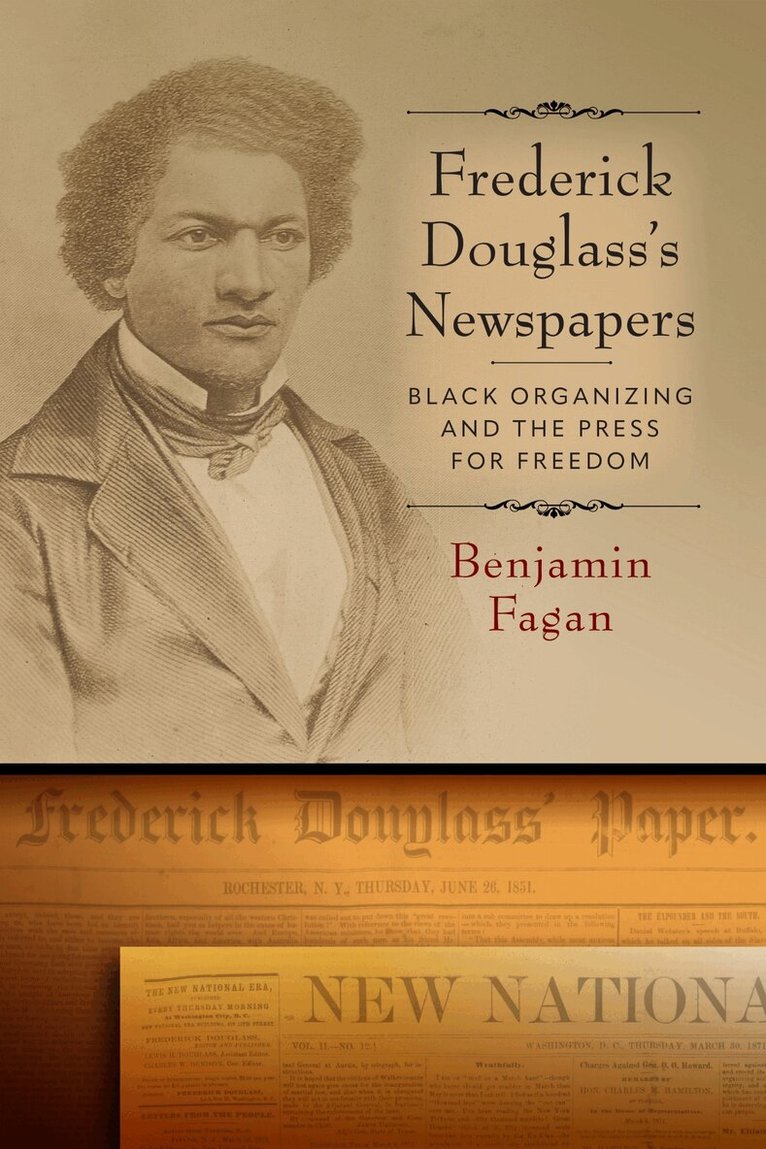
The first book to focus on the newspapers edited by Frederick Douglass and their impact on Black organizingA robust body of work has established the importance of print in general, and newspapers in particular, to African American culture in the 1800s. Such work regularly acknowledges Frederick Douglass (1818–1895) as one of the most influential newspaper editors of the nineteenth century, a judgment that Douglass and many of his contemporaries shared. But while recent scholarship has continued to expand our understanding of Douglass's life and work, his newspapers remain largely understudied. Frederick Douglass's Newspapers is the first book that explores the full range of Douglass's periodicals.Benjamin Fagan traces the making and impact of the four newspapers edited by Douglass: the North Star (1847–1851), Frederick Douglass' Paper (1851–1860), Douglass' Monthly (1858–1863), and the New National Era (1870–1874). Fagan highlights how Douglass and his co-workers—which included Martin R. Delany, James McCune Smith, William C. Neil, and Douglass's daughter Rosetta Douglass, among others—practiced versions of Black organizing as they made his newspapers. By teasing out the inner workings of Douglass's newspapers, Fagan explores the complex and often messy practices of Black organizing that made these publications possible.In doing so, this book places Douglass's newspapers at the center of the story of Black organizing in the nineteenth century. Douglass's newspapers not only offered examples of how to organize for Black readers across the country, but he and his co-workers also participated in a variety of other kinds of Black organizations. Writers for Douglass's papers put such experiences into print, and stories and lessons of Black organizing filled the pages of Douglass's newspapers. They covered a variety of issues: abolitionism, school integration, politics both domestic and international, the Civil War, and the burgeoning Black labor movement, among others. Fagan's close examination of the making of Douglass's newspapers as well as what appeared in their pages chronicles how his publications were simultaneously examples and archives of Black organizing.