Brill Research Perspectives in Ancient History – serie
Visar alla böcker i serien Brill Research Perspectives in Ancient History. Handla med fri frakt och snabb leverans.
13 produkter
13 produkter
1 215 kr
Skickas inom 5-8 vardagar
Water played an important part of ancient Roman life, from providing necessary drinking water, supplying bath complexes, to flowing in large-scale public fountains. The Roman culture of water was seen throughout the Roman Empire, although it was certainly not monolithic and it could come in a variety of scales and forms, based on climatic and social conditions of different areas. This discussion seeks to define ‘water culture’ in Roman society by examining literary, epigraphic, and archaeological evidence, while understanding modern trends in scholarship related to the study of Roman water. The culture of water can be demonstrated through expressions of power, aesthetics, and spectacle. Further there was a shared experience of water in the empire that could be expressed through religion, landscape, and water’s role in cultures of consumption and pleasure.
1 215 kr
Skickas inom 5-8 vardagar
Sparta’s dominance over other Greek states was greatly hampered and finally ended because of the impossibility of maintaining its power in the face of oliganthropia, an irreversible demographic shortfall of its citizen manpower. In Spartan Oliganthropia, Timothy Doran examines the population decline of the Spartiates in the Classical and Hellenistic eras, a reduction from 8,000 to fewer than 1,000. The causes and consequences of this decline are significant not only for ancient Greek history, but also for population studies of pre-industrial societies and population dynamics more generally. This work offers a fresh survey of representative modern scholarship on this phenomenon as well as its own conclusions, discussing topics such as elite under-reproduction, wealth polarization, the link between female empowerment and low birthrates, and ideological notions of eugenic exclusivity, suggesting avenues for further research.
1 215 kr
Skickas inom 5-8 vardagar
As political power in Rome became centered on the emperor and his family, a system of honors and titles developed as one way to negotiate this new power dynamic. Classified under the modern collective heading ‘imperial cult’ (or emperor worship or ruler cult), this system of worship comprises religious rituals as well as political, economic, and social aspects. In this article, Gwynaeth McIntyre surveys the range of ancient literary sources and modern scholarly debates on how individuals became gods in the Roman world. Beginning with the development of exceptional honors granted to Julius Caesar and his deification, she traces the development of honors, symbols, and religious rituals associated with the worship of imperial family members. She uses case studies to illustrate how cult practices, temples, and priesthoods were established, highlighting the careful negotiation required between the emperor, imperial family, Senate, and populace in order to make mortals into gods.
1 174 kr
Skickas inom 5-8 vardagar
Rome engaged in military and diplomatic expansionistic state behavior, which we now describe as imperialism, since well before the appearance of ancient sources describing this activity. Over the course of at least 800 years, the Romans established and maintained a Mediterranean-wide empire from Spain to Syria (and sometimes farther east) and from the North Sea to North Africa. How and why they did this is a perennial source of scholarly controversy. Earlier debates over whether Rome was an aggressive or defensive imperial state have progressed to theoretically-informed discussions of the extent to which system-level or discursive pressures shaped the Roman Empire. Roman imperialism studies now encompass such ancillary subfields as Roman frontier studies and Romanization.
1 215 kr
Skickas inom 5-8 vardagar
In this publication Fleur Kemmers gives an overview of 21st century scholarship on Roman coinage for students and scholars in the fields of ancient history and Roman archaeology. First, it addresses the study of numismatics as a discipline and the theoretical and methodological advances of the last decades. Secondly, it provides guidelines on how to consult numismatic reference works, including those available online. Recent scholarly approaches and insights in the functions of Roman coins as both vehicles of political communication and instruments for state payments are critically assessed. Furthermore, the publication reviews the evidence for a conscious monetary policy on the part of the Roman authorities. Finally, the impact of Roman expansion and imperialism on monetisation and coin use in Rome´s Empire is discussed.
1 215 kr
Skickas inom 5-8 vardagar
The last half century has seen an explosion in the study of late antiquity, which has characterised the period between the third and seventh centuries not as one of catastrophic collapse and ‘decline and fall’, but rather as one of dynamic and positive transformation. Yet research on cities in this period has provoked challenges to this positive picture of late antiquity. This study surveys the nature of this debate, examining problems associated with the sources historians use to examine late antique urbanism, and the discourses and methodological approaches they have constructed from them. It aims to set out the difficulties and opportunities presented by the study of cities in late antiquity in terms of transformations of politics, the economy, and religion, and to show that this period witnessed very real upheaval and dislocation alongside continuity and innovation in cities around the Mediterranean.
1 215 kr
Skickas inom 5-8 vardagar
The Romans founded colonies throughout Italy and the provinces from the early Republic through the high Empire. Far from being mere ‘bulwarks of empire,’ these colonies were established by diverse groups or magistrates for a range of reasons that responded to the cultural and political problems faced by the contemporary Roman state and populace. This project traces the diachronic changes in colonial foundation practices by contextualizing the literary, epigraphic, archaeological, and numismatic evidence with the overall perspective that evidence from one period of colonization should not be used analogistically to explain gaps in the evidence for a different period. The Roman colonies were not necessarily ‘little Romes,’ either structurally, juridically, or religiously, and therefore their role in the spread of Roman culture or the exercise of Roman imperialism was more complex than is sometimes acknowledged.
1 215 kr
Skickas inom 5-8 vardagar
Etruscan Orientalization provides a historiography of the terms ‘orientalizing’ and ‘orientalization’ in eighteenth through twentieth century European scholarship on early Etruscan history as it sought to understand how civilizational knowledge transferred in antiquity from East to West. This original orientalist framing of cultural influence was influenced by notions of Italian nationalism and colonialism, all traits that can still be felt in modern understandings of ‘orientalizing’ as an art historical style, chronological period, and process of cultural change. This work argues that scholarship on Mediterranean connectivity in early first millennium BCE can provide new insights by abandoning the term ‘orientalizing’.
1 087 kr
Skickas inom 5-8 vardagar
Studies of the peoples of Anatolia take for granted the existence and importance of regional ethnic communities on the peninsula when investigating issues of identity, ethnic origins, and cultural assimilation (especially Hellenization). In reviewing the scholarship, Jeremy LaBuff argues that such assumptions lead to problematic conclusions that ignore or poorly apply recent theoretical work on ethnicity and current critiques of the assimilation model. A critical consideration of this work leads to an appreciation for the somewhat limited, and at times non-existent, role of regional ethnicity to the experiences of the inhabitants and communities of Anatolia, who mainly promoted more local forms of belonging in the face of the attempted orderings of ethnographic and imperial discourses.
1 156 kr
Skickas inom 5-8 vardagar
B. G. Niebuhr, the founder of ‘modern history’, exerts an enduring influence; even in death, Goethe once claimed, ‘[Niebuhr] still walks around and works’. Today, Niebuhr is a humbler phantom, rarely invoked and largely forgotten. Similar fates await the shades of Theodor Mommsen, Friedrich Münzer, and Matthias Gelzer. Yet, each demands reconsideration and revitalization. Their texts remain foundational, constituting the conceptual and methodological core of Republican political studies. Politics in the Roman Republic (re)presents the first critical, comprehensive, Anglophone survey of these scholars’ influence. Its innovative reassessments dispel deep-seated misconceptions and emphasize relevance. The work’s unique (re)interpretations render it essential reading for any student of Rome: specialist and non-specialist alike.
1 087 kr
Skickas inom 5-8 vardagar
The authors of the first serious scholarly works on Greek warfare were not free to write their surveys as they wished. In the nineteenth-century German-speaking world, the supreme authority on all military history rested with the Great General Staff, the intellectual nerve centre of the Prussian army. Officers rejected the ability of historians to understand warfare and imposed their pragmatic perspective on any attempt to study past wars. How did classicists and historians respond to this challenge? This book explores how the scope and method of the first handbooks on Greek warfare were shaped by their environment; it questions the ancient wisdom that practical expertise is the best guide to writing military history.
1 087 kr
Skickas inom 5-8 vardagar
Plato’s political thought continues to be of enduring interest among classicists, philosophers, political theorists, and intellectual historians. The present volume introduces readers to the topic through a survey of important recent trends in the scholarly literature, focusing on challenges to the authenticity of the Seventh Letter; reassessments of the “Socratic Problem”; democratic readings of the Republic; and the rehabilitation of the Statesman and Laws. It provides an overview of the key methodological issues that must be addressed in interpreting the Platonic dialogues, while also suggesting directions for further research.
1 158 kr
Skickas inom 3-6 vardagar
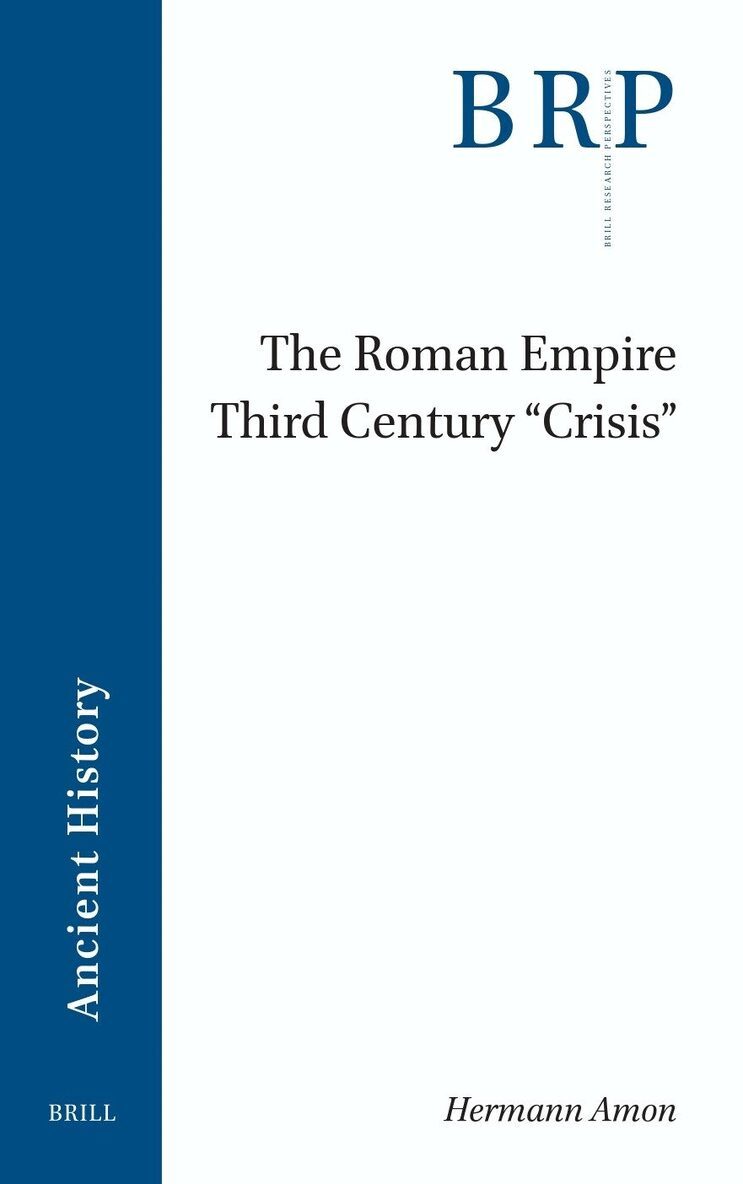
The years from the assassination of Severus Alexander to Diocletian’s rise to power (235–284) remain of interest to ancient historians. This period, commonly known as the Third Century “Crisis,” exerted a significant influence on the political, economic, and socioreligious developments of late antiquity. This period witnessed assaults on the empire’s borders by Germans and Persians, along with an acceleration of changes resulting from these attacks. Through a survey of ancient literary sources and the work of modern scholars, this volume offers an overview of critical issues faced by the empire, such as border wars, the role of the emperor, the Senate, and the equestrian order, as well as issues of finance and currency. Furthermore, specific attention is given to the regions of Gaul, Palmyra, and Egypt.