Brill Research Perspectives in Art and Law - Böcker
Visar alla böcker i serien Brill Research Perspectives in Art and Law. Handla med fri frakt och snabb leverans.
15 produkter
15 produkter
1 180 kr
Skickas inom 5-8 vardagar
Taking as its exemplum the use of images in judicial decisions, this article argues that the ratio decidendi of legal precedent should be supplemented with the imago decidendi, the figure or depiction that motivates judgment. Drawing upon the history of legal humanism, and particularly the tradition of juristic emblems, it is argued that an adequate understanding of case law rules and decisions requires attention to the imagery that conceives and propels the reasoned deliberation that follows. To adequately apprehend the transmission of law in a digital age requires acknowledging that images think differently, that the ambulation of the eye in the image is very different to the linear glance of the text.
1 180 kr
Skickas inom 5-8 vardagar
‘What is art?’ is one of the classic questions that philosophy has addressed over the ages, from the ancients to today. Taking as its starting point debates over the various definitions of art found in history, this article presents and discusses some of the major theories offered by both the analytic and continental traditions. It then looks at the theoretical reasons that led twentieth-century philosophy to reopen the question of definition, and in many cases inquire into the ontology of art itself. Finally, a series of considerations are addressed to help shift the problem of definition onto a new plane, one that is able to respond to the challenges of the performing and participatory arts, which more than any other form of art present particularly unconventional ontologies.
Between Ordinary and Extraordinary
The Normativity of the Singular Case in Art and Law
Häftad, Engelska, 2018
1 180 kr
Skickas inom 5-8 vardagar
What is the relationship between the general, abstract norm and the singular, concrete case that sometimes affirms a parallel, contrasting, norm? The present essay engages with this question. The argument stems from an analysis of extraordinary singular cases that sometimes emerge, sometimes are “produced” or “promoted” as exemplary (for strategic reasons, like in law). In this essay Angela Condello argues that approaching normativity in art and law from the perspective of the singular case also illustrates the theoretical importance of interdisciplinary legal scholarship, since the singularity creates room for extra-legal values to emerge as legitimate demands, desires, and needs.
1 140 kr
Skickas inom 5-8 vardagar
The aim of this essay is to analyse TV series from the point of view of philosophical aesthetics. Aiming to show how philosophy may contribute to “seriality studies”, Andrzejewski and Salwa focus on seriality as a factor which defines the structure of TV series, their aesthetic properties, as well as their modes of reception. TV series have been studied within media theory and cultural studies for quite a long time, but they have been approached mainly in terms of their production, distribution, and consumption across various and changing social contexts. Following the agenda of philosophical aesthetics Andrzejewski and Salwa claim instead seriality implies a sort of normativity, i.e. that it is possible to indicate what features a television show has to have in order to be a serial show as well as the manner in which it should be watched if it is to be experienced as a serial work.
1 180 kr
Skickas inom 5-8 vardagar
What is the relationship between street art and the law? In A Philosophy Guide to Street Art and the Law, Andrea Baldini argues that street art has a constitutive relationship with the law. A crucial aspect of the identity of this urban art kind depends on its capacity to turn upside down dominant uses of public spaces. Street artists subvert those laws and social norms that regulate the city. Baldini shows that street art has not only transformed public spaces and their functions into artistic material, but has also turned its rebellious attitude toward the law into a creative resource. He aims at elucidating and arguing for this claim, while drawing important implications at the level of street art’s metaphysics, value, and relationship with rights of intellectual property, in particular copyright and moral rights. At the other end of the spectrum of contractual art, street art is outlaw art.
From Fountain to Moleskine
The Work of Art in the Age of its Technological Producibility
Häftad, Engelska, 2019
1 140 kr
Skickas inom 5-8 vardagar
Photography was invented in the mid-nineteenth century, and ever since that moment painters have been asking what they are there for. Everyone has their own strategy. Some say they do not paint what is there, but their impressions. Others paint things that are not seen in the world, and therefore cannot be photographed, because they are abstractions. Others yet exhibit urinals in art galleries. This may look like the end of art but, instead, it is the dawn of a new day, not only for painting but – this is the novelty – for every form of art, as well as for the social world in general and for industry, where repetitive tasks are left to machines and humans are required to behave like artists.
1 140 kr
Skickas inom 5-8 vardagar
Law and images are generally not regarded as having much in common, since law is based on textual and images are based on visual information. The paper demonstrates that quite to the contrary, legal norms can be understood as models of intended moral behaviour and hence as images, in the same way as images can be said to have a normative and hence regulatory effect. Following an interdisciplinary approach along the lines of cultural research, the paper explains how images “function” to lawyers and how the law “works” to those trained in the visual sciences. In addition, laying the foundations for a research field “Law and Images” in parallel to the well-established “Law and Literature”, the paper describes the main avenues for future research in this field. Also, the paper contains a brief systematization of images in law, of law and for law.
1 085 kr
Skickas inom 5-8 vardagar
The complex nature of industrial design, which combines functional and aesthetic elements, allows different modes of protection: cumulative, separate or partially overlapping regimes are applicable according to different legal systems. The legal framework is rapidly changing, especially in Europe where the principle of cumulation of a special sui generis regime for protecting industrial design with copyright rules has been established. In the last decade, national courts of some Member States conferred to the “cumulative regime” a peculiar meaning, other courts enforced design rights in line with the interpretation given by the Court of Justice of the EU. The copyright/design interface is presented here to a wider, non-specialist audience, taking as a starting point the notion of industrial design derived from design studies, on the border between art and science.
1 046 kr
Skickas inom 5-8 vardagar
The advent of Artificial Intelligence (AI) as an “autonomous author” urges the law to rethink authorship, originality, creativity. AI-generated artworks are in search of an author because current copyright laws offer as a solution only public domain or fragile regulatory mechanisms. During the 20th century visual artists have been posing persistent challenges to the law world: Conceptual Art favoured legal mechanisms alternative to copyright law. The case of AI-art is, however, different: for the first time the artworld is discovering the prospective of an art without human authors.Rather than preserving the status quo in the law world, policy makers should consider a reformative conception of AI in copyright law and take inspiration from innovative theories in the field of robot law, where new frames for a legal personhood of artificial agents are proposed.This would have a spill-over effect also on copyright regulations.
1 292 kr
Skickas inom 5-8 vardagar
In the present work, a legal philosopher (Angela Condello) and a literaray scholar (Tiziano Toracca) develop the idea that a comparison between law and literature must be framed starting from the modes in which law and literature function. In this sense, they read law and literature as arts of compromising characterized by an analogous and yet, at the same time, profoundly different structure. Both, in fact, mediate conflicts between norms and transgressions, and more precisely between a principle of normativity (repression), on the one hand; and a principle of counternormativity (repressed), on the other hand. Through a progression in three steps, aimed at clarifying some peculiarities of law (1) and literature (2), by referring to examples of their interaction (3), the authors finally sketch some relevant hypotheses on why a placement across these two arts of compromising suggests some theoretical itineraries on their threshold.
1 085 kr
Skickas inom 5-8 vardagar
What do we mean when we talk about the identity of a musical work and what does such an identity involve? What in fact are the properties that make it something worth protecting and preserving? These issues are not only of legal relevance; they are central to a philosophical discipline that has seen considerable advances over the last few decades: musical ontology. Taking into account its main theoretical models, this essay argues that an understanding of the ontological status of musical works should acknowledge the irreducible ambivalence of music as an “art of the trace” and as a “performative art.” It advocates a theory of the musical work as a “social object” and, more specifically, as a sound artefact that functions aesthetically and which is based on a trace informed by a normative value. Such a normativity is further explored in relation to three primary ways of conceiving and fixing the trace: orality, notation and phonography.
1 215 kr
Skickas inom 5-8 vardagar
This work sets out to consider the fate of creativity and forms of cultural production as they fall into and between the regimes of cultural heritage law and intellectual property law. It examines and challenges the dualisms that ground both regimes, exposing their (unsurprising) reflection of occidental ways of seeing the world. The work reflects on the problem of regulating creativity and cultural production according to Western thought systems in a world that is not only Western. At the same time, it accepts that the challenge in taking on the dualisms that hold together the existing legal regimes regulating creativity and cultural production lies in a critically nuanced approach to the geo-political distinction between the West and the rest. Like many of the distinctions considered in this book, this is one that holds and does not hold.
Del 2021 - Brill Research Perspectives in Art and Law
Ground Zero of the Arts: Rules, Processes, Forms
Häftad, Engelska, 2021
1 087 kr
Skickas inom 5-8 vardagar
This book proposes to investigate the arts from the inside, namely to consider, first and foremost, what artists do to create their works in order to proceed fruitfully in the direction of their evaluation and explanation. To this end, it develops a philosophical inquiry that examines the ground zero of the arts, their common foundations, namely the rules for artistic creation, the processes that involve artists in their activities, the forms that they can or cannot achieve. This proposal and its outline for a rule-based ontology of the arts addresses four themes: the relationship between human nature and artistic practices, the features of art-making, the conception of artworks as structures, and the social nature of the arts.
Del 2024 - Brill Research Perspectives in Art and Law
Conundrum of Control
Making Sense through Artistic Practices
Häftad, Engelska, 2024
1 050 kr
Skickas inom 5-8 vardagar
Various forms of control play a central role in our lives. However, the nature of control is a difficult conundrum to probe. Believing we "control" ourselves, nature or others may seem like a sign of autonomy, power and self-determination, but it is often an illusion and not always desirable. Art practices help us make sense of the questions and paradoxes related to the enhancing interplay between control and non-control by putting them on display. What happens if this interplay between the two poles collapses? What are the consequences for our forms of life?
Del 2025 - Brill Research Perspectives in Art and Law
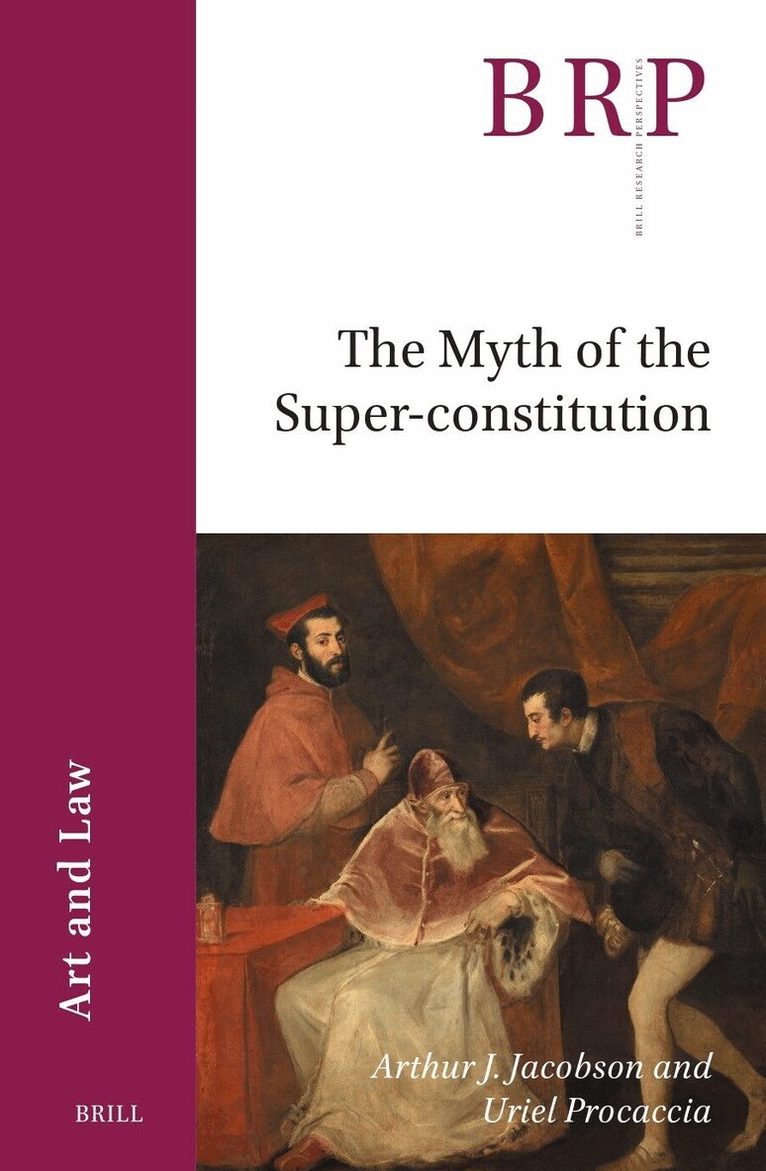
Myth of the Super-constitution
Häftad, Engelska, 2025
1 158 kr
Skickas inom 3-6 vardagar
Normally, all laws within any given jurisdiction ought to conform to some “higher” legal imperative called a “constitution”. In modern times, constitutions are usually embedded in a formal document, and laws that fail to meet this standard are held to be “unconstitutional” and adjudicated null and void. In former times, constitutions often resided in looser terms like “natural law” and rested on extra-legal foundations such as consecrated customs or religious convictions. However, what happens if the constitution itself is offensive to some deeply ingrained norms within the prevailing culture? Is it possible to override constitutions for failing to meet some elementary standards of decency or moral propriety? In recent memory, critics reviled the Third Reich as a rogue regime in spite of the fact that it meticulously followed its own corrupt policies. Is it possible to maintain the idea that even constitutions must comply with some external standards? Is such a possibility intellectually defensible? Or must we accept the fact that no formal regime is full-proof against the looming threat of human depravity?