Cambridge Texts and Studies in the History of Education – serie
Visar alla böcker i serien Cambridge Texts and Studies in the History of Education. Handla med fri frakt och snabb leverans.
13 produkter
13 produkter
550 kr
Skickas inom 7-10 vardagar
A detailed historical account of the origins of the modern examination system in England from 1850 to 1900. At the beginning of the nineteenth century public examinations were almost unknown, yet by its end they were established as the most generally acceptable method of assessment and selection; with many they had become almost an article of the Victorian faith, though their objectivity and efficacy were already becoming matters of public controversy. The Oxford and Cambridge honours examinations provided a major source for Victorian ideas of open competition and public examinations. It was seen that this model could be applied to a whole range of educational and administrative purposes. The crucial developments came between 1850 and 1870: major landmarks were the Northcote-Trevelyan Report of 1853 on the Civil Service, the foundation of the Oxford and Cambridge Local Examinations of 1857 and 1858, and Gladstone's introduction in 1870 of open competition into the Home Civil Service.
416 kr
Skickas inom 7-10 vardagar
This book traces the nineteenth-century formation, growth and structure of the central authority for education in England. The author uses a wide variety of published and unpublished material and describes the influences - religious, social, political and economic and others that moulded the authority. He considers the effect of the form of the three bodies that - originally held authority for education - the Education Department, the Science and Art Department and the Charity commission - on educational provision and progress throughout the Victorian era. In particular the author considers the impact of the machinery of government on the developing educational system. Dr Bishop discusses such questions as: to what extent was the provision and content of institutionalized education determined by essentially administrative considerations? What factors caused the fragmentation of such educational services as were then provided; and was the lack of unity of supervision at the centre the product of chance or design?
428 kr
Skickas inom 7-10 vardagar
The French Revolution was the first of the great social upheavals which transformed European society; its effects on the French national educational system and its wider influence on education is obviously important. Little has been written on the topic and Professor Barnard offers a modern study. He begins with a survey of the educational system under the Ancien Régime and describes the criticisms and schemes of reform which had already been offered before the Revolution. Then follow accounts of the educational activities of the revolutionary assemblies and the individual institutions set up during the period. The story ends with an account of the lasting influence of these reforms. Throughout, Professor Barnard emphasises the importance of the concept of education as a fundamental civic right and the duty of the state to provide and regulate it. The book gives the student of the history of education, of social history and modern France a useful survey of a central topic.
428 kr
Skickas inom 7-10 vardagar
The learned, pious and gentle Archbishop Fénelon (1651-1715), author of Télémaque and royal tutor, was one of the great European educationists and especially important for his writings on the education of girls; but his work is little known to students of the history and theory of education because suitable translations of the main texts have been lacking. Professor Barnard now makes them available in English, with a substantial introduction and notes. The introduction gives a biography and character sketch of Fénelon, against the religious, political and educational background of his times; a second section analyses Fénelon's educational theories.
428 kr
Skickas inom 7-10 vardagar
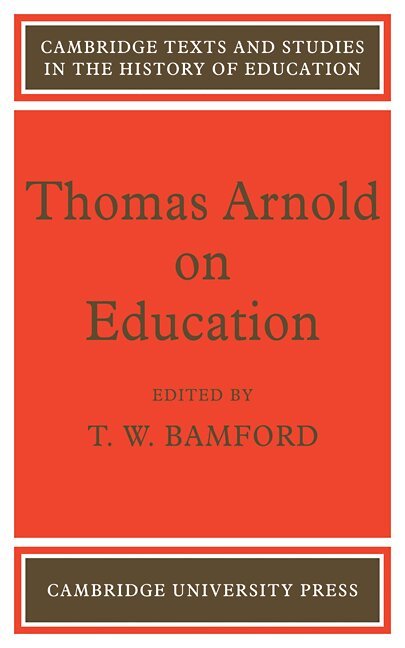
Thomas Arnold, headmaster of Rugby School from 1828 till his death, is famous as the reformer of public schools. Dr Bamford sees this reputation as a misleading one and in his introduction he presents Arnold as a paradoxical figure. 'He had a very large family, but did not really understand children at all, he ran a public school but his heart was in the religious and social struggles outside the gates. Again, he adored the classics and despised the moderns but thought that the future hope of mankind lay with industry. As a headmaster it was his duty to educate and prepare boys for the professions and yet openly he despised these occupations. Even after he died the paradox remains, for he is said to have reformed the public schools whereas in fact there is precious little evidence of it.' In this book, a selection of his writings on education is presented to students of education. The writings are preceded by a full introduction which describes Arnold's social, religious and educational ideas and evaluates his influence.
415 kr
Skickas inom 7-10 vardagar
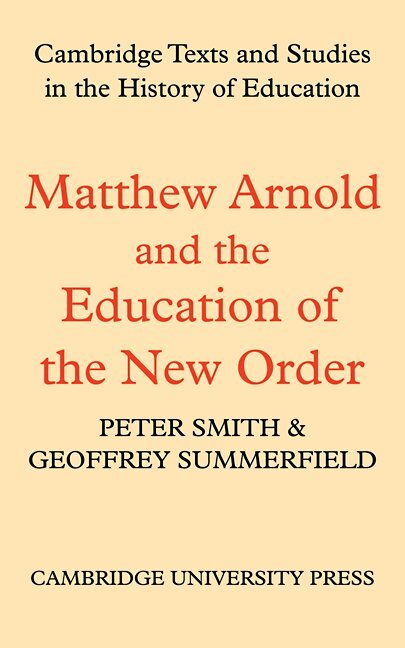
A selection from Arnold's writing on education, other than Culture and Anarchy. All the pieces stem from his work as Inspector of Schools: they illustrate his concern both with the principles that must be established as a basis for the education of an industrial democracy and his practical concern with the day-to-day running of schools. 'Democracy' was first published as the introduction to The Popular Education of France. It faces the fundamental political problems and outlines the general objectives of a state educational system. 'A French Eton' was the result of the same examination of French education to see what the British could learn from it; here he considers private education for the middle-classes. 'The twice-revised code' criticises the national Revised Code of 1862: a system founded on gross utilitarianism. Extracts from Arnold's reports as an inspector show the man of principle at work in particular circumstances and relating what he sees to what he would wish to see. The speech on his retirement comments on his lifetime of active involvement in education.
416 kr
Skickas inom 7-10 vardagar
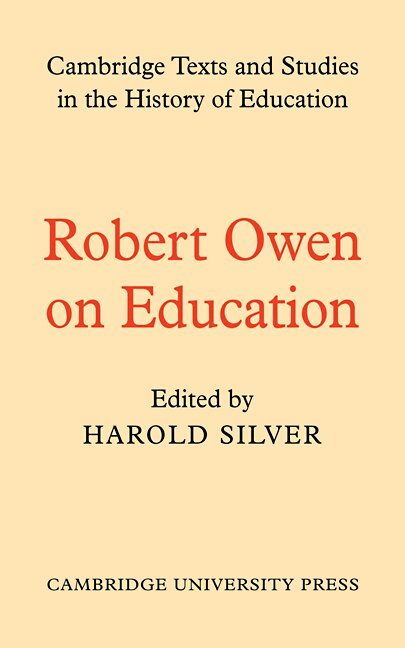
Robert Owen was one of the most extraordinary Englishmen who ever lived and a great man. In a way his history is the history of the establishment of modern industrial Britain, reflected in the mind and activities of a very intelligent, capable and responsible industrialist, alive to the best social thought of his time. The organisation of industrial labour, factory legislation, education, trade unionism, co-operation, rationalism: he was passionately and ably engaged in all of them. His community at New Lanark was the nearest thing to an industrial heaven in the Britain of dark satanic mills; he tried to found a rational co-operative community in the USA. In everything he contemplated, he saw education as a key. This selection of his writings on education illustrates his rationalist concept of the formation of character and its implications for education and society; also his growing utopian concern with social reorganisation; and third, his impact on social movements. Silver's introduction shows Owen's relationship to particular educational traditions and activities and his long-term influence on attitudes to education.
416 kr
Skickas inom 7-10 vardagar
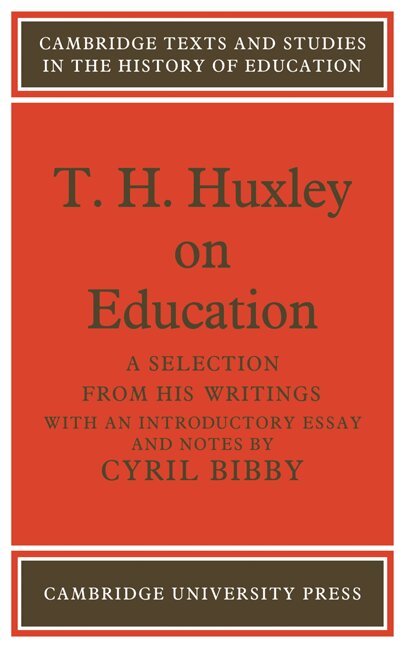
Thomas Henry Huxley (1825-1895) is known primarily as a scientist but he was also an influential educationalist, spending most of his working life teaching at the School of Mines (which later became Imperial College of Science and Technology). In this 1971 text, the most significant of his writings on education have been selected, edited and gathered together. The book is introduced by a substantial essay in which Cyril Bibby assesses Huxley's influence on the historical development of education and indicates the ways in which his educational thinking bears closely on many problems of twentieth-century society. The book contains sufficient bibliographical apparatus to guide the reader in further study, together with a useful chronology of Huxley's life and writings in their historical context.
441 kr
Skickas inom 7-10 vardagar
A study of Robert Lowe (1811-1892), a philosophical radical in the utilitarian tradition, educationalist and politician. He held a number of government positions, and as vice-president of the Committee of Council on Education (1859-1864) he introduced the controversial 'payment by results' scheme, 'results' being measured by examinations and constituting the pre-condition for the payment of State grants. Mr Sylvester assesses Lowe's career and political importance, and argues for a reconsideration of his somewhat reactionary reputation.
428 kr
Skickas inom 7-10 vardagar
Friedrich Froebel (1782-1852) has long been known as a great educational reformer and the founder of kindergartens. Most of Froebel's works deal with young children. This selection, translated from the German for this volume, shows the development of his educational doctrines. The extracts are arranged by topic, with a brief introduction to each section. The first gives Froebel's impressions during his formative years and his reasons for choosing teaching as a vocation; the second presents his basic principles from his most important work, The Education of Man; and two remaining sections record his observations of children in their early years. A general introduction appraises Froebel's main beliefs and his influence, and a bibliography is included. To those concerned with child development and the history of education, this volume offers a concise readable account of the beliefs and achievements of a remarkable nineteenth-century educator given in his own words.
416 kr
Skickas inom 7-10 vardagar
James Mill's two principal published works on education are the article 'Education', for the Encyclopedia Britannica, written in 1815, and the pamphlet Schools for all, in preference to Schools for Churchmen only, written in 1812. The first was general and theoretical, and raises points about the relationship between the aims of education, psychological theory and social life. It is a classic document of utilitarianism. The second was written as part of the debate about the interlocked themes of primary education, monitorial education, and religious education. It is practical and political, and one of the first statements about secularism in education and the need to provide primary schooling for all in England. Mr Burston's introduction relates the two pieces to Mill's general intellectual and philosophical position, and to the historical context in which he wrote. Notes explain allusions in the text, and there is a bibliography.
428 kr
Skickas inom 7-10 vardagar
An account of the progress made in the provision of education in Nottingham in the nineteenth century. Dr Wardle makes full use of the evidence of newpapers, contemporary accounts and statistics relating to population, child employment, public health, welfare agencies, and charitable organisations to produce an integrated study of the educational, social and economic aspects of a town's growth over 100 years. The experience of Nottingham is compared (generally favourably) with that of other cities. The full use of newspapers means that areas of the educational picture usually overlooked are here given due prominence; for example, the numerically significant private schools, and the lending libraries organised by groups of workmen. This book gives a vivid picture of the growth of our educational system, not only as it was seen by the administrators, but also as it was seen by the parents, and pupils for whom it was intended.
428 kr
Skickas inom 7-10 vardagar
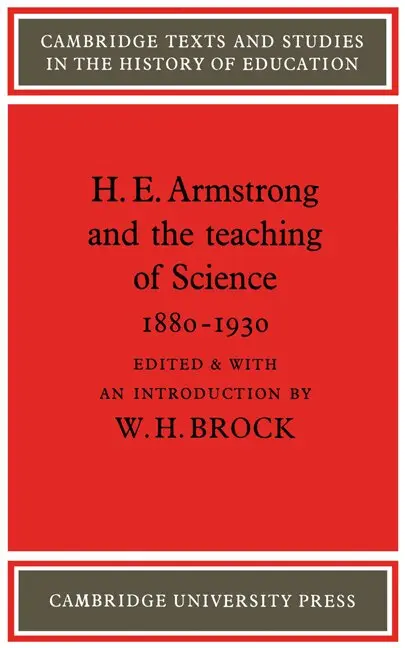
Originally published in 1973, this is a selection of the educational writings of H. E. Armstrong, edited with a full introduction by W. H. Brock. Henry Armstrong (1848-1937) was a controversial and energetic publicist for reforms in science teaching and curricula. He was concerned to make teaching at all levels less didactic and authoritarian, more practical and experimental; where possible a student should be prompted by his own curiosity, and should learn things first hand. He called his approach 'heuristic' - meaning learning through discovery - and sought to establish it through public platforms like the British Association, schools and through his own training of teachers. In his introduction Dr Brock offers a historical critique of Dr Armstrong's methods and achievements, and considers to what extent he can be seen as a progenitor of subsequent curriculum reforms.