Carl Newell Jackson Lectures - Böcker
Visar alla böcker i serien Carl Newell Jackson Lectures. Handla med fri frakt och snabb leverans.
7 produkter
7 produkter
334 kr
Skickas inom 7-10 vardagar
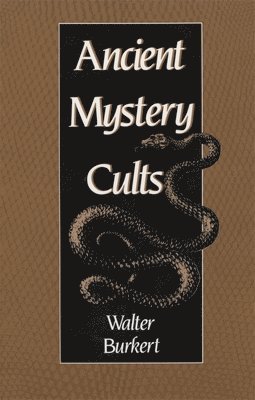
The foremost historian of Greek religion provides the first comprehensive, comparative study of a little-known aspect of ancient religious beliefs and practices. Secret mystery cults flourished within the larger culture of the public religion of Greece and Rome for roughly a thousand years. This book is neither a history nor a survey but a comparative phenomenology, concentrating on five major cults. In defining the mysteries and describing their rituals, membership, organization, and dissemination, Walter Burkert displays the remarkable erudition we have come to expect of him; he also shows great sensitivity and sympathy in interpreting the experiences and motivations of the devotees.
Del 11 - Carl Newell Jackson Lectures
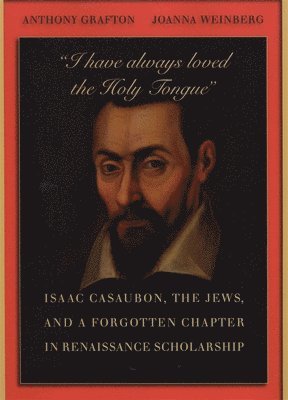
“I have always loved the Holy Tongue”
Isaac Casaubon, the Jews, and a Forgotten Chapter in Renaissance Scholarship
Inbunden, Engelska, 2011
394 kr
Skickas inom 10-15 vardagar
“[An] extraordinary book.” —New RepublicFusing high scholarship with high drama, Anthony Grafton and Joanna Weinberg uncover a secret and extraordinary aspect of a legendary Renaissance scholar’s already celebrated achievement. The French Protestant Isaac Casaubon (1559–1614) is known to us through his pedantic namesake in George Eliot’s Middlemarch. But in this book, the real Casaubon emerges as a genuine literary hero, an intrepid explorer in the world of books. With a flair for storytelling reminiscent of Umberto Eco, Grafton and Weinberg follow Casaubon as he unearths the lost continent of Hebrew learning—and adds this ancient lore to the well-known Renaissance revival of Latin and Greek. The mystery begins with Mark Pattison’s nineteenth-century biography of Casaubon. Here we encounter the Protestant Casaubon embroiled in intellectual quarrels with the Italian and Catholic orator Cesare Baronio. Setting out to understand the nature of this imbroglio, Grafton and Weinberg discover Casaubon’s knowledge of Hebrew. Close reading and sedulous inquiry were Casaubon’s tools in recapturing the lost learning of the ancients—and these are the tools that serve Grafton and Weinberg as they pore through pre-1600 books in Hebrew, and through Casaubon’s own manuscript notebooks. Their search takes them from Oxford to Cambridge, from Dublin to Cambridge, Massachusetts, as they reveal how the scholar discovered the learning of the Hebrews—and at what cost.
Del 13 - Carl Newell Jackson Lectures
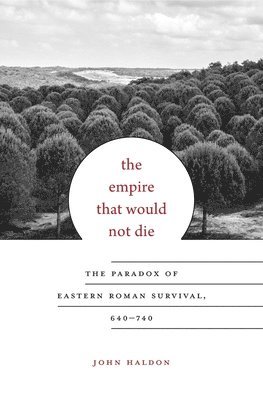
Empire That Would Not Die
The Paradox of Eastern Roman Survival, 640–740
Inbunden, Engelska, 2016
494 kr
Skickas inom 10-15 vardagar
The eastern Roman Empire was the largest state in western Eurasia in the sixth century. Only a century later, it was a fraction of its former size. Surrounded by enemies, ravaged by warfare and disease, the empire seemed destined to collapse. Yet it did not die. In this holistic analysis, John Haldon elucidates the factors that allowed the eastern Roman Empire to survive against all odds into the eighth century.By 700 CE the empire had lost three-quarters of its territory to the Islamic caliphate. But the rugged geography of its remaining territories in Anatolia and the Aegean was strategically advantageous, preventing enemies from permanently occupying imperial towns and cities while leaving them vulnerable to Roman counterattacks. The more the empire shrank, the more it became centered around the capital of Constantinople, whose ability to withstand siege after siege proved decisive. Changes in climate also played a role, permitting shifts in agricultural production that benefitted the imperial economy.At the same time, the crisis confronting the empire forced the imperial court, the provincial ruling classes, and the church closer together. State and church together embodied a sacralized empire that held the emperor, not the patriarch, as Christendom’s symbolic head. Despite its territorial losses, the empire suffered no serious political rupture. What remained became the heartland of a medieval Christian Roman state, with a powerful political theology that predicted the emperor would eventually prevail against God’s enemies and establish Orthodox Christianity’s world dominion.
Del 3 - Carl Newell Jackson Lectures
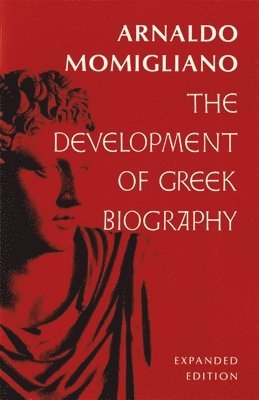
Development of Greek Biography
Expanded Edition
Häftad, Engelska, 1993
341 kr
Skickas inom 10-15 vardagar
Tracing the growth of ancient biography from the fifth century to the first century B.C., Arnaldo Momigliano asks fruitful questions about the origins and development of Greek biography. By clarifying the social and intellectual implications of the fact that the Greeks kept biography and autobiography distinct from historiography, he contributes to an understanding of a basic dichotomy in the Western tradition of historical writing. The Development of Greek Biography is fully annotated, and includes a bibliography designed to serve as an introduction to the study of biography in general.This classic study is now reissued with the addition of Momigliano’s essay “Second Thoughts on Greek Biography” (1971).
283 kr
Skickas inom 7-10 vardagar
Peter Brown presents a masterly history of Roman society in the second, third, and fourth centuries. Brown interprets the changes in social patterns and religious thought, breaking away from conventional modern images of the period.
458 kr
Skickas inom 10-15 vardagar
From the earliest times, philosophers and others have thought deeply about ethical questions. But it was Aristotle who founded ethics as a discipline with clear principles and well-defined boundaries. Ethics After Aristotle focuses on the reception of Aristotelian ethical thought in the Hellenistic and Roman worlds, underscoring the thinker’s enduring influence on the philosophers who followed in his footsteps from 300 BCE to 200 CE.Beginning with Aristotle’s student and collaborator Theophrastus, Brad Inwood traces the development of Aristotelian ethics up to the third-century Athenian philosopher Alexander of Aphrodisias. He shows that there was no monolithic tradition in the school, but a rich variety of moral theory. The philosophers of the Peripatetic school produced surprisingly varied theories in dialogue with other philosophical traditions, generating rich insight into human virtue and happiness. What unifies the different strands of thought—what makes them distinctively Aristotelian—is a form of ethical naturalism: that our knowledge of the good and virtuous life depends first on understanding our place in the natural world, and second on the exercise of our natural dispositions in distinctively human activities. What is now referred to as “virtue ethics,” Inwood argues, is a less important part of Aristotle’s legacy than the naturalistic approach Aristotle articulated and his philosophical descendants developed further.Offering a wide range of ways of thinking about ethics from an ancient perspective, Ethics After Aristotle is a penetrating study of how philosophy evolves in the wake of an unusually powerful and original thinker.
429 kr
Skickas inom 7-10 vardagar
From Augustus to Constantine, the Roman Empire in the Near East expanded step by step, southward to the Red Sea and eastward across the Euphrates to the Tigris. In a remarkable work of interpretive history, Fergus Millar shows us this world as it was forged into the Roman provinces of Syria, Judaea, Arabia, and Mesopotamia. His book conveys the magnificent sweep of history as well as the rich diversity of peoples, religions, and languages that intermingle in the Roman Near East. Against this complex backdrop, Millar explores questions of cultural and religious identity and ethnicity—as aspects of daily life in the classical world and as part of the larger issues they raise.As Millar traces the advance of Roman control, he gives a lucid picture of Rome’s policies and governance over its far-flung empire. He introduces us to major regions of the area and their contrasting communities, bringing out the different strands of culture, communal identity, language, and religious belief in each. The Roman Near East makes it possible to see rabbinic Judaism, early Christianity, and eventually the origins of Islam against the matrix of societies in which they were formed. Millar’s evidence permits us to assess whether the Near East is best seen as a regional variant of Graeco-Roman culture or as in some true sense oriental.A masterful treatment of a complex period and world, distilling a vast amount of literary, documentary, artistic, and archaeological evidence—always reflecting new findings—this book is sure to become the standard source for anyone interested in the Roman Empire or the history of the Near East.