Center Books in Anabaptist Studies - Böcker
Visar alla böcker i serien Center Books in Anabaptist Studies. Handla med fri frakt och snabb leverans.
12 produkter
12 produkter
480 kr
Skickas inom 5-8 vardagar
In the first book ever written on the subject, Carl Bowman examines how and why members of the Church of the Brethren-historically known as "Dunkers" after their method of baptism-were assimilated faster and earlier than their Amish, Mennonite, or even Hutterite cousins.
433 kr
Skickas inom 5-8 vardagar
Among the Old Order Mennonite and Amish communities of Lancaster County, Pennsylvania, the coming of the telephone posed a serious challenge to the longstanding traditions of work, worship, silence, and visiting. In 1907, Mennonites crafted a compromise in order to avoid a church split and grudgingly allowed telephones for lay people while prohibiting telephone ownership among the clergy. By 1909, the Amish had banned the telephone completely from their homes. Since then, the vigorous and sometimes painful debates about the meaning of the telephone reveal intense concerns about the maintenance of boundaries between the community and the outside world and the processes Old Order communities use to confront and mediate change. In Holding the Line, Diane Zimmerman Umble offers a historical and ethnographic study of how the Old Order Mennonites and Amish responded to and accommodated the telephone from the turn of the twentieth century to the present. For Old Order communities, Umble writes, appropriate use of the telephone marks the edges of appropriate association -- who can be connected to whom, in what context, and under what circumstances.Umble's analysis of the social meaning of the telephone explores the effect of technology on community identity and the maintenance of cultural values through the regulation of the means of communication.
332 kr
Skickas inom 7-10 vardagar
Recent years have seen a shift in the belief that a religious world-view, specifically a Christian one, precludes a commitment to environmentalism. Whether as "stewards of God's creation" or champions of "environmental justice," church members have increasingly found that a strong pro-ecology stand on environmental issues is an integral component of their faith. But not all Christian denominations are latecomers to the issue of environmentalism. In Creation and the EnvironmentCalvin W. Redekop and his co-authors explain the unique environmental position of the Anabaptists, in particular the Mennonites. After a brief survey of the major forces contributing to the word's present ecological crisis, Creation and the Environment explores the uniquely Anabaptist view of our relationship to what they see as the created order. In rural Amish and Mennonite communities, they explain, the environment-especially the "land"-is considered part of the Kingdom God plans to establish on earth. In this view, the creation is part of the divine order, with the redemption of humankind inextricably linked to the redemption and restoration of the material world.The well-being a purpose of creation and human history are thus seen as completely interdependent. Contributors: Heather Ackley Bean, Claremont Graduate School * Kenton Brubaker, Eastern Mennonite University * Thomas Finger, Claremont Graduate School * Karen Klassen Harder, Bethel College, Kansas * James Harder, Bethel College, Kansas * Lawrence Hart, Cheyenne Cultural Center, Clinton, Oklahoma * Theodore Hiebert, McCormick Theological Seminary * Karl Keener, Pennsylvania State University * Walter Klaassen, Conrad Grebel College * David Kline, Holmes County, Ohio * Calvin W. Redekop, Conrad Grebel College * Mel Schmidt * Dorothy Jean Weaver, Eastern Mennonite University * Michael Yoder, Northwestern College, Iowa.
616 kr
Skickas inom 7-10 vardagar
Founded in part on a rejection of "worldly" power and the use of force, Anabaptism carried with it the promise of redemptive power. Yet the attempt to banish worldly power to the margins of the Christian community has been fraught with dilemmas, contradictions, and, at times, blatant abuses of authority. In this groundbreaking book, Benjamin W. Redekop, Calvin W. Redekop, and their coauthors draw on classic and contemporary thinking to confront the issue of power and authority in the Anabaptist-Mennonite community. From the power relationships of the sixteenth-century Peasants' War to issues of contemporary sexuality, the topics of Power, Authority, and the Anabaptist Tradition are sure to interest a wide audience. Contributors: Stephen C. Ainlay, College of the Holy Cross * J. Lawrence Burkholder, President Emeritus, Goshen College * Lydia Neufeld Harder, Toronto School of Theology * Joel Hartman, University of Missouri * Jacob A. Loewen, missionary, retired * Dorothy Yoder Nyce, Writer and former Assistant Professor, Goshen College * Lynda Nyce, Bluffton College * Wesley Prieb (deceased), former dean, Tabor College * Benjamin W. Redekop, Kettering University * Calvin W.Redekop, Conrad Grebel College, emeritus * James M. Stayer, Queen's University, Ontario
332 kr
Skickas
Since its publication in 1989, The Riddle of Amish Culture has become recognized as a classic work on one of America's most distinctive religious communities. But many changes have occurred within Amish society over the past decade, from westward migrations and a greater familiarity with technology to the dramatic shift away from farming into small business which is transforming Amish culture. For this revised edition, Donald B. Kraybill has taken these recent changes into account, incorporating new demographic research and new interviews he has conducted among the Amish. In addition, he includes a new chapter describing Amish recreation and social gatherings, and he applies the concept of "social capital" to his sensitive and penetrating interpretation of how the Amish have preserved their social networks and the solidarity of their community.
483 kr
Tillfälligt slut
This collection of original essays focuses on the rich, historically diverse, and often misunderstood experiences of Amish, Mennonite, and other women of Anabaptist traditions across 400 years. Equal parts sociology, religious history, and gender studies, the book explores the changing roles and issues surrounding Anabaptist women in communities ranging from sixteenth-century Europe to contemporary North America.Gathered under the overarching theme of the insider/outsider distinction, the essays discuss, among other topics: *How womanhood was defined in early Anabaptist societies of the sixteenth and seventeenth centuries, and how women served as central figures by convening meetings across class boundaries or becoming religious leaders *How nineteenth-century Amish tightened the connections among the individual, the family, the household, and the community by linking them into a shared framework with the father figure at the helm *The changing work world and domestic life of Mennonite women in the three decades following World War II *The recent ascendency of antimodernism and plain dress among the Amish *The special difficulties faced by scholars who try to apply a historical or sociological method to the very same cultural subgroups from which they derive The essays in this collection follow a fascinating journey through time and place to give voice to women who are often characterized as the "quiet in the land." Their voices and their experiences demonstrate the power of religion to shape identity and social practice.
456 kr
Skickas inom 5-8 vardagar
Calvin Redekop and his co-authors argue that Mennonite successes in the business world are the result of skillful adaptation of the sect's "communal ethic."
On the Backroad to Heaven
Old Order Hutterites, Mennonites, Amish, and Brethren
Häftad, Engelska, 2002
340 kr
Skickas inom 5-8 vardagar
On the Backroad to Heaven is a unique guidebook to the world of Old Order Anabaptist groups. Focusing on four Old Order communities-the Hutterites, Mennonites, Amish, and Brethren-Donald B. Kraybill and Carl Desportes Bowman provide a fascinating overview of their culture, growth, and distinctive way of life. Following a general introduction to Old Order culture, they show how each group uses a different strategy to create and sustain its identity. The Hutterites, for example, keep themselves geographically segregated from the larger society, whereas the Brethren interact more freely with it. The Amish and Mennonites are more alike in how they engage the outside world, adopting a complex but flexible strategy of compromise that produces an evolving canon of social and religious rules. This first comparative study sketches the differences as well as the common threads that bind these groups together.
387 kr
Skickas inom 5-8 vardagar
In this new edition of The Amish and the State Donald Kraybill brings together legal scholars and social scientists to explore the unique series of conflicts between a traditional religious minority and the modern state. In the process, the authors trace the preservation-and the erosion-of religious liberty in American life. Kraybill begins with an overview of the Amish in North America and describes the "negotiation model" used throughout the book to interpret a variety of legal conflicts. Subsequent chapters deal with specific aspects of religious freedom over which the Amish and the state have clashed. Focusing on the period from 1925 to 2001 in the United States, the authors examine conflicts over military service and conscription, Social Security and taxes, education, health care, land use and zoning, regulation of slow-moving vehicles, and other first amendment issues. New concluding chapters, by constitutional expert William Ball, who defended the Amish before the Supreme Court in 1972 in the landmark Wisconsin v. Yoder case, and law professor Garret Epps, assess the Amish contribution to preserving religious liberty in the United States.
607 kr
Tillfälligt slut
In this new edition of The Amish and the State Donald Kraybill brings together legal scholars and social scientists to explore the unique series of conflicts between a traditional religious minority and the modern state. In the process, the authors trace the preservation-and the erosion-of religious liberty in American life. Kraybill begins with an overview of the Amish in North America and describes the "negotiation model" used throughout the book to interpret a variety of legal conflicts. Subsequent chapters deal with specific aspects of religious freedom over which the Amish and the state have clashed. Focusing on the period from 1925 to 2001 in the United States, the authors examine conflicts over military service and conscription, Social Security and taxes, education, health care, land use and zoning, regulation of slow-moving vehicles, and other first amendment issues. New concluding chapters, by constitutional expert William Ball, who defended the Amish before the Supreme Court in 1972 in the landmark Wisconsin v. Yoder case, and law professor Garret Epps, assess the Amish contribution to preserving religious liberty in the United States.
607 kr
Tillfälligt slut
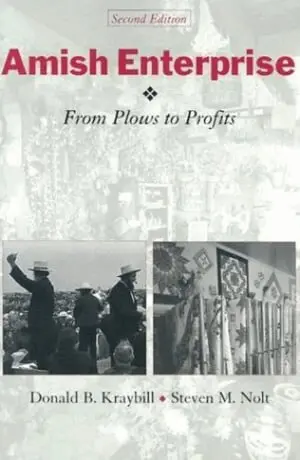
Amish culture has been rooted in the soil since its beginnings in 1693. But what happens when members of America's oldest Amish community enter non-farm work in one generation? How will hundreds of cottage industries and micro-enterprises reshape the heart of Amish life? Will traditional eighth grade education still prove adequate? What about gender roles, child-rearing practices, leisure activities, and growing ties with outsiders? Amish Enterprise was the first book to discuss these dramatic changes that are transforming Amish communities across North America. Based on interviews with more than 150 Amish entrepreneurs, the authors trace the rise and impact of businesses in Lancaster's Amish settlement in recent decades. In this new edition, the authors update demographic and technological changes, and also describe Amish enterprises outside of Pennsylvania in a new chapter.
311 kr
Skickas inom 7-10 vardagar
Amish culture has been rooted in the soil since its beginnings in 1693. But what happens when members of America's oldest Amish community enter non-farm work in one generation? How will hundreds of cottage industries and micro-enterprises reshape the heart of Amish life? Will traditional eighth grade education still prove adequate? What about gender roles, child-rearing practices, leisure activities, and growing ties with outsiders? Amish Enterprise was the first book to discuss these dramatic changes that are transforming Amish communities across North America. Based on interviews with more than 150 Amish entrepreneurs, the authors trace the rise and impact of businesses in Lancaster's Amish settlement in recent decades. In this new edition, the authors update demographic and technological changes, and also describe Amish enterprises outside of Pennsylvania in a new chapter.