CERI Series in Comparative Politics and International Studies – serie
Visar alla böcker i serien CERI Series in Comparative Politics and International Studies. Handla med fri frakt och snabb leverans.
5 produkter
5 produkter
625 kr
Skickas inom 3-6 vardagar
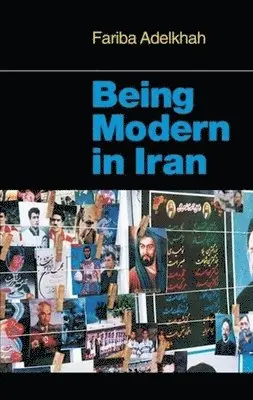
What does it mean to be modern in Iran today? Can one properly speak of modernity in relation to what many consider to be the paradigmatic Islamic state? Since its 1979 revolution seized the world's attention, the Islamic Republic of Iran has remained a subject of misunderstanding, passion, and polemic, making these questions difficult to answer-or even to ask. This book-a study of Iran's political culture in the broadest and deepest sense-looks into both of these questions by examining the tremendous changes taking place in Iran today. Because of the difficulties posed for researchers and journalists by the nature of the regime, those interested in contemporary Iranian social life have had to rely on a small number of specialized studies-most of which overemphasize the revolution's radical break with the past and focus exclusively on the Republic's Islamic character as the decisive factor in its social reality. But modernity has not simply been banished and excluded from Iran; nor have the effects of globalization passed it by.Drawing on her extensive ethnographic fieldwork in Iran and an encyclopedic knowledge of contemporary Iranian politics and culture, anthropologist Fariba Adelkhah investigates modernity in the Islamic Republic of Iran by looking at the growth of individualism, the bureaucracy, commercial forces, and rationalization in post-revolution Iran. Being Modern in Iran ranges over such topics as * taxation and Islamic legitimacy; * Mayor Kharbaschi's creation of public space in Tehran; * the culture of giving; * religious economics; * the elections of 1996 and 1997, and the popular rejoicing that greeted them; * the nation-wide soccer craze; * the changing role of clerics; * the changing use of the Koran; and * the growth of competition in all areas of life. These subjects are brought to life by vignette discussions of pigeon-fanciers, flower symbolism, funeral rites, dreams, self-help manuals, cosmetics, and much more.Adelkhah avoids a simpleminded dualism between an "odious," backward, and repressive regime on the one side and a "kindly" civil society representing progress and freedom on the other; rather, she argues that a public space is being created through the existence of many religious, political, and economic activities. This sophisticated anthropology of the Iranian state sheds much-needed light on the unique nature of the social experiment Iran has been experiencing since the revolution.
1 031 kr
Skickas inom 3-6 vardagar
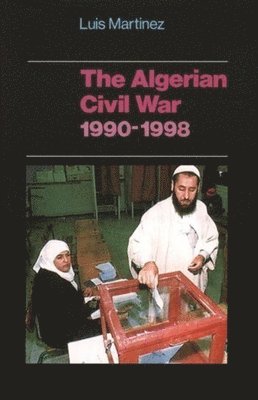
The civil war in Algeria shows no sign of imminent resolution. Yet little has been written about the conflict, its various participants, and the opinions of Algerians-indeed, even about what exactly is being fought over. Restrictions on movement within Algeria have severely limited the ability of foreign journalists to analyze these issues, and there has been a paucity of firsthand accounts of how the conflict has played out across Algeria. Now, one of Europe's leading authorities on contemporary Algerian politics has gained the kind of access necessary to present a clear, evenhanded account. The author interviewed residents in places in which few journalists have set foot: the impoverished suburbs of the major cities and the infamous "Triangle of Death"-the stronghold of the Armed Islamic Group and the scene of some of the worst carnage. Rather than presenting a historical account, The Algerian Civil War focuses on the strategies employed by the war's main combatants, seeking to understand the significance of the conflict to all parties embroiled in it.
1 287 kr
Skickas inom 3-6 vardagar
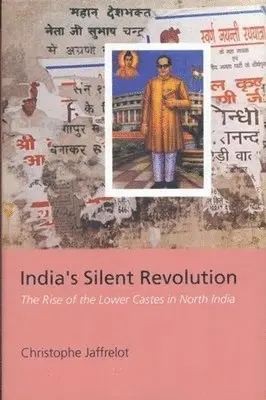
Since the 1960s a new assertiveness has characterized India's formerly silent majority, the lower castes that comprise more than two-thirds of the population. Today India's most populous state, Uttar Pradesh, is controlled by lower-caste politicians, as is Bihar, and lower-caste representation in national politics is growing inexorably. Jaffrelot argues that this trend constitutes a genuine "democratization" of India and that the social and economic effects of this "silent revolution" are bound to multiply in the years to come.
1 177 kr
Skickas inom 3-6 vardagar
In the new global political economy, "privatization" names a transformation of the roles of public and private actors with the goal of reforming government policies and economic aid programs. It is an objective, a slogan, a fetish. But what does it signify? On the one hand, it refers to the process of changing industries, businesses, and services from governmental or public ownership to private agencies. But privatization now also extends to what are normally the prerogatives of national states: taxation, customs, internal security, national defense, and peace negotiations. In much of the literature, privatization is associated with the retreat, decline, or even demise of the state. Using Max Weber's concept of delegation, or "discharge," as a point of departure, Hibou and the contributors of this volume propose an alternative view, interpreting the contemporary restructuring of economic and political relations in much of the world as "the privatization of the state." This book challenges received ideas about the process of globalization and its presumed homogenization by suggesting that rather than weakening the powers of the state, privatization actually strengthens it.With examples from Russia, Poland, China, Taiwan, Indonesia, North Africa, and sub-Saharan Africa, the book questions the supposed inefficiency of states in regulating capitalism and the role economic and financial knowledge play as substitutes for political and social analysis.
1 177 kr
Skickas inom 3-6 vardagar
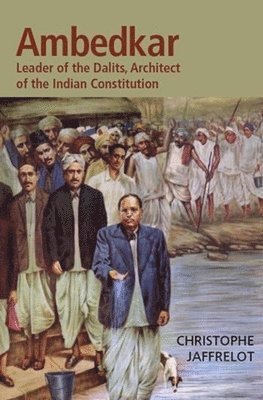
Dr. Bhimrao Ramji Ambedkar (1891-1956) rose from a community of "untouchables," to become a major figure in modern Indian history. Christophe Jaffrelot's biography reconsiders Dr. Ambedkar's life and thought and his unique combination of pragmatism and idealism. Establishing himself as a scholar, activist, journalist, and educator, Ambedkar ultimately found himself immersed in Indian politics and helped to draft the nation's constitution as law minister in Nehru's first cabinet. Ambedkar's ideas remain an inspiration to India's Dalit community.