Clarendon Lectures in Economics - Böcker
Visar alla böcker i serien Clarendon Lectures in Economics. Handla med fri frakt och snabb leverans.
14 produkter
14 produkter
651 kr
Skickas inom 5-8 vardagar
Over the past two decades, academic economics has undergone a mild revolution in methodology. The language, concepts and techniques of noncooperative game theory have become central to the discipline.This book provides the reader with some basic concepts from noncooperative theory, and then goes on to explore the strengths, weaknesses, and future of the theory as a tool of economic modelling and analysis. The central theses are that noncooperative game theory has been a remarkably popular tool in economics over the past decade because it allows analysts to capture essential features of dynamic competition and competition where some parties have proprietary information. The theory is weakest in providing a sense of when it - and equilibrium analysis in particular - can be applied and what to do when equilibrium analysis is inappropriate. Many of these weaknesses can be addressed by the consideration of individuals who are boundedly rational and learn imperfectly from the past.Written in a non-technical style and working by analogy, the book, first given as part of the Clarendon Lectures in Economics, is readily accessible to a broad audience and will be of interest to economists and students alike. Knowledge of game theory is not required as the concepts are developed as the book progresses.
2 258 kr
Skickas inom 5-8 vardagar
This book authoritatively considers the phenomenon of the severe economic crises of the 1970s and 1980s, as exemplified by the combination of high inflation and negative growth in Israel and Latin America. The author analyses the common characteristics of such processes and their possible cures–with a detailed first-hand account of Israeli stabilization policy, and a comparative policy-oriented analysis of Latin American reforms. Professor Bruno also calls on his experience to give a preliminary evaluation of recent stabilizations and reform attempts in several East European economies. The discussion of the theoretical underpinnings of `shock' treatments provides a good example for the blending of a number of disciplines: lessons of economic history; open economy monetary and macro theory; game-theoretic applications to the theory of economic policy design (concepts such as dynamic inconsistency, government reputation, and credibility); and the rationalization of incomes policy.The Clarendon Lectures in Economics were established in 1987. They consist of coherent sets of three or four lectures given by distinguished economists which are accessible to advanced undergraduates and also of interest to academics. Subjects vary from high theory and applications of theory to policy-oriented topics. Lecturers include Professors J.-M. Grandmont, David Kreps, Kenneth Arrow, Angus Deaton, Robert Schiller, and Oliver Hart.
1 002 kr
Skickas inom 5-8 vardagar
This book provides an overview of the recent research on saving and consumption, a field in which substantial progress has been made over the last decade.Attempts by economists to understand saving and consumption patterns have generated some of the best science in economics. For more than fifty years, there has been serious empirical and theoretical activity, and data, theory, and policy have never been separated as has happened in many branches of economics. Research has drawn microeconomists interested in household behaviour, as well as macroeconomists, for whom the behaviour of aggregate consumption has always occupied a central role in explaining aggregate fluctuations. Econometricians have also made distinguished contributions, and there has been a steady flow of new methodologies by those working on saving and consumption, in time-series econometrics, as well as in the study of micro and panel data.A coherent account of these developments is presented here, emphasizing the interplay between micro and the macro, between studies of cross-section and panels, and those using aggregate time series data.
621 kr
Skickas inom 5-8 vardagar
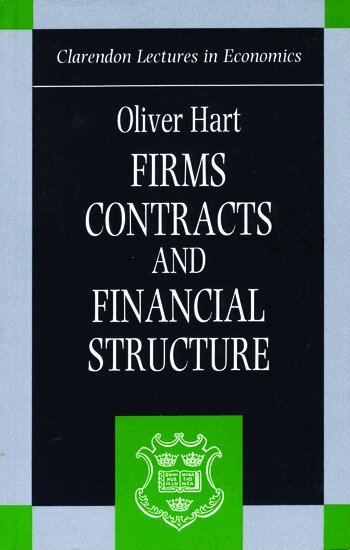
This book provides a framework for thinking about economic instiutions such as firms. The basic idea is that institutions arise in situations where people write incomplete contracts and where the allocation of power or control is therefore important. Power and control are not standard concepts in economic theory. The book begins by pointing out that traditional approaches cannot explain on the one hand why all transactions do not take place in one huge firm and on the other hand why firms matter at all. An incomplete contracting or property rights approach is then developed. It is argued that this approach can throw light on the boundaries of firms and on the meaning of asset ownership. In the remainder of the book, incomplete contacting ideas are applied to understand firms' financial decisions, in particular, the nature of debt and equity (why equity has votes and creditors have foreclosure rights); the capital structure decisions of public companies; optimal bankruptcy procedure; and the allocation of voting rights across a company's shares. The book is written in a fairly non-technical style and includes many examples. It is aimed at advanced undergraduate and graduate students, academic and business economists, and lawyers as well as those with an interest in corporate finance, privatization and regulation, and transitional issues in Eastern Europe, the former Soviet Union, and China. Little background knowledge is required, since the concepts are developed as the book progresses and the existing literature is fully reviewed.
673 kr
Skickas inom 7-10 vardagar
The efficient markets hypothesis has been the central proposition in finance for nearly thirty years. It states that securities prices in financial markets must equal fundamental values, either because all investors are rational or because arbitrage eliminates pricing anomalies. This book describes an alternative approach to the study of financial markets: behavioral finance. This approach starts with an observation that the assumptions of investor rationality and perfect arbitrage are overwhelmingly contradicted by both psychological and institutional evidence. In actual financial markets, less than fully rational investors trade against arbitrageurs whose resources are limited by risk aversion, short horizons, and agency problems. The book presents and empirically evaluates models of such inefficient markets. Behavioral finance models both explain the available financial data better than does the efficient markets hypothesis and generate new empirical predictions. These models can account for such anomalies as the superior performance of value stocks, the closed end fund puzzle, the high returns on stocks included in market indices, the persistence of stock price bubbles, and even the collapse of several well-known hedge funds in 1998. By summarizing and expanding the research in behavioral finance, the book builds a new theoretical and empirical foundation for the economic analysis of real-world markets.
2 124 kr
Skickas inom 5-8 vardagar
The efficient markets hypothesis has been the central proposition in finance for nearly thirty years. It states that securities prices in financial markets must equal fundamental values, either because all investors are rational or because arbitrage eliminates pricing anomalies. This book describes an alternative approach to the study of financial markets: behavioral finance. This approach starts with an observation that the assumptions of investor rationality and perfect arbitrage are overwhelmingly contradicted by both psychological and institutional evidence. In actual financial markets, less than fully rational investors trade against arbitrageurs whose resources are limited by risk aversion, short horizons, and agency problems. The book presents and empirically evaluates models of such inefficient markets. Behavioral finance models both explain the available financial data better than does the efficient markets hypothesis and generate new empirical predictions. These models can account for such anomalies as the superior performance of value stocks, the closed end fund puzzle, the high returns on stocks included in market indices, the persistence of stock price bubbles, and even the collapse of several well-known hedge funds in 1998. By summarizing and expanding the research in behavioral finance, the book builds a new theoretical and empirical foundation for the economic analysis of real-world markets.
706 kr
Skickas inom 5-8 vardagar
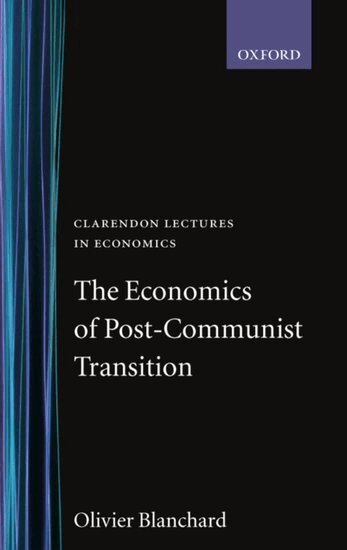
Transition in Central and Eastern Europe has led to a U-shaped response of output: a sharp decline in output followed by recovery. Most of the countries of Central Europe seem now firmly on the upside; most of the countries of Eastern Europe are still close to the bottom of the U: an optimistic view is that they are now negotiating the turn. Olivier Blanchard, a distinguished economist who has worked on transition since its beginning, is one of the first to present a unified analysis of the process of transition. The U-shaped response of output, its causes and its implications, are the subject of this book. The text is split into four chapters. The first reviews the facts; the second focuses on the two basic mechanisms underlying transition: reallocation and restructuring; the third looks more closely at a number of issues, from the interactions between restructuring and privatization to the nature of the labour market in transition; the fourth chapter pulls the material together in an analytical model of transition. This model is then used to discuss policy issues, from the design of privatization to the role of fiscal policy in transition.
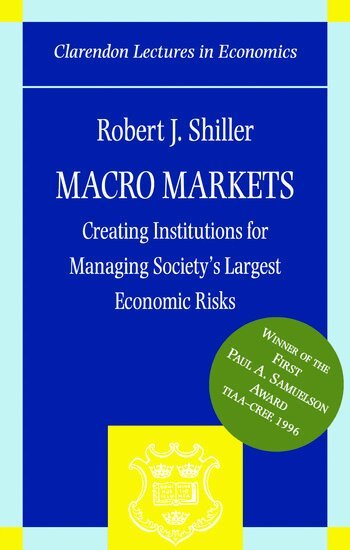
Macro Markets
Creating Institutions for Managing Society's Largest Economic Risks
Häftad, Engelska, 1998
616 kr
Skickas inom 5-8 vardagar
Macro Markets puts forward a unique and authoritative set of detailed proposals for establishing new markets for the management of the biggest economic risks facing society. Our existing financial markets are seen as being inadequate in dealing with such risks and Professor Shiller suggests major new markets as solutions to the problem. Shiller argues that although some risks, such as natural disaster or temporary unemployment, are shared by society, most risks are borne by the individual and standards of living determined by luck. He investigates whether a new technology of markets could make risk-sharing possible, and shows how new contracts could be designed to hedge all manner of risks to the individual's living standards. He proposes new international markets for perpetual claims on national incomes, and on components and aggregates of national incomes, concluding that these markets may well dwarf our stock markets in their activity and significance. He also argues for new liquid international markets for residential and commercial property. Establishing such unprecedented new markets presents some important technical problems which Shiller attempts to solve with proposals for implementing futures markets on perpetual claims on incomes, and for the construction of index numbers for cash settlement of risk management contracts. These new markets could fundamentally alter and diminish international economic fluctuations, and reduce the inequality of incomes around the world.
1 635 kr
Skickas inom 5-8 vardagar
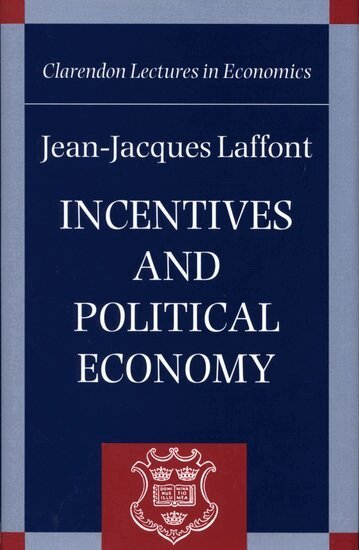
Mainstream economics has recognized only recently the necessity to incorporate political constraints into economic analysis intended for policy advisors. Incentives and Political Economy uses recent advances in contract theory to build a normative approach to constitutional design in economic environments.The first part of the book remains in the tradition of benevolent constitutional design with complete contracting. It treats politicians as informed supervisors and studies how the Constitution should control them, in particular to avoid capture by interest groups. Incentive theories for the separation of powers or systems of checks and balances are developed. The second part of the book recognises the incompleteness of the constitutional contract which leaves discretion to the politicans selected by the electoral process. Asymmetric information associates information rents with economic policies and the political game becomes a game of costly redistribution of those rents. Professor Laffont investigates the trade-offs between an inflexible constitution which leaves little discretion to politicians but sacrifices ex post efficiency and a constitution weighted towards ex post efficiency but also giving considerable discretion to politicians to pursue private agendas. The final part of the book reconsiders the modeling of collusion given asymmetric information. It proposes a new approach to characterizing incentives constraints for group behaviour when asymmetric information is non-verifiable. This provides a methodology to characterise the optimal constitutional response to activities of interest groups and to study the design of any institution in which group behavior is important.
1 146 kr
Skickas inom 5-8 vardagar
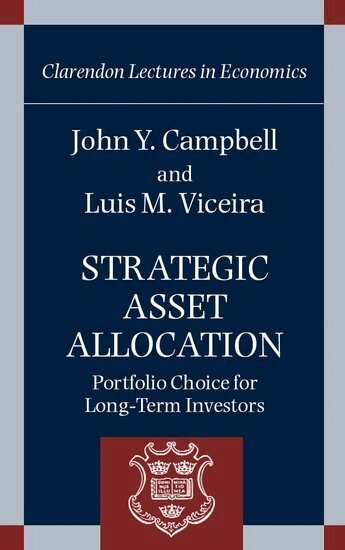
Academic finance has had a remarkable impact on many financial services. Yet long-term investors have received curiously little guidance from academic financial economists.Mean-variance analysis, developed almost fifty years ago, has provided a basic paradigm for portfolio choice. This approach usefully emphasizes the ability of diversification to reduce risk, but it ignores several critically important factors. Most notably, the analysis is static; it assumes that investors care only about risks to wealth one period ahead. However, many investors---both individuals and institutions such as charitable foundations or universities---seek to finance a stream of consumption over a long lifetime. In addition, mean-variance analysis treats financial wealth in isolation from income. Long-term investors typically receive a stream of income and use it, along with financial wealth, to support their consumption.At the theoretical level, it is well understood that the solution to a long-term portfolio choice problem can be very different from the solution to a short-term problem. Long-term investors care about intertemporal shocks to investment opportunities and labor income as well as shocks to wealth itself, and they may use financial assets to hedge their intertemporal risks. This should be important in practice because there is a great deal of empirical evidence that investment opportunities---both interest rates and risk premia on bonds and stocks---vary through time. Yet this insight has had little influence on investment practice because it is hard to solve for optimal portfolios in intertemporal models. This book seeks to develop the intertemporal approach into an empirical paradigm that can compete with the standard mean-variance analysis. The book shows that long-term inflation-indexed bonds are the riskless asset for long-term investors, it explains the conditions under which stocks are safer assets for long-term than for short-term investors, and it shows how labor income influences portfolio choice. These results shed new light on the rules of thumb used by financial planners. The book explains recent advances in both analytical and numerical methods, and shows how they can be used to understand the portfolio choice problems of long-term investors.
310 kr
Skickas inom 7-10 vardagar
It has long been recognized that productivity growth and the business cycle are closely interrelated. Yet, until recently, the two phenomena have been investigated separately in the economics literature. This book provides the first consistent attempt to analyze the effects of macroeconomic volatility on productivity growth, and also the reverse causality from growth to business cycles. The authors show that by looking at the economy through the lens of private entrepreneurs, who invest under credit constraints, one can go some way towards explaining persistent macroeconomic volatility and the effects of volatility on growth. Beginning with an analysis of the effects of volatility on growth, the authors argue that the lower the level of financial development in a country the more detrimental the effect of volatility on growth. This prediction is confirmed by cross-country panel regressions. The data also suggests that a fixed exchange rate regime or more countercyclical budgetary policies are growth-enhancing in countries with a lower level of financial development. The former reduce aggregate volatility whereas the latter reduce the negative effects of volatility on long-term productivity-enhancing investment by firms. The book concludes with an investigation into how the interplay between credit constraints and pecuniary externalities is sufficient to generate persistent business cycles and to explain the occurrence of currency crises.
823 kr
Skickas inom 5-8 vardagar
It has long been recognized that productivity growth and the business cycle are closely interrelated. Yet, until recently, the two phenomena have been investigated separately in the economics literature. This book provides the first consistent attempt to analyze the effects of macroeconomic volatility on productivity growth, and also the reverse causality from growth to business cycles. The authors show that by looking at the economy through the lens of private entrepreneurs, who invest under credit constraints, one can go some way towards explaining persistent macroeconomic volatility and the effects of volatility on growth. Beginning with an analysis of the effects of volatility on growth, the authors argue that the lower the level of financial development in a country the more detrimental the effect of volatility on growth. This prediction is confirmed by cross-country panel regressions. The data also suggests that a fixed exchange rate regime or more countercyclical budgetary policies are growth-enhancing in countries with a lower level of financial development. The former reduce aggregate volatility whereas the latter reduce the negative effects of volatility on long-term productivity-enhancing investment by firms. The book concludes with an investigation into how the interplay between credit constraints and pecuniary externalities is sufficient to generate persistent business cycles and to explain the occurrence of currency crises.
816 kr
Skickas inom 5-8 vardagar
Mainstream economics has only recently recognized the need to incorporate political constraints into economic analysis intended for policy advisors. "Incentives and Political Economy" uses recent advances in contract theory to build a normative approach to constitutional design in economic environments. It is written by one of Europe's leading theorists. The first part of the book remains in the tradition of benevolent constitutional design with complete contracting. It treats politicians as informed supervisors and studies how the Constitution should control them, in particular to avoid capture by interest groups. Incentive theories for the separation of powers or systems of checks and balances are developed. The second part of the book recognizes the incompleteness of the constitutional contract which leaves a lot of discretion to the politicians selected by the electoral process. Asymmetric information associates information rents with economic policies and the political game becomes a game of costly redistribution of those rents. Professor Laffont investigates the trade-offs between an inflexible constitution which leaves little discretion to politicians but sacrifices ex post efficiency and a constitution weighted towards ex post efficiency but also giving considerable discretion to politicians to pursue private agendas. The final part of the book reconsiders the modeling of collusion given asymmetric information. It proposes a new approach to characterizing incentives constraints for group behaviour when asymmetric information is non-verifiable. This provides a methodology to characterize the optimal constitutional response to activities of interest groups and to study the design of any institutions in which group behavior is important.
904 kr
Skickas inom 5-8 vardagar
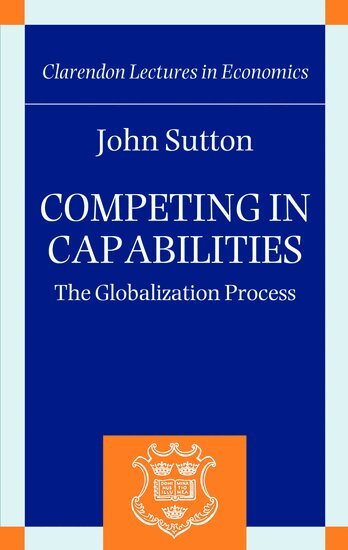
This book offers a new perspective on the economics of globalization, based on the concepts of firms' capabilities as the immediate cause of countries' wealth. It presents new ways of looking at the way China, India, and Africa have been drawn into the global economy over the past two decades. It offers new perspectives on some of the most central questions in the current debate: What effects does the rise of China have for the advanced industrial economies? Why have some industries adapted quickly and effectively to the changing global scene, while others have not? How were the 'Transition Economies' of Eastern Europe affected by trade liberalization? How have the economic prospects of sub-Saharan African countries changed over the past decade? This analysis contributes to the recent literature on quality and trade, which is providing a new and different approach to the analysis of globalization, and which focusses on those economic mechanisms that are central to the current wave of this centuries-old phenomenon.This book forms the basis for the author's course on Globalisation and Strategy, given to Masters students in Economics and Management at the London School of Economics.