Classical Culture and Society - Böcker
Visar alla böcker i serien Classical Culture and Society. Handla med fri frakt och snabb leverans.
12 produkter
12 produkter
1 307 kr
Skickas inom 5-8 vardagar
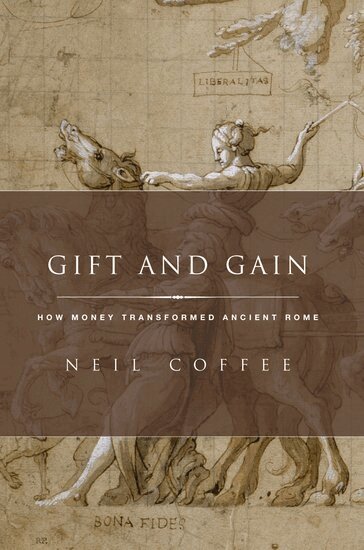
The economy of ancient Rome, with its money, complex credit arrangements, and long-range shipping, was surprisingly modern. Yet Romans also exchanged goods and services within a robust system of gifts and favors, which sustained the supportive relationships necessary for survival in the absence of the extensive state and social institutions. In Gift and Gain: How Money Transformed Ancient Rome, Neil Coffee shows how a vibrant commercial culture progressively displaced systems of gift giving over the course of Rome's classical era. The change was propelled the Roman elite, through their engagement in shipping, moneylending, and other enterprises. Members of the same elite, however, remained habituated to traditional gift relationships, relying on them to exercise influence and build their social worlds. They resisted the transformation, through legislation, political movements, and philosophical argument. The result was a recurring clash across the contexts of Roman social and economic life. The book traces the conflict between gift and gain from Rome's prehistory, down through the conflicts of the late Republic, into the early Empire, showing its effects in areas as diverse as politics, government, legal representation, philosophical thought, public morality, personal and civic patronage, marriage, dining, and the Latin language. These investigations show Rome shifting, unevenly but steadily, away from its pre-historic reliance on relationships of mutual aid, and toward to the more formal, commercial, and contractual relations of modernity.
1 264 kr
Skickas inom 7-10 vardagar
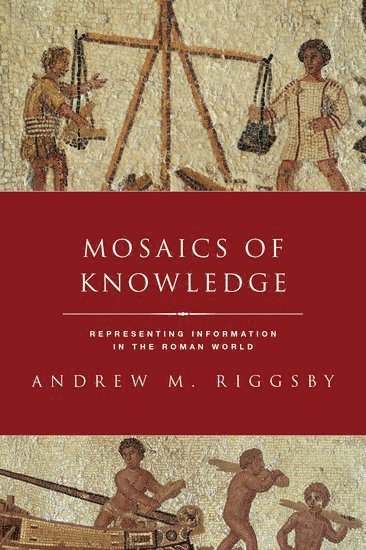
Today's information technology often seems to take on a life of its own, spreading into every part of our lives. In the Roman world things were different. Technologies were limited to small, scattered social groups. By examining five technologies-lists, tables, weights and measures, artistic perspective, and mapping-Mosaics of Knowledge demonstrates how the Romans broke up a world we might have imagined them to unite. That is, the recording, storage, and recall of information in physical media might be expected to bind together persons distant in time and space. More often than not, however, Roman instances serve to create or reinforce the isolation of particular groups. Persons in different "locations"- whether those are geographical, social, or occupational-had access to quite different informational resources, and the overall situation is thus not controlled by the needs of any particular class or group. On the one hand, these constraints on use in turn constrain the development and power of individual technologies. Development is slow, scattered, and far from one-directional. On the other, seeming technological weaknesses can turn out to be illusory if we set them in actual use-contexts. Romans deploy no more but also no less "computing" power than needed for very narrowly defined goals. This study combines detailed readings of a wide variety of evidence (inscriptions, small archeological finds, artworks, literary texts) with theoretical consideration of the social, cognitive, and material contexts for their use to present a unique portrait of Roman IT capabilities, limitations, and habits.
1 227 kr
Skickas inom 3-6 vardagar
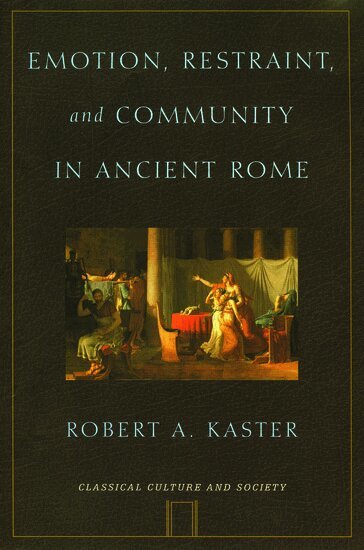
Emotion, Restraint, and Community examines the ways in which emotions, and talk about emotions, interacted with the ethics of the Roman upper classes in the late Republic and early Empire. By considering how various Roman forms of fear, dismay, indignation, and revulsion created an economy of displeasure that shaped society in constructive ways, the book casts new light both on the Romans and on cross-cultural understanding of emotions.
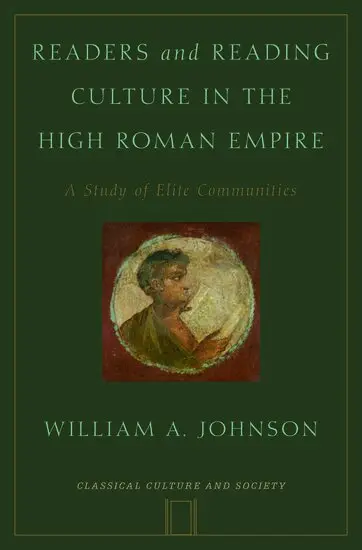
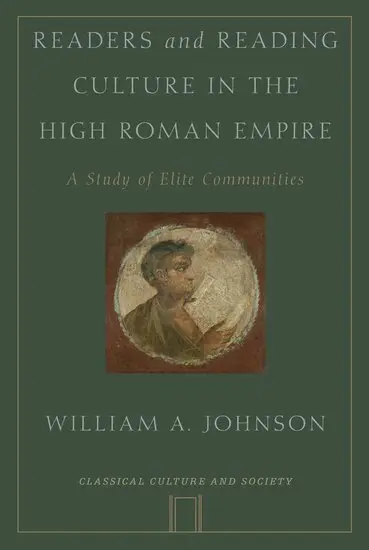
Readers and Reading Culture in the High Roman Empire
A Study of Elite Communities
Inbunden, Engelska, 2010
1 460 kr
Skickas inom 5-8 vardagar
In Readers and Reading Culture in the High Roman Empire, William Johnson examines the system and culture of reading among the elite in second-century Rome. The investigation proceeds in case-study fashion using the principal surviving witnesses, beginning with the communities of Pliny and Tacitus (with a look at Pliny's teacher, Quintilian) from the time of the emperor Trajan. Johnson then moves on to explore elite reading during the era of the Antonines, including the medical community around Galen, the philological community around Gellius and Fronto (with a look at the curious reading habits of Fronto's pupil Marcus Aurelius), and the intellectual communities lampooned by the satirist Lucian. Along the way, evidence from the papyri is deployed to help to understand better and more concretely both the mechanics of reading, and the social interactions that surrounded the ancient book. The result is a rich cultural history of individual reading communities that differentiate themselves in interesting ways even while in aggregate showing a coherent reading culture with fascinating similarities and contrasts to the reading culture of today.
1 290 kr
Skickas inom 3-6 vardagar
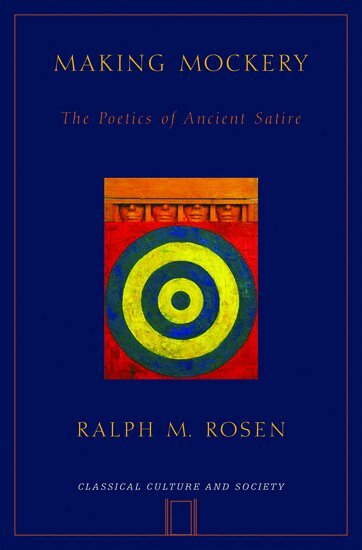
Making Mockery explores the dynamics of comic mockery and satire in Greek and Roman poetry, and argues that poets working with such material composed in accordance with shared generic principles and literary protocols. It encourages a synoptic, synchronic view of such poetry, from archaic iambus through Roman satire, and argues that if we can appreciate the abstract poetics of mockery that governs individual poets in such genres, we can we better understand how such poetry functioned in its own historical moment. Rosen examines in particular the various strategies deployed by ancient satirical poets to enlist the sympathies of a putative audience, convince them of the justice of their indignation and the legitimacy of their personal attacks. The mocking satirist at the height of his power remains elusive and paradoxical-a figure of self-constructed abjection, yet arrogant and sarcastic at the same time; a figure whose speech can be self-righteous one moment, but scandalous the next; who will insist on the "reality" of his poetry, but make it clear that this reality is always mediated by an inescapable movement towards fictionality. While scholars have often, in principle, acknowledged the force of irony, persona-construction and other such devices by which satirists destabilize their claims, very often in practice-especially when considering individual satirists in isolation from others-they too succumb to the satirist's invitation to take what he says at face value. Despite the sophisticated critical tools they may bring to bear on satirical texts, therefore, classicists still tend to treat such poets ultimately as monochromatically indignant, vindictive individuals on a genuine self-righteous mission. This study, however, argues that that a far subtler analysis of the aggressive, poeticized subject in Classical antiquity-its target, and its audience-is called for.
507 kr
Skickas inom 5-8 vardagar
Emotion, Restraint, and Community examines the ways in which emotions, and talk about emotions, interacted with the ethics of the Roman upper classes in the late Republic and early Empire. By considering how various Roman forms of fear, dismay, indignation, and revulsion created an economy of displeasure that shaped society in constructive ways, the book casts new light both on the Romans and on cross-cultural understanding of emotions.
569 kr
Skickas inom 5-8 vardagar
Making Mockery explores the dynamics of comic mockery and satire in Greek and Roman poetry, and argues that poets working with such material composed in accordance with shared generic principles and literary protocols. It encourages a synoptic, synchronic view of such poetry, from archaic iambus through Roman satire, and argues that if we can appreciate the abstract poetics of mockery that governs individual poets in such genres, we can we better understand how such poetry functioned in its own historical moment. Rosen examines in particular the various strategies deployed by ancient satirical poets to enlist the sympathies of a putative audience, convince them of the justice of their indignation and the legitimacy of their personal attacks. The mocking satirist at the height of his power remains elusive and paradoxical--a figure of self-constructed abjection, yet arrogant and sarcastic at the same time; a figure whose speech can be self-righteous one moment, but scandalous the next; who will insist on the "reality" of his poetry, but make it clear that this reality is always mediated by an inescapable movement towards fictionality. While scholars have often, in principle, acknowledged the force of irony, persona-construction and other such devices by which satirists destabilize their claims, very often in practice--especially when considering individual satirists in isolation from others--they too succumb to the satirist's invitation to take what he says at face value. Despite the sophisticated critical tools they may bring to bear on satirical texts, therefore, classicists still tend to treat such poets ultimately as monochromatically indignant, vindictive individuals on a genuine self-righteous mission. This study, however, argues that that a far subtler analysis of the aggressive, poeticized subject in Classical antiquity--its target, and its audience--is called for.
1 375 kr
Skickas inom 5-8 vardagar
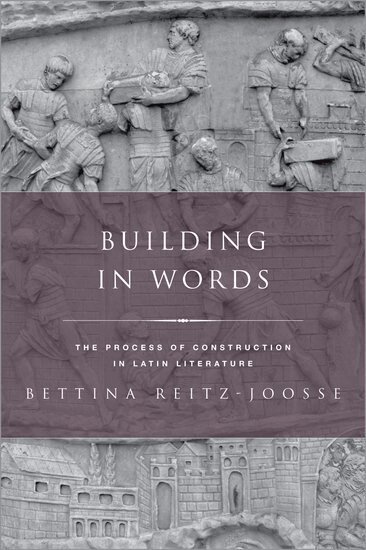
Building in Words explores the relationship between text and architecture in the Roman world from the perspective of architectural process. Ancient Romans frequently encountered buildings under construction - they experienced noisy building work, disruptive transportation of materials, and sometimes spectacular engineering feats. Bettina Reitz-Joosse analyzes how Roman authors responded to the process of building and construction in their literary works. Roman authors tell stories of architectural creation to give meaning to finished monuments. Their narratives can stress technological or logistic mastery or highlight morally problematic aspects of construction, particularly in large-scale engineering projects. While offering descriptions of the process of creating architecture, Roman writers also reflect on the creation of their own works. Building in Words demonstrates the richness of the image of construction for literary composition: writers use it to comment on the aesthetics or ambition of their literary work, to articulate the power and durability, but also the fragility of literature.Reitz-Joosse here offers original readings of a range of literary authors of the early Roman empire, including Vergil, Pliny the Elder, Tacitus, and Statius, and places literary texts in dialogue with contemporary epigraphic and archaeological material. Through its focus on building as a process, Building in Words furthers our understanding of the aesthetics of both architecture and literature in ancient Rome.
1 540 kr
Skickas inom 5-8 vardagar
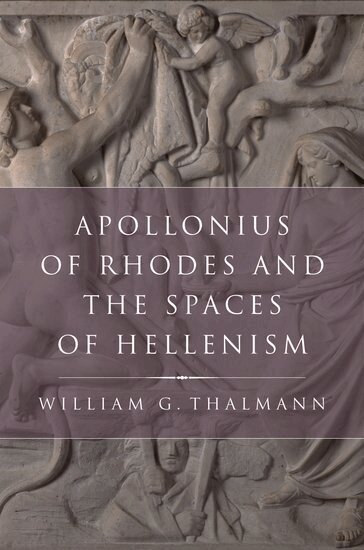
Although Apollonius of Rhodes' extraordinary epic poem on the Argonauts' quest for the Golden Fleece has begun to get the attention it deserves, it still is not well known to many readers and scholars. This book explores the poem's relation to the conditions of its writing in third century BCE Alexandria, where a multicultural environment transformed the Greeks' understanding of themselves and the world. Apollonius uses the resources of the imagination - the myth of the Argonauts' voyage and their encounters with other peoples - to probe the expanded possibilities and the anxieties opened up when definitions of Hellenism and boundaries between Greeks and others were exposed to question. Central to this concern with definitions is the poem's representation of space. Thalmann uses spatial theories from cultural geography and anthropology to argue that the Argo's itinerary defines space from a Greek perspective that is at the same time qualified. Its limits are exposed, and the signs with which the Argonauts mark space by their passage preserve the stories of their complex interactions with non-Greeks. The book closely considers many episodes in the narrative with regard to the Argonauts' redefinition of space and the implications of their actions for the Greeks' situation in Egypt, and it ends by considering Alexandria itself as a space that accommodated both Greek and Egyptian cultures.
1 480 kr
Skickas inom 5-8 vardagar
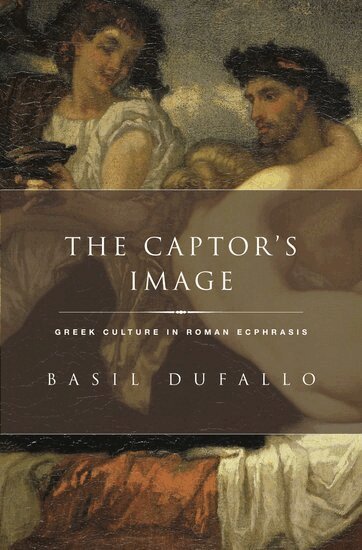
An influential view of ecphrasis--the literary description of art objects--chiefly treats it as a way for authors to write about their own texts without appearing to do so, and even insist upon the aesthetic dominance of the literary text over the visual image. However, when considering its use in ancient Roman literature, this interpretation proves insufficient. The Captor's Image argues for the need to see Roman ecphrasis, with its prevalent focus on Hellenic images, as a site of subtle, ongoing competition between Greek and Roman cultures. Through close readings of ecphrases in a wide range of Latin authors--from Plautus, Catullus, and Horace to Vergil, Martial, and Ovid, among others--Dufallo contends that Roman ecphrasis reveals an uncertain receptivity to Greek culture that includes implications for the shifting notions of Roman identity in the Republican and Imperial periods. Individual chapters explore how the simple assumption of a self-asserting ecphrastic text is called into question by comic performance, intentionally inconsistent narrative, satire, Greek religious iconography, the contradictory associations of epic imagery, and the author's subjection to a patron. Visual material such as wall painting, statuary, and drinkware vividly contextualizes the discussion. As the first book-length treatment of artistic ecphrasis at Rome, The Captor's Image resituates a major literary trope within its hybrid cultural context while advancing the idea of ecphrasis as a cultural practice through which the Romans sought to redefine their identity with, and against, Greekness.
1 239 kr
Skickas inom 5-8 vardagar
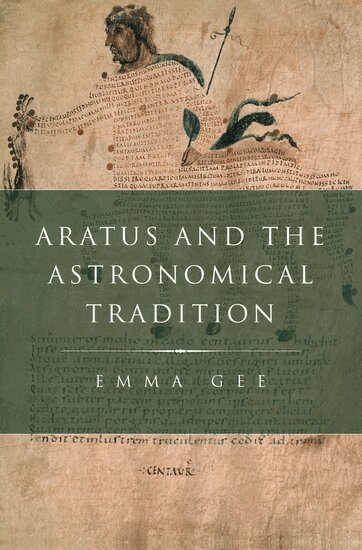
Why were the stars so important in Rome? Their literary presence far outweighs their role as a time-reckoning device, which was in any case superseded by the synchronization of the civil and solar years under Julius Caesar. One answer is their usefulness in symbolizing a universe built on "intelligent design." Predominantly in ancient literature, the stars are seen as the gods' graffiti in the ordered heaven. Moreover, particularly in the Roman world, divine and human governance came to be linked, with one striking manifestation of this connection being the predicted enjoyment of a celestial afterlife by emperors. Aratus' Phaenomena, which describes the layout of the heavens and their effect, through weather, on the lives of men, was an ideal text for expressing such relationships: its didactic style was both accessible and elegant, and it combined the stars with notions of divine and human order. In especially the late Republic extending until the age of Christian humanism, the impact of this poem on the literary environment is out of all proportion to its relatively modest size and the obscurity of its subject matter. It was translated into Latin many times between the first century BC and the Renaissance, and carried lasting influence outside its immediate genre. Aratus and the Astronomical Tradition answers the question of Aratus' popularity by looking at the poem in the light of Western cosmology. It argues that the Phaenomena is the ideal vehicle for the integration of astronomical 'data' into abstract cosmology, a defining feature of the Western tradition. This book embeds Aratus' text into a close network of textual interactions, beginning with the text itself and ending in the sixteenth century, with Copernicus. All conversations between the text and its successors experiment in some way with the balance between cosmology and information. The text was not an inert objet d'art, but a dynamic entity which took on colors often contradictory in the ongoing debate about the place and role of the stars in the world. In this debate Aratus plays a leading, but by no means lonely, role. With this study, students and scholars will have the capability to understand this mysterious poem's place in the unique development of Western cosmology.
Readers and Reading Culture in the High Roman Empire
A Study of Elite Communities
Häftad, Engelska, 2012
596 kr
Skickas inom 5-8 vardagar
In Readers and Reading Culture in the High Roman Empire, William Johnson examines the system and culture of reading among the elite in second-century Rome. The investigation proceeds in case-study fashion using the principal surviving witnesses, beginning with the communities of Pliny and Tacitus (with a look at Pliny's teacher, Quintilian) from the time of the emperor Trajan. Johnson then moves on to explore elite reading during the era of the Antonines, including the medical community around Galen, the philological community around Gellius and Fronto (with a look at the curious reading habits of Fronto's pupil Marcus Aurelius), and the intellectual communities lampooned by the satirist Lucian. Along the way, evidence from the papyri is deployed to help to understand better and more concretely both the mechanics of reading, and the social interactions that surrounded the ancient book. The result is a rich cultural history of individual reading communities that differentiate themselves in interesting ways even while in aggregate showing a coherent reading culture with fascinating similarities and contrasts to the reading culture of today.