Collected Works of Jacques Maritain - Böcker
Visar alla böcker i serien Collected Works of Jacques Maritain. Handla med fri frakt och snabb leverans.
7 produkter
7 produkter
1 611 kr
Skickas inom 10-15 vardagar
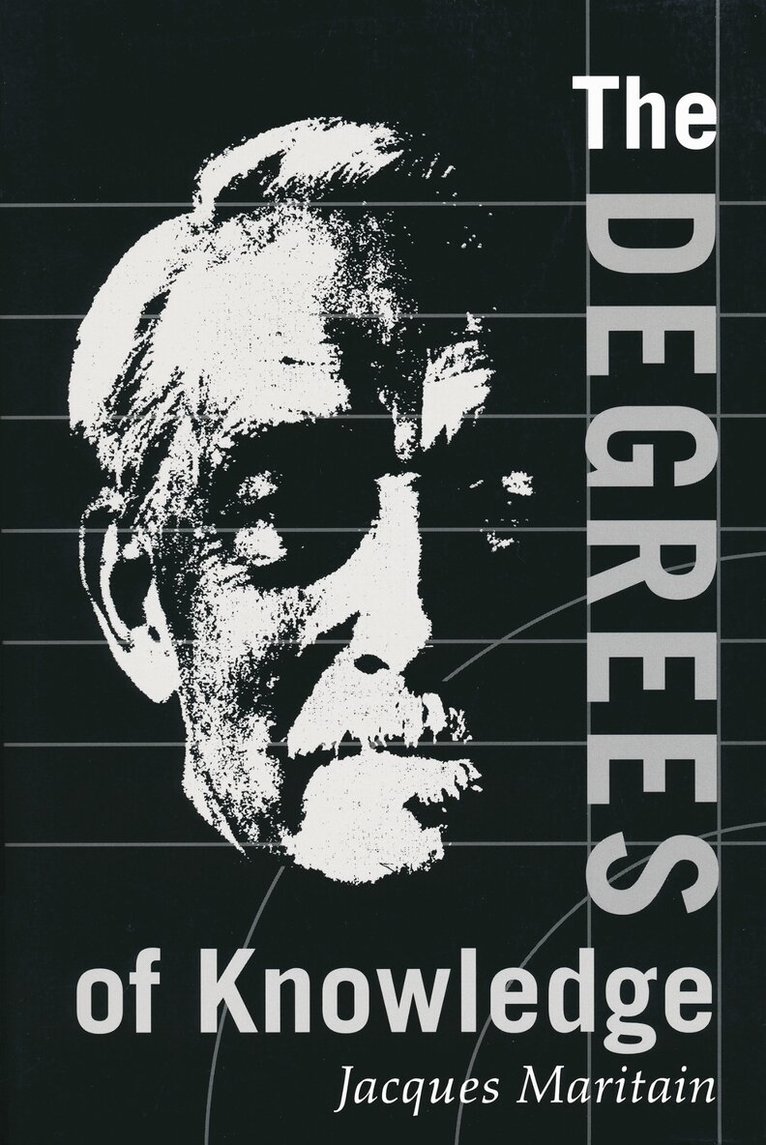
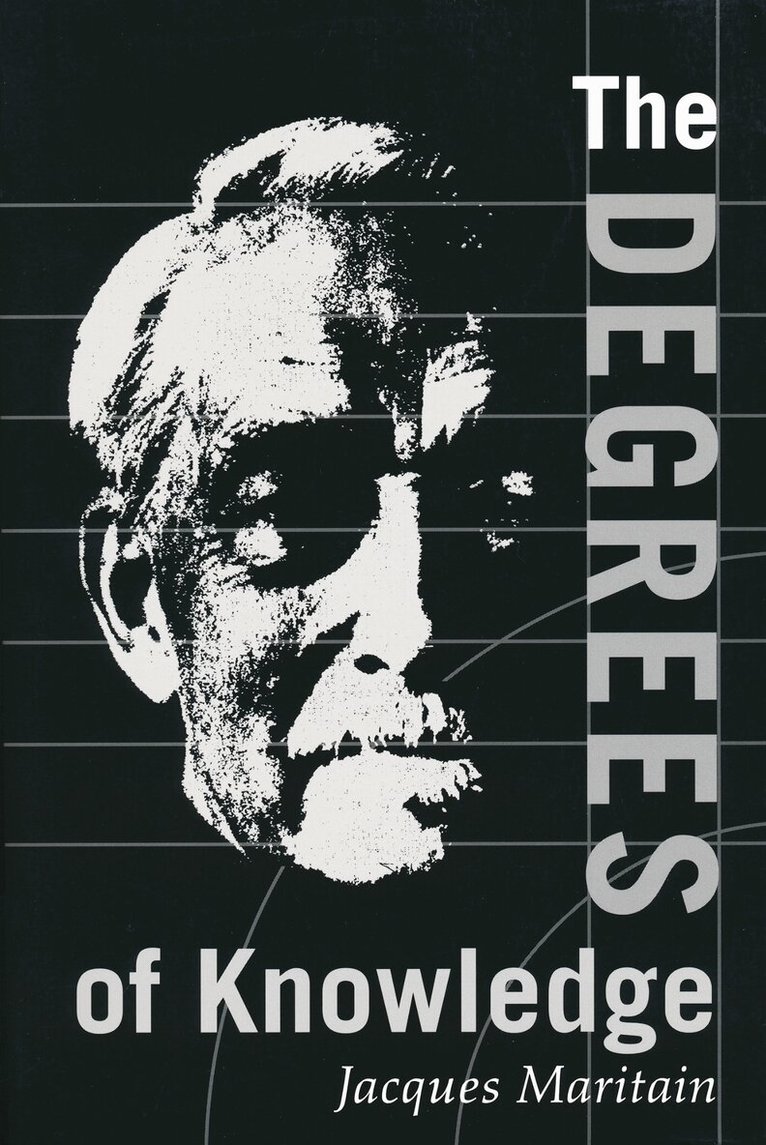
Maritain argues that there are different 'kinds' and 'orders' of knowledge and, within them, different 'degrees' determined by the nature of the thing to be known and the 'degree of abstraction' involved. The book is divided into two parts: Part one discusses the degrees of knowledge for science and philosophy – or 'rational knowledge,' and part two discusses the degrees of knowledge for religious faith and mysticism – or 'super-rational knowledge.'
422 kr
Skickas inom 10-15 vardagar
Maritain argues that there are different 'kinds' and 'orders' of knowledge and, within them, different 'degrees' determined by the nature of the thing to be known and the 'degree of abstraction' involved. The book is divided into two parts: Part one discusses the degrees of knowledge for science and philosophy – or 'rational knowledge,' and part two discusses the degrees of knowledge for religious faith and mysticism – or 'super-rational knowledge.'
Integral Humanism, Freedom in the Modern World, and a Letter on Independence, Revised Edition
Inbunden, Engelska, 1996
1 344 kr
Skickas inom 10-15 vardagar
The three books presented in this volume, Integral Humanism, Freedom in the Modern World, and A Letter on Independence, were all written in the early 1930s, a time of dire trouble for France. France was then surrounded by enemies preparing for war and was itself so violently split between parties of Left and Right that it seemed on the verge of civil war. In this collection, Jacques Maritain accepts the responsibility of a Christian philosopher to actively address the agonizing practical problems of the time.Maritain discusses major political issues such as the relation of freedom and religion, the opposition of democracy to any form of totalitarianism, the relation of the spiritual and the temporal, the need for an integral and Christian humanism, and the prospects for a new Christian civilization, all in opposition to the materialism of both communism and capitalism.Against the fierce antagonism of the parties of the political Left and Right, Maritain declares a plague on both their houses and strongly affirms the need for independence from both of them. He does so by distinguishing between two senses of the terms Left and Right, one denoting a temperamental or physiological disposition, the other a definite political position. In the latter sense, Maritain asserts that he is an independent, while acknowledging that he is, by temperament, a man of the Left.
Bergsonian Philosophy and Thomism
Collected Works of Jacques Maritain, Volume 1
Inbunden, Engelska, 2007
488 kr
Skickas inom 10-15 vardagar
Published in 1913 as La Philosophie Bergsonienne, this incisive critique of the thought of Henri Bergson was Jacques Maritain's (1882–1973) first book. In it he shows himself already to have an authoritative grasp of the thought of St. Thomas Aquinas and an uncanny ability to demonstrate its relevance to alternative philosophical systems such as that of Henri Bergson. Volume 1 in the series The Collected Works of Jacques Maritain, this edition faithfully reproduces the 1955 translation published by the Philosophical Library. It would be difficult to overestimate Bergson's role in extricating French philosophy from the deadening materialism that dominated the Sorbonne. It was that cultural milieu that brought Maritain and his wife Raïssa to the brink of suicide. They drew back for two major reasons. First were the lectures of Henri Bergson at the Collège de France, in which the Maritains found a defense of metaphysics, of the transcendent beyond the material, within which they could find meaning in life. The second reason was their conversion to Catholicism, a move they and many of their contemporaries made after being introduced to Bergson's work. Soon after his conversion, Jacques Maritain immersed himself in the thought of Thomas Aquinas and was struck by the comparative weaknesses of Bergson. This book is Maritain's relentless criticism of the philosophy of the man whose lectures had meant so much to him. Its ferocity marks it as a young man's book, written in part to exorcize the defects of Bergson's philosophy as they were understood by one now schooled in Thomism. Twenty-five years later, Maritain, while not retracting his criticisms, regretted their intemperance and, as a result, moderated his assessment of Bergson in a long preface to the second edition. In it, we find a philosopher who mastered his craft and a critic of rare perception and refinement.
1 344 kr
Skickas inom 10-15 vardagar
With this volume of the Collected Works of Jacques Maritain, the University of Notre Dame Press published the first English edition of a remarkable group of essays that Maritain had prepared for publication in the year before his death. He brought together various writings that had not appeared in print or had circulated privately. The heart of the book is to be found in two groups of articles.The first consists of philosophical essays. Several deal with truth, with philosophy at the time of Vatican II, and with the divine aseity; two are on philosophy of nature, dealing with evolution and with animal instinct; and three are on moral philosophy.A second group consists of primarily theological essays. Four are contributions to what Maritain calls an existential epistemology. They are followed by a moving meditation on the Mass and essays on the Church triumphant, resurrection, and the priesthood.When he lay dying at Fossanova, Thomas Aquinas, in deference to the wishes of the Cistercians, with whom he had found refuge, wrote a commentary on the Song of Songs. How better could a lifelong Thomist round off his lifetime of writing than with his own essay on the Song of Songs? This is what Maritian does in the serenely profound meditation that closes the volume.
Integral Humanism, Freedom in the Modern World, and a Letter on Independence, Revised Edition
Häftad, Engelska, 1996
359 kr
Skickas
The three books presented in this volume, Integral Humanism, Freedom in the Modern World, and A Letter on Independence, were all written in the early 1930s, a time of dire trouble for France. France was then surrounded by enemies preparing for war and was itself so violently split between parties of Left and Right that it seemed on the verge of civil war. In this collection, Jacques Maritain accepts the responsibility of a Christian philosopher to actively address the agonizing practical problems of the time.Maritain discusses major political issues such as the relation of freedom and religion, the opposition of democracy to any form of totalitarianism, the relation of the spiritual and the temporal, the need for an integral and Christian humanism, and the prospects for a new Christian civilization, all in opposition to the materialism of both communism and capitalism.Against the fierce antagonism of the parties of the political Left and Right, Maritain declares a plague on both their houses and strongly affirms the need for independence from both of them. He does so by distinguishing between two senses of the terms Left and Right, one denoting a temperamental or physiological disposition, the other a definite political position. In the latter sense, Maritain asserts that he is an independent, while acknowledging that he is, by temperament, a man of the Left.
515 kr
Skickas inom 10-15 vardagar
With this volume of the Collected Works of Jacques Maritain, the University of Notre Dame Press published the first English edition of a remarkable group of essays that Maritain had prepared for publication in the year before his death. He brought together various writings that had not appeared in print or had circulated privately. The heart of the book is to be found in two groups of articles.The first consists of philosophical essays. Several deal with truth, with philosophy at the time of Vatican II, and with the divine aseity; two are on philosophy of nature, dealing with evolution and with animal instinct; and three are on moral philosophy.A second group consists of primarily theological essays. Four are contributions to what Maritain calls an existential epistemology. They are followed by a moving meditation on the Mass and essays on the Church triumphant, resurrection, and the priesthood.When he lay dying at Fossanova, Thomas Aquinas, in deference to the wishes of the Cistercians, with whom he had found refuge, wrote a commentary on the Song of Songs. How better could a lifelong Thomist round off his lifetime of writing than with his own essay on the Song of Songs? This is what Maritian does in the serenely profound meditation that closes the volume.