Context & Content - Böcker
Visar alla böcker i serien Context & Content. Handla med fri frakt och snabb leverans.
16 produkter
16 produkter
332 kr
Skickas inom 5-8 vardagar
John Perry offers a rethinking of Gottlob Frege's seminal contributions to philosophy of language. Frege's innovations provided the basis of modern logic, but his influence in other areas should not be understated. For instance, the view that he developed in "On Sense and Reference", the most studied essay in the philosophy of language, dominated twentieth-century work in the field and continues to be very influential. Perry explains and charts the development of Frege's views in this area, and argues that his doctrine of indirect reference directed philosophy of language on a long detour from which only now can we emerge. Perry advocates a move away from indirect reference and presents an alternative framework which does not require the abandoning of circumstances in the references of sentences.
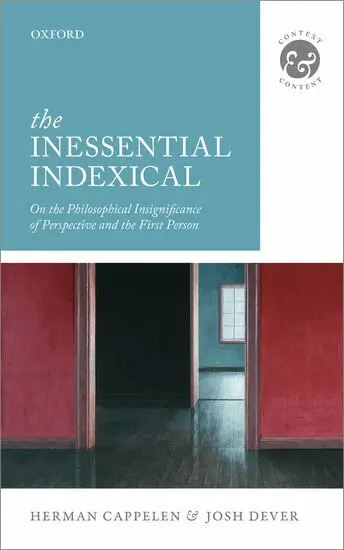
The Inessential Indexical
On the Philosophical Insignificance of Perspective and the First Person
Häftad, Engelska, 2015
434 kr
Skickas inom 7-10 vardagar
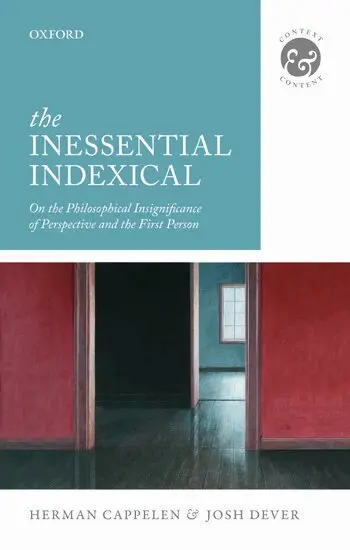
When we represent the world in language, in thought, or in perception, we often represent it from a perspective. We say and think that the meeting is happening now, that it is hot here, that I am in danger and not you; that the tree looks larger from my perspective than from yours. The Inessential Indexical is an exploration and defense of the view that perspectivality is a philosophically shallow aspect of the world. Cappelen and Dever oppose one of the most entrenched and dominant trends in contemporary philosophy: that perspective (and the perspective of the first person in particular) is philosophically deep and that a proper understanding of it is important not just in the philosophies of language and mind, but throughout philosophy. They argue that there are no such things as essential indexicality, irreducibly de se attitudes, or self-locating attitudes. Their goal is not to show that we need to rethink these phenomena, to explain them in different ways. Their goal is to show that the entire topic is an illusion--there's nothing there. The Context and Content series is a forum for outstanding original research at the intersection of philosophy, linguistics, and cognitive science. The general editor is François Recanati (Institut Jean-Nicod, Paris).
1 213 kr
Skickas inom 7-10 vardagar
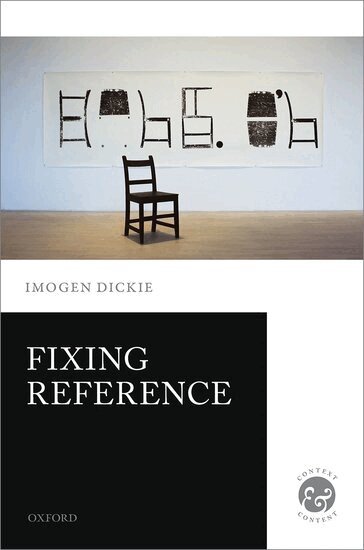
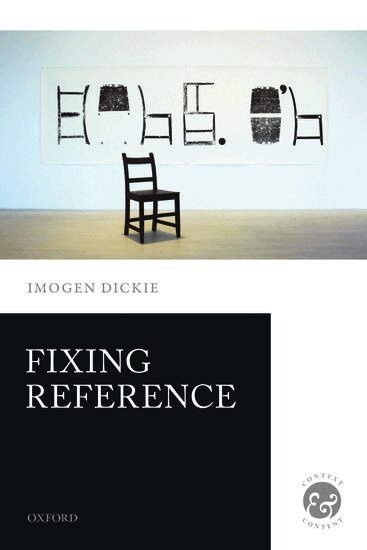
Imogen Dickie develops an account of aboutness-fixing for thoughts about ordinary objects, and of reference-fixing for the singular terms we use to express them. Extant discussions of this topic tread a weary path through descriptivist proposals, causalist alternatives, and attempts to combine the most attractive elements of each. The account developed here is a new beginning. It starts with two basic principles. The first connects aboutness and truth: a belief is about the object upon whose properties its truth or falsity depends. The second connects truth and justification: justification is truth conducive; in general and allowing exceptions, a subject whose beliefs are justified will be unlucky if they are not true, and not merely lucky if they are. These principles--one connecting aboutness and truth; the other truth and justification--combine to yield a third principle connecting aboutness and justification: a body of beliefs is about the object upon which its associated means of justification converges; the object whose properties a subject justifying beliefs in this way will be unlucky to get wrong and not merely luck to get right. The first part of the book proves a precise version of this principle. Its remaining chapters use the principle to explain how the relations to objects that enable us to think about them--perceptual attention; understanding of proper names; grasp of descriptions--do their aboutness-fixing and thought-enabling work. The book includes discussions of the nature of singular thought and the relation between thought and consciousness.
529 kr
Skickas inom 7-10 vardagar
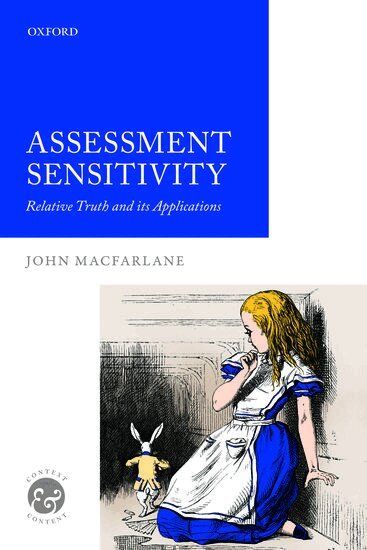
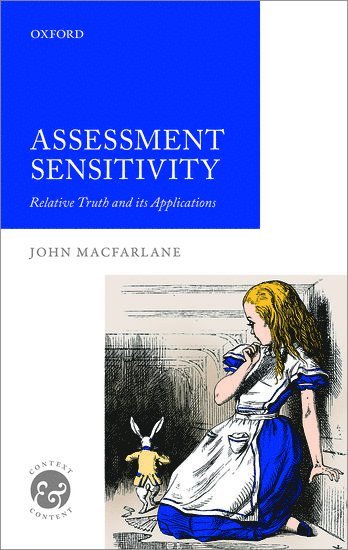
John MacFarlane debates how we might make sense of the idea that truth is relative, and how we might use this idea to give satisfying accounts of parts of our thought and talk that have resisted traditional methods of analysis. Although there is a substantial philosophical literature on relativism about truth, going back to Plato's Theaetetus, this literature (both pro and con) has tended to focus on refutations of the doctrine, or refutations of these refutations, at the expense of saying clearly what the doctrine is. In contrast, Assessment Sensitivity begins with a clear account of what it is to be a relativist about truth, and uses this view to give satisfying accounts of what we mean when we talk about what is tasty, what we know, what will happen, what might be the case, and what we ought to do. The book seeks to provide a richer framework for the description of linguistic practices than standard truth-conditional semantics affords: one that allows not just standard contextual sensitivity (sensitivity to features of the context in which an expression is used), but assessment sensitivity (sensitivity to features of the context from which a use of an expression is assessed).The Context and Content series is a forum for outstanding original research at the intersection of philosophy, linguistics, and cognitive science. The general editor is François Recanati (Institut Jean-Nicod, Paris).
583 kr
Skickas
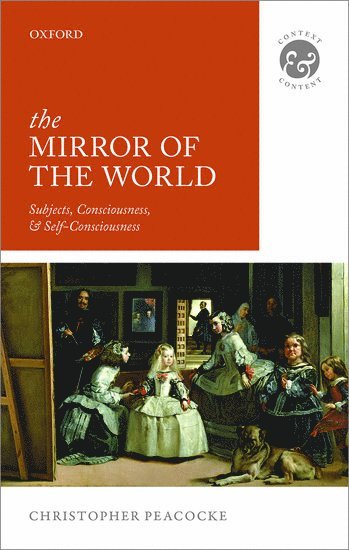
Christopher Peacocke presents a philosophical theory of subjects of consciousness, together with a theory of the nature of first person representation of such a subject of consciousness. He develops a new treatment of subjects, distinct from previous theories, under which subjects were regarded either as constructs from mental events, or fundamentally embodied, or Cartesian egos. In contrast, his theory of the first person integrates with the positive treatment of subjects—and it contributes to the explanation of various distinctive first person phenomena in the theory of thought and knowledge. These are issues on which contributions have been made by some of the greatest philosophers, and Peacocke brings his points to bear on the contributions to these issues made by Hume, Kant, Frege, Wittgenstein, and Strawson. He also relates his position to the recent literature in the philosophy of mind, and then goes on to distinguish and characterize three varieties of self-consciousness. Perspectival self-consciousness involves the subject's capacity to appreciate that she is of the same kind as things given in a third personal way, and attributes the subject to a certain kind of objective thought about herself. Reflective self-consciousness involves awareness of the subject's own mental states, reached in a distinctive way. Interpersonal self-consciousness is awareness that one features, as a subject, in some other person's mental states. These varieties, and the relations and the forms of co-operation between them, are important in explaining features of our knowledge, our social relations, and our emotional lives. The theses of The Mirror of the World are of importance not only for philosophy, but also for psychology, the arts, and anywhere else that the self and self-representation loom large. The Context and Content series is a forum for outstanding original research at the intersection of philosophy, linguistics, and cognitive science. The general editor is François Recanati (Institut Jean-Nicod, Paris).
427 kr
Skickas inom 7-10 vardagar
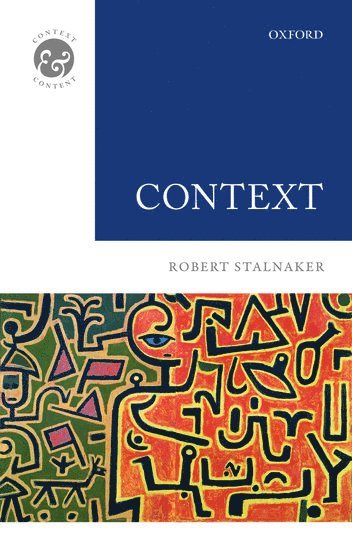
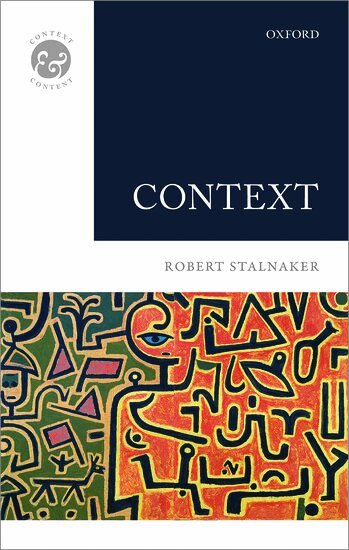
Robert Stalnaker explores the notion of the context in which speech takes place, its role in the interpretation of what is said, and in the explanation of the dynamics of discourse. He distinguishes different notions of context, but the main focus is on the notion of context as common ground, where the common ground is an evolving body of background information that is presumed to be shared by the participants in a conversation. The common ground is the information that is presupposed by speakers and addressees, and a central concern of this book is with the notion of presupposition, and with the interaction of compositional structure with discourse dynamics in the explanation of presuppositional phenomena. Presupposed information includes background information both about the subject matter of a discourse and about the evolving discourse itself, and about the attitudes of the participants in the discourse, including who and where they are, and what they agree and disagree about. Stalnaker provides a way of representing self-locating information that helps to explain how it can be shared and communicated, and how it evolves over time. He discusses the semantic and pragmatics of conditionals and epistemic modals, and their role in representing agreement, disagreement, and the negotiation about how a context should evolve. The book concludes with a discussion of the relations between contextualism and semantic relativism. The Context and Content series is a forum for outstanding original research at the intersection of philosophy, linguistics, and cognitive science. The general editor is François Recanati (Institut Jean-Nicod, Paris).
434 kr
Skickas inom 7-10 vardagar
Imogen Dickie develops an account of aboutness-fixing for thoughts about ordinary objects, and of reference-fixing for the singular terms we use to express them. Extant discussions of this topic tread a weary path through descriptivist proposals, causalist alternatives, and attempts to combine the most attractive elements of each. The account developed here is a new beginning. It starts with two basic principles. The first connects aboutness and truth: a belief is about the object upon whose properties its truth or falsity depends. The second connects truth and justification: justification is truth conducive; in general and allowing exceptions, a subject whose beliefs are justified will be unlucky if they are not true, and not merely lucky if they are. These principles--one connecting aboutness and truth; the other truth and justification--combine to yield a third principle connecting aboutness and justification: a body of beliefs is about the object upon which its associated means of justification converges; the object whose properties a subject justifying beliefs in this way will be unlucky to get wrong and not merely luck to get right. The first part of the book proves a precise version of this principle. Its remaining chapters use the principle to explain how the relations to objects that enable us to think about them--perceptual attention; understanding of proper names; grasp of descriptions--do their aboutness-fixing and thought-enabling work. The book includes discussions of the nature of singular thought and the relation between thought and consciousness.
1 043 kr
Skickas inom 5-8 vardagar
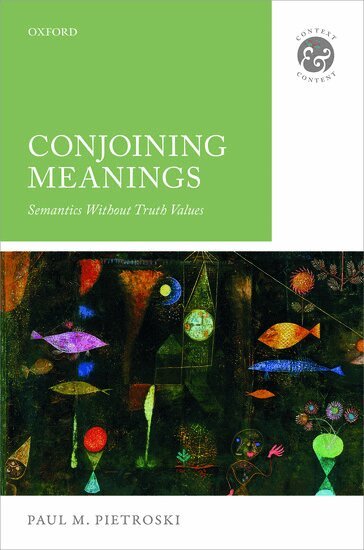
Humans naturally acquire languages that connect meanings with pronunciations. Paul M. Pietroski presents an account of these distinctive languages as generative procedures that respect substantive constraints. Children acquire meaningful lexical items that can be combined, in certain ways, to form meaningful complex expressions. This raises questions about what meanings are, how they can be combined, and what kinds of meanings lexical items can have. According to Pietroski, meanings are neither concepts nor extensions, and sentences do not have truth conditions. He argues that meanings are composable instructions for how to access and assemble concepts of a special sort. More specifically, phrasal meanings are instructions for how to build monadic concepts (a.k.a. mental predicates) that are massively conjunctive, while lexical meanings are instructions for how to fetch concepts that are monadic or dyadic. This allows for polysemy, since a lexical item can be linked to an address that is shared by a family of fetchable concepts. But the posited combinatorial operations are limited and limiting. They impose severe restrictions on which concepts can be fetched for purposes of semantic composition. Correspondingly, Pietroski argues that in lexicalization, available representations are often used to introduce concepts that can be combined via the relevant operations.
1 108 kr
Skickas inom 3-6 vardagar
John Perry offers a rethinking of Gottlob Frege's seminal contributions to philosophy of language. Frege's innovations provided the basis of modern logic, but his influence in other areas should not be understated. For instance, the view that he developed in "On Sense and Reference", the most studied essay in the philosophy of language, dominated twentieth-century work in the field and continues to be very influential. Perry explains and charts the development of Frege's views in this area, and argues that his doctrine of indirect reference directed philosophy of language on a long detour from which only now can we emerge. Perry advocates a move away from indirect reference and presents an alternative framework which does not require the abandoning of circumstances in the references of sentences.
393 kr
Skickas inom 5-8 vardagar
Peter Hanks defends a new theory about the nature of propositional content. According to this theory, the basic bearers of representational properties are particular mental or spoken actions. Propositions are types of these actions, which we use to classify and individuate our attitudes and speech acts. Hanks abandons several key features of the traditional Fregean conception of propositional content, including the idea that propositions are the primary bearers of truth-conditions, the distinction between content and force, and the concept of entertainment. The main difficulty for this traditional conception is the problem of the unity of the proposition, the problem of explaining how propositions have truth conditions and other representational properties. The new theory developed here, in its place,explains the unity of propositions and provides new solutions to a long list of puzzles and problems in philosophy of language.
549 kr
Skickas inom 5-8 vardagar
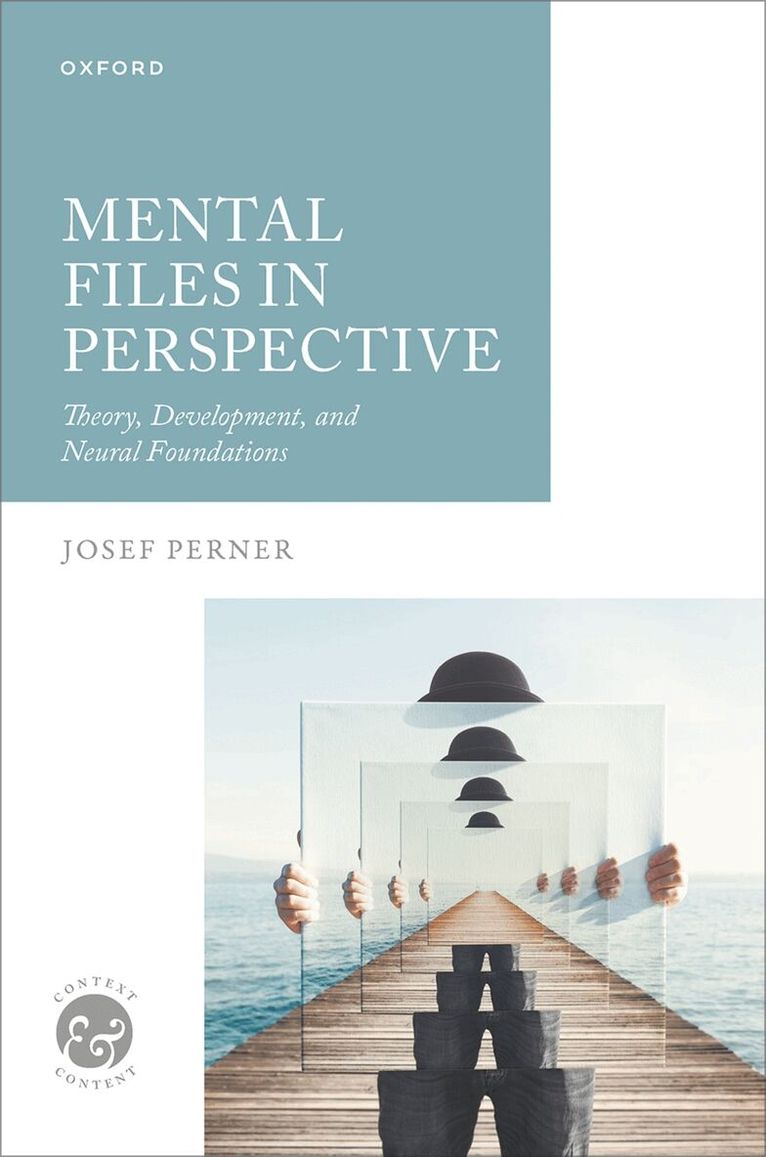
Intellectual development is primarily considered a domain specific enterprise. Children develop naïve physics, a folk psychology (theory of mind), a naïve biology, etc. But understanding perspective is a general, overarching phenomenon that cuts across such domains in development and in the brain. This has important theoretical consequences. For instance, our folk psychology cannot consist of a uniform "theory of mind" for explaining behaviour. Parts of the theory that are sensitive to perspective differences have to be separated from those that are not. A central concern is how perspective is represented in the mind. The answer comes from mental files theory. A mental file represents or refers to an object. It presents the object under a particular mode of presentation-perspective. Coreferential files refer to the same object and present the object under different perspectives. Files, thus, give us a concrete way to capture perspectives with the tools for basic object cognition. This book introduces mental files theory in relation to object files and discourse referents and then applies it to the development of perspective taking in early childhood and to brain imaging. The theory goes well beyond perspective; it is the theoretical tool for representing persisting objects, tracking them over time, and storing knowledge about them. From a leading figure in developmental psychology, this book addresses a topic much neglected in the cognitive sciences. The Context and Content series is a forum for outstanding original research at the intersection of philosophy, linguistics, and cognitive science. The general editor is François Recanati (Institut Jean-Nicod, Paris).
1 164 kr
Skickas inom 3-6 vardagar
Robert Stalnaker explores the notion of the context in which speech takes place, its role in the interpretation of what is said, and in the explanation of the dynamics of discourse. He distinguishes different notions of context, but the main focus is on the notion of context as common ground, where the common ground is an evolving body of background information that is presumed to be shared by the participants in a conversation. The common ground is the information that is presupposed by speakers and addressees, and a central concern of this book is with the notion of presupposition, and with the interaction of compositional structure with discourse dynamics in the explanation of presuppositional phenomena. Presupposed information includes background information both about the subject matter of a discourse and about the evolving discourse itself, and about the attitudes of the participants in the discourse, including who and where they are, and what they agree and disagree about. Stalnaker provides a way of representing self-locating information that helps to explain how it can be shared and communicated, and how it evolves over time. He discusses the semantic and pragmatics of conditionals and epistemic modals, and their role in representing agreement, disagreement, and the negotiation about how a context should evolve. The book concludes with a discussion of the relations between contextualism and semantic relativism.The Context and Content series is a forum for outstanding original research at the intersection of philosophy, linguistics, and cognitive science. The general editor is François Recanati (Institut Jean-Nicod, Paris).
1 060 kr
Skickas inom 5-8 vardagar
John MacFarlane debates how we might make sense of the idea that truth is relative, and how we might use this idea to give satisfying accounts of parts of our thought and talk that have resisted traditional methods of analysis. Although there is a substantial philosophical literature on relativism about truth, going back to Plato's Theaetetus, this literature (both pro and con) has tended to focus on refutations of the doctrine, or refutations of these refutations, at the expense of saying clearly what the doctrine is. In contrast, Assessment Sensitivity begins with a clear account of what it is to be a relativist about truth, and uses this view to give satisfying accounts of what we mean when we talk about what is tasty, what we know, what will happen, what might be the case, and what we ought to do. The book seeks to provide a richer framework for the description of linguistic practices than standard truth-conditional semantics affords: one that allows not just standard contextual sensitivity (sensitivity to features of the context in which an expression is used), but assessment sensitivity (sensitivity to features of the context from which a use of an expression is assessed).The Context and Content series is a forum for outstanding original research at the intersection of philosophy, linguistics, and cognitive science. The general editor is François Recanati (Institut Jean-Nicod, Paris).
983 kr
Skickas inom 7-10 vardagar
Peter Hanks defends a new theory about the nature of propositional content. According to this theory, the basic bearers of representational properties are particular mental or spoken actions. Propositions are types of these actions, which we use to classify and individuate our attitudes and speech acts. Hanks abandons several key features of the traditional Fregean conception of propositional content, including the idea that propositions are the primary bearers of truth-conditions, the distinction between content and force, and the concept of entertainment. The main difficulty for this traditional conception is the problem of the unity of the proposition, the problem of explaining how propositions have truth conditions and other representational properties. The new theory developed here, in its place,explains the unity of propositions and provides new solutions to a long list of puzzles and problems in philosophy of language.
The Inessential Indexical
On the Philosophical Insignificance of Perspective and the First Person
Inbunden, Engelska, 2013
1 024 kr
Skickas inom 7-10 vardagar
When we represent the world in language, in thought, or in perception, we often represent it from a perspective. We say and think that the meeting is happening now, that it is hot here, that I am in danger and not you; that the tree looks larger from my perspective than from yours. The Inessential Indexical is an exploration and defense of the view that perspectivality is a philosophically shallow aspect of the world. Cappelen and Dever oppose one of the most entrenched and dominant trends in contemporary philosophy: that perspective (and the perspective of the first person in particular) is philosophically deep and that a proper understanding of it is important not just in the philosophies of language and mind, but throughout philosophy. They argue that there are no such things as essential indexicality, irreducibly de se attitudes, or self-locating attitudes. Their goal is not to show that we need to rethink these phenomena, to explain them in different ways. Their goal is to show that the entire topic is an illusion--there's nothing there.The Context and Content series is a forum for outstanding original research at the intersection of philosophy, linguistics, and cognitive science. The general editor is François Recanati (Institut Jean-Nicod, Paris).
1 078 kr
Skickas inom 7-10 vardagar
Christopher Peacocke presents a philosophical theory of subjects of consciousness, together with a theory of the nature of first person representation of such a subject of consciousness. He develops a new treatment of subjects, distinct from previous theories, under which subjects were regarded either as constructs from mental events, or fundamentally embodied, or Cartesian egos. In contrast, his theory of the first person integrates with the positive treatment of subjects--and it contributes to the explanation of various distinctive first person phenomena in the theory of thought and knowledge. These are issues on which contributions have been made by some of the greatest philosophers, and Peacocke brings his points to bear on the contributions to these issues made by Hume, Kant, Frege, Wittgenstein, and Strawson. He also relates his position to the recent literature in the philosophy of mind, and then goes on to distinguish and characterize three varieties of self-consciousness. Perspectival self-consciousness involves the subject's capacity to appreciate that she is of the same kind as things given in a third personal way, and attributes the subject to a certain kind of objective thought about herself. Reflective self-consciousness involves awareness of the subject's own mental states, reached in a distinctive way. Interpersonal self-consciousness is awareness that one features, as a subject, in some other person's mental states. These varieties, and the relations and the forms of co-operation between them, are important in explaining features of our knowledge, our social relations, and our emotional lives. The theses of The Mirror of the World are of importance not only for philosophy, but also for psychology, the arts, and anywhere else that the self and self-representation loom large.The Context and Content series is a forum for outstanding original research at the intersection of philosophy, linguistics, and cognitive science. The general editor is François Recanati (Institut Jean-Nicod, Paris).