Current Topics in Neurobiology - Böcker
Visar alla böcker i serien Current Topics in Neurobiology. Handla med fri frakt och snabb leverans.
7 produkter
7 produkter
534 kr
Skickas inom 10-15 vardagar
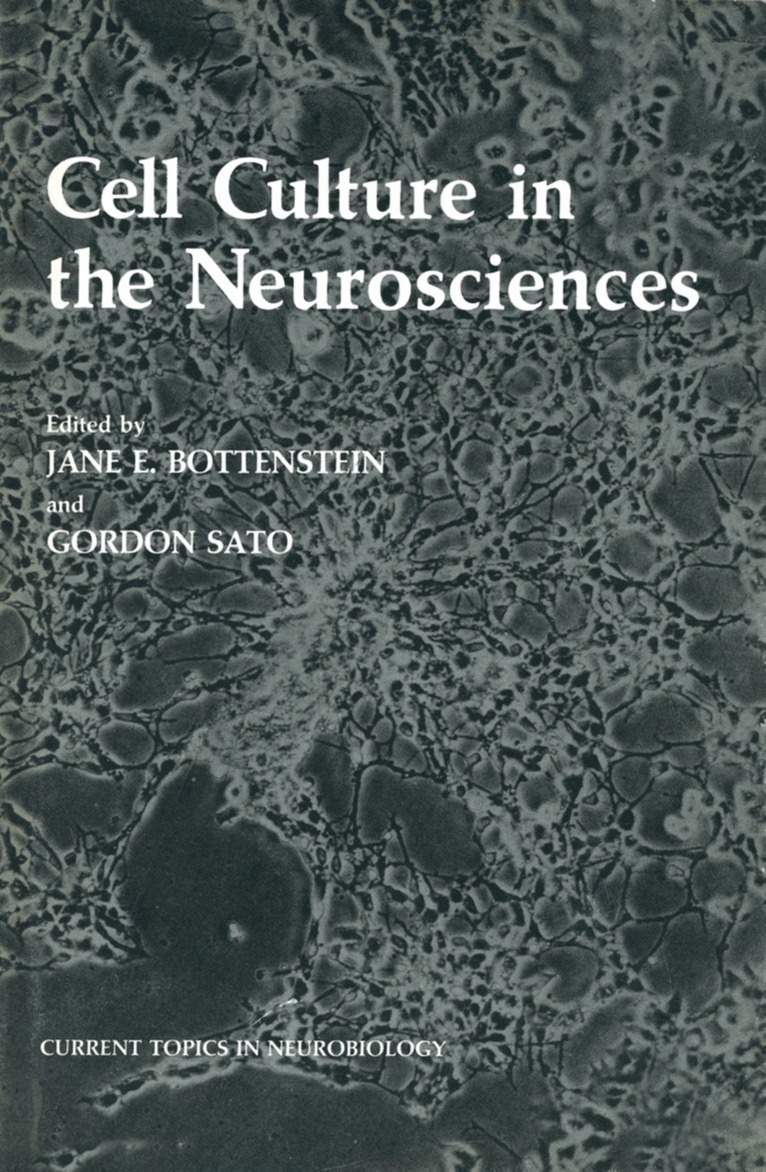
A fundamental problem in neuroscience is the elucidation of the cellular and molecular mechanisms underlying the development and function of the nervous system. The complexity of organization, the heteroge neity of cell types and their interactions, and the difficulty of controlling experimental variables in intact organisms make this a formidable task. Because of the ability that it affords to analyze smaller components of the nervous system (even single cells in some cases) and to better control experimental variables, cell culture has become an increasingly valuable tool for neuroscientists. Many aspects of neural development, such as proliferation, differentiation, synaptogenesis, and myelination, occur in culture with time courses remarkably similar to those in vivo. Thus, in vitro methods often provide excellent model systems for investigating neurobiological questions. Ross Harrison described the first culture of neural tissue in 1907 and used morphological methods to analyze the cultures. Since that time the technique has been progressively modified and used to address an ever widening range of developmental questions. In recent years a con vergence of new or improved cell culture, biochemical, electrophysiol ogical, and immunological methods has occurred and been brought to bear on neurobiological questions. This volume is intended not to be comprehensive but rather to highlight some of the latest findings, with a review of previous important work as well, in which combinations of these methods are used.
925 kr
Skickas inom 10-15 vardagar
Elucidation of the important roles played by peptides as hypothalamic-adenohypo- physeal releasing factors, or regulatory hormones, has in recent years led to the recognition that peptides may also be of significance as intercellular messengers in other regions of the nervous system. In this regard, it is interesting that Sub- stance P, which has been proposed as a putative neurotransmitter in the spinal cord, was rediscovered by Leeman and her co-workers during their search for the corticotropin-releasing factor in the hypothalamus. Indeed, with the wide- spread availability and use of radioimmunoassay techniques, it has become ap- parent that various "hypothalamic releasing factors" are localized in extrahypo- thalamic areas of the central nervous system as well. This book represents an expression of the belief that the impact on neurobiology of research into neuro- peptides will be comparable to, if not greater than, the recent achievements obtained with the biogenic amines. As already appears to be the case, future inves- tigations on brain pep tides will undoubtedly uncover a host of new transmitter candidates, with obvious implications for neuropharmacology.Perhaps the most dramatic developments in this field have been the discoveries of the endogenous opiate peptides (enkephalin and endorphin), and the profound physiological and behavioral effects of specific peptides.
534 kr
Skickas inom 10-15 vardagar
This book is a collection of papers describing some of the first attempts to apply the techniques of recombinant DNA and molecular biology to studies of the nervous system. We believe this is an important new direction for brain research that will eventually lead to insights not pos sible with more traditional approaches. At first glance, the marriage of molecular biology to brain research seems an unlikely one because of the tremendous disparity in the histories of these two disciplines and the problems they face. Molecular biology is by nature a reductionist approach to biology. Molecular biologists have always tried to attack central questions in the most direct approach possible, usually in the most simple system available: a bacterium or a bacterial virus. Important experiments can usually be repeated quickly and cheaply, in many cases by the latest group of graduate students entering the field. The success of molecular biology has been so profound because the result of each important experiment has made the next critical question obvious, and usually answerable, in short order. Studies of the nervous system have a very different history. First, the human brain is what really interests us and it is the most complex structure that we know in biology. The central question is clear: How do we carry out higher functions such as learning and thinking? How ever, at present there is no widely accepted and testable theory of learn ing and no clear path to such a theory.
1 062 kr
Skickas inom 10-15 vardagar
Studies of simple and emerging systems have been undertaken to un derstand the processes by which a developing system unfolds, and to understand more completely the basis of the complexity of the fully formed structures. The nervous system has long been particularly in triguing for such studies, because of the early recognition of a multitude of distinctly differentiated states exhibited by nerve cells with different morphologies. Anatomical studies suggest that one liver cell may be very like another, but indicate that neurons come in a remarkable di versity of forms. This diversity at the anatomical level has parallels at the physiological and biochemical levels. It is becoming increasingly easy to characterize the different cellular phenotypes of neurons. The repeatability with which these phenotypes are expressed may account in part for the specificity and reliability with which neurons form con nections, and it has allowed precise description of the first appearance and further development of the differentiated characteristics of individ ual neurons from relatively undifferentiated precursor cells. This rep resents a major advance over our knowledge of development at the level of tissues, and makes it feasible to define and address questions about the underlying molecular mechanisms involved. Central to these advances has been the clear recognition that there is no single best preparation for the study of neuronal development. Furthermore, it has become evident that no single technique can tell us all we want to know.
534 kr
Skickas inom 10-15 vardagar
An outstanding characteristic of the nervous system is that neurons make selective functional contacts. Each neuron behaves as if it recog nizes the neurons with which it associates and rejects associations with others. The specific interneuronal relationships that result define the innate neuronal circuits that determine the functioning of this system. The purpose of this volume is to present some approaches to the problem of neuronal recognition. The volume has been somewhat arbitrarily divided into three sections. In the first section, the overrid ing theme is the degree of specificity of neuronal recognition. How specific is specific? Is the specificity so precise that the neurites of one neuron will only make synaptic contact with a unique target neuron? If less precise, within what range? Are the rules for specification that are operative in the embryo still operative at the same level of precision when connections regenerate in the mature organism? Are they still operative in dissociated tissue grown in culture? The second section of this volume contains reviews of morphologi cal studies of synaptogenesis and biochemical studies of synaptic com ponents. Can the morphology of developing cellular contacts provide clues about selectivity? Can the chemical components of synaptic junc tions be isolated and characterized? Do they include resolvable compo nents that mediate neuronal recognition? The third section contains studies seeking to identify the existence of specific molecules that might mediate cellular recognition. A major question here is whether molecules of this type even exist.
550 kr
Skickas inom 10-15 vardagar
The impetus for compiling this book was the recent development of culture strains of neuroblastoma and glial cells and the immediate and enthusiastic way they have been taken up as model systems. After the first sudden rush of activity, it seems appropriate to pause, to assess progress, and to contemplate the future contributions that may be possible using these culture techniques. Long before the advent of established strains, cultures of nervous tissue had already contributed to neurobiology. Ross Harrison, in 1906, in a single experimental series, established tissue culture as a promising new technique in cell biology and settled the Golgi-Cajal controversy as to whether axonic processes originated as outgrowths from the cell body or were formed first in the intercellular spaces and were later connected to the cell body. Harrison observed process growth from nerve cells in cultures, thus settling the matter in favor of Cajal. Of great importance to neurobiology is the discovery by Rita Levi-Montalcini of nerve growth factor. Cultures of spinal ganglia played a major role in the discovery, isolation, and characterization of the factor (Levi-Montalcini et ai. , 1954). In my opinion, this discovery, although very well known, has not yet been adequately recognized for its germinal influence on neurobiology and embryology. Progress since the advent of clonal cultures has been more modest. I would like to cite two pieces of work which emphasize the technical ad vantages of these cultures.
1 094 kr
Skickas inom 10-15 vardagar
Neuroimmunology could be defined as the application of immunological methods to problems in neurobiology but such a definition is so all encompassing as to be unhelpful. It is not a precisely circumscribed discipline but it seems worthwhile at the outset to point to three of the major areas of activity. One rather early use of the term was in connection with studies on the immune response to antigens in the nervous system. This includes topics such as autoimmunity in the central and peripheral nervous sys tems, the response to neural tumors or viral infections, and the im munopathology of such processes. Although not at the forefront of the currently fashionable preoccupation with neuroimmunology, this area continues to be a vital and interesting one from both clinical and basic perspectives. A second very active area is the exploitation of antibodies to iden tified components of neural cells, and in particular to those molecules involved as neurotransmitters, in transmitter synthesis and breakdown, and as synaptic receptors. The immunohistochemical detection of these antigens has led to new insights into the functional organization of the nervous system, and reference to such studies is almost a sz'ne qua non for discussions of most central and peripheral synapses.