SUNY series, Democracy and Education - Böcker
Visar alla böcker i serien SUNY series, Democracy and Education. Handla med fri frakt och snabb leverans.
7 produkter
7 produkter
372 kr
Tillfälligt slut
This book is by, for, and about teachers. It is a showcase for the innovative practices that teachers have found most effective in teaching social responsibility. The authors offer a rare discussion of actual classroom practices and the insights teachers have had in experimenting with new ways to help students develop conflict resolution skills and social responsibility.
475 kr
Tillfälligt slut
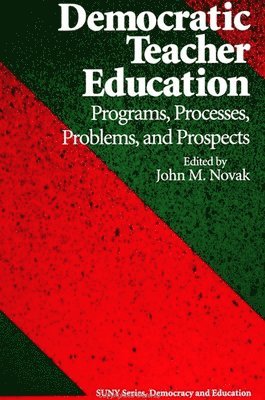
This book captures the spirit, richness, and diversity of democratic teacher educators as they put their ideas into practice in creative and persistent ways. Using a diverse group of democratic educational projects from throughout North America, this volume taps into varied ways teacher educators from large state institutions, small rural colleges, urban private universities, new academic programs, special teacher development centers, and public voluntary citizen organizations are working to create the resources and opportunities for teachers to develop the skills and confidence necessary to promote sustained democratic processes.
1 027 kr
Tillfälligt slut
A bold, Deweyan critique of American education reform.In a field crowded with quick fixes, federal initiatives, and technological "solutions," few works ask the harder question: what counts as genuine educational improvement in the first place?The Stone Trumpet by Richard A. Gibboney is a bold, wide-ranging examination of American school reform across three turbulent decades. Drawing on a Deweyan-progressive framework, Gibboney challenges readers to rethink not only how reforms are implemented, but whether they are educationally worthwhile at all.From the New Math and science reforms of the 1960s to competency-based education, Individually Guided Education, and the Coalition of Essential Schools, The Stone Trumpet offers a searching, often irreverent critique of major reform movements. It exposes how "technological" approaches to schooling can displace thoughtful judgment—and how well-intentioned reforms can fail when they lose sight of intellectual and democratic purposes.Part history, part critique, and part philosophical inquiry, The Stone Trumpet provides richly detailed case studies and a coherent lens for evaluating decades of reform efforts.
391 kr
Tillfälligt slut
A bold, Deweyan critique of American education reform.In a field crowded with quick fixes, federal initiatives, and technological "solutions," few works ask the harder question: what counts as genuine educational improvement in the first place?The Stone Trumpet by Richard A. Gibboney is a bold, wide-ranging examination of American school reform across three turbulent decades. Drawing on a Deweyan-progressive framework, Gibboney challenges readers to rethink not only how reforms are implemented, but whether they are educationally worthwhile at all.From the New Math and science reforms of the 1960s to competency-based education, Individually Guided Education, and the Coalition of Essential Schools, The Stone Trumpet offers a searching, often irreverent critique of major reform movements. It exposes how "technological" approaches to schooling can displace thoughtful judgment—and how well-intentioned reforms can fail when they lose sight of intellectual and democratic purposes.Part history, part critique, and part philosophical inquiry, The Stone Trumpet provides richly detailed case studies and a coherent lens for evaluating decades of reform efforts.
591 kr
Skickas inom 3-6 vardagar
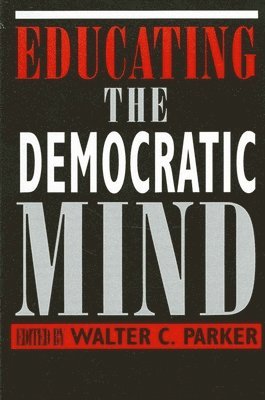
Addresses the question: How can schools help shape young minds to address the challenges of a democratic society?There can be no democracy without democrats, and democrats are made, not born. This volume features sixteen provocative essays, old and new, on the concern to educate young people for that loosely-defined genre of political and social life called democracy. It is an historical collection on the central question of our era: How and what might children be taught so that they respond well and creatively to the demands of an increasingly diverse society that is organized under and struggling, on and off, to realize the democratic ideal? How are we to educate children to embrace difference and maintain a common life? Contributors include Walter C. Parker, Ann V. Angell, James A. Banks, Jane Bernard-Powers, Carole L. Hahn, David Mathews, William B. Stanley, and James Anthony Whitson.
365 kr
Tillfälligt slut
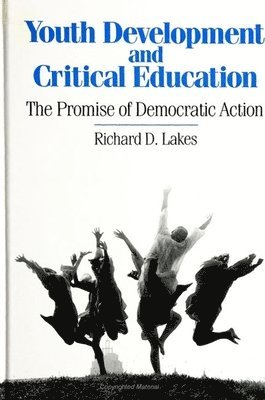
Profiles programs for economically disadvantaged, inner-city youth engaged in neighborhood revitalization and community organization programs.Public policy debates about urban crime and the fate of America's crumbling inner cities suggest a need to consider solutions that create conditions for sustainable community development-where youths join with caring adults in intergenerational coalitions at the grassroots. Using a field-based approach, the author reviews over two dozen youth development projects in non-school and after-school settings. The analyses of these programs examines how young people might achieve a level of economic and political self-determination and community control, as well as personal fulfillment coupled with healthy adolescent growth. Once empowered with critical insights, young people can exhibit positive, real-life displays of their visions, dreams, and ambitions.
475 kr
Tillfälligt slut
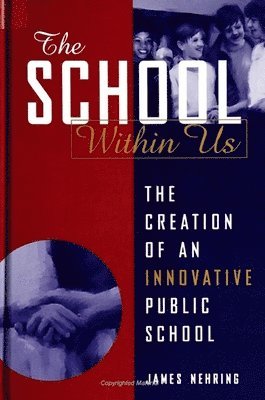
The inspirational story of a group of teachers, parents, and students who face and overcome many challenges in their struggle to create a very unconventional school within a school.This book tells the story of a community of teachers, parents, and students who thoughtfully took charge of their very conventional circumstances and created a very unconventional school. With authority and liveliness, Nehring, a veteran teacher who led the development of the school, describes the many challenges faced and overcome in The Bethlehem Lab School from its inception as a proposal in 1988 to the graduation of its first senior class.Working on the fault line between theory and practice, Nehring and his colleagues built a school on performance-based assessment in a state resurgent with standardized testing. Committed to small scale in a suburban community with a typically large high school and wide elective offering, the Lab School-which functions as a school within a school-offered a highly focused, integrated curriculum, culminating in a senior internship program and thesis project. With students and parents closely involved, the school developed a democratic culture attuned to many voices and a high degree of collaboration.Throughout its development, the Lab School faced skepticism from colleagues and community members but continually proved them wrong as it raised private foundation money, won crucial faculty votes, attracted a diverse student population, succeeded with competitive college admissions for its graduates, and won strong support from students and parents