Developmental Cognitive Neuroscience - Böcker
Visar alla böcker i serien Developmental Cognitive Neuroscience. Handla med fri frakt och snabb leverans.
11 produkter
11 produkter
859 kr
Skickas inom 7-10 vardagar
What is attention? How does it go wrong? Do attention deficits arise from genes or from the environment? Can we cure it with drugs or training? Are there disorders of attention other than deficit disorders? The past decade has seen a burgeoning of research on the subject of attention. This research has been facilitated by advances on several fronts: New methods are now available for viewing brain activity in real time, there is expanding information on the complexities of the biochemistry of neural activity, individual genes can be isolated and their functions identified, analysis of the component processes included under the broad umbrella of "attention" has become increasingly sophisticated, and ingenious methods have been devised for measuring typical and atypical development of these processes, from infancy into childhood, and then into adulthood. In this book, Kim Cornish and John Wilding are concerned with attention and its development, both typical and atypical, particularly in disorders with a known genetic etiology or assumed genetic linkage. Tremendous advances across seemingly diverse disciplines - molecular genetics, pediatric neurology, child psychiatry, developmental cognitive neuroscience, and education - have culminated in a wealth of new methods for elucidating disorders at multiple levels, possibly paving the way for new treatment options. Cornish and Wilding use three specific-yet-interlinking levels of analysis: genetic blueprint (genotype), the developing brain, and the behavioral-cognitive outcomes (phenotype), as the basis for charting the attention profiles of six well-documented neurodevelopmental disorders: ADHD, autism, fragile X syndrome, Down syndrome, Williams syndrome, and 22q11 deletion syndrome. Their overarching aim in this book is to provide the most authoritative and extensive account to date of disorder-specific attention profiles and their development from infancy through adolescence.
Toward a Unified Theory of Development
Connectionism and Dynamic System Theory Re-Considered
Inbunden, Engelska, 2009
1 287 kr
Skickas inom 5-8 vardagar
From William James to Sigmund Freud to Jean Piaget to B.F. Skinner, scholars (and parents!) have wondered how children move from the blooming, buzzing confusion of infancy, through the tumult of childhood and adolescence, into adulthood. Does development occur continuously over time or in a series of dramatic stages? Is development driven by learning or by biological maturational processes? What is the nature of experience, and how does it generate change? The study of development has always been organized around these big questions. And answers to these questions have a profound influence on daily life, forming a framework for how parents think about their own children, and influencing both national policy and educational curricula. This book defines and refines two major theoretical approaches within developmental science that address the central issues of development-connectionism and dynamical systems theory. Spencer, Thomas, and McClelland have brought together chapters that provide an introduction, overview, and critical evaluation of each approach, including three sets of case studies that illustrate how both approaches have been used to study topics ranging from early motor development to the acquisition of grammar. They also present a collection of commentaries by leading scholars, which offer a critical view from both an "outsiders" and an "insiders" perspective. The book is unique in the range of its treatment-it begins to delineate how developmental science can incorporate advances within neuroscience and computational modeling, and brings the new ideas of connectionism and dynamic systems theory into sharper focus, clarifying their usefulness and explanatory power.
1 921 kr
Skickas inom 7-10 vardagar
Our experience of the spatial world is a unitary one; we perceive objects and layouts, we remember them and act on them, and we can even talk about them with ease. Despite this impression of seamlessness, spatial representations in human adults appear to be specialized in domain-dependent manner, engaging different properties and computational mechanisms for different functions. In this book, the authors present evidence that this domain-specific specialization in cognitive function emerges early in development and is reflected in patterns of breakdown that occur under genetic defect. The authors focus on spatial representation in children and adults with Williams syndrome, a relatively rare genetic syndrome that gives rise to an unusual profile of severely impaired spatial representation together with spared language. Results from a variety of spatial domains -- including object representation, motion perception, action, navigation, and spatial language -- appear to display a strikingly uneven profile of sparing and deficit within spatial representations, consistent with the idea that specialization of function drives development and breakdown. These findings raise a crucial question: Can specific genes target specific aspects of cognitive structure? Looking deeper into the patterns of performance across spatial domains, the book explores the notion that understanding patterns of normal development across domains is crucial to understanding unusual development. Using insights from normal development, the authors propose a speculative hypothesis that explains the emergence of the William syndrome profile, and how complex cognitive outcomes can arise from the deletion of a small set of genes.
2 756 kr
Skickas inom 7-10 vardagar
What are the processes, from conception to adulthood, that enable a single cell to grow into a sentient adult? The processes that occur along the way are so complex that any attempt to understand development necessitates a multi-disciplinary approach, integrating data from cognitive studies, computational work, and neuroimaging - an approach till now seldom taken in the study of child development.Neuroconstructivism is a major new 2 volume publication that seeks to redress this balance, presenting an integrative new framework for considering development. In the first volume, the authors review up-to-to date findings from neurobiology, brain imaging, child development, computer and robotic modelling to consider why children's thinking develops the way it does. They propose a new synthesis of development that is based on 5 key principles found to operate at many levels of descriptions. They use these principles to explain what causes a number of key developmental phenomena, including infants' interacting with objects, early social cognitive interactions, and the causes of dyslexia. The "neuroconstructivist" framework also shows how developmental disorders do not arise from selective damage to the normal cognitive system, but instead arise from atypical constraints. How these principles work is illustrated in several case studies ranging from perceptual to social and reading development. Finally, the authors use neuroimaging, behavioural analyses, computational simulations and robotic models to provide a way of understanding the mechanisms and processes that cause development to occur.
915 kr
Skickas inom 7-10 vardagar
What are the processes, from conception to adulthood, that enable a single cell to grow into a sentient adult? The processes that occur along the way are so complex that any attempt to understand development necessitates a multi-disciplinary approach, integrating data from cognitive studies, computational work, and neuroimaging - an approach till now seldom taken in the study of child development.Neuroconstructivism is a major new 2 volume publication that seeks to redress this balance, presenting an integrative new framework for considering development. In the first volume, the authors review up-to-to date findings from neurobiology, brain imaging, child development, computer and robotic modelling to consider why children's thinking develops the way it does. They propose a new synthesis of development that is based on 5 key principles found to operate at many levels of descriptions. They use these principles to explain what causes a number of key developmental phenomena, including infants' interacting with objects, early social cognitive interactions, and the causes of dyslexia. The "neuroconstructivist" framework also shows how developmental disorders do not arise from selective damage to the normal cognitive system, but instead arise from developmental processes that operate under atypical constraints. How these principles work is illustrated in several case studies ranging from perceptual to social and reading development. Finally, the authors use neuroimaging, behavioural analyses, computational simulations and robotic models to provide a way of understanding the mechanisms and processes that cause development to occur.
1 803 kr
Skickas inom 7-10 vardagar
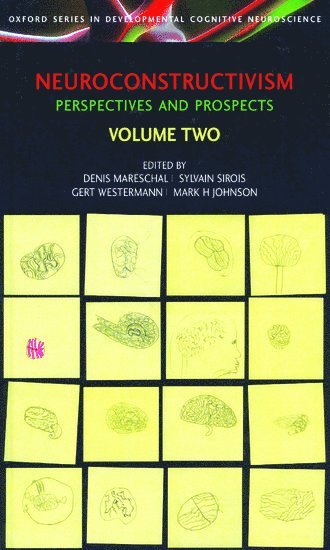
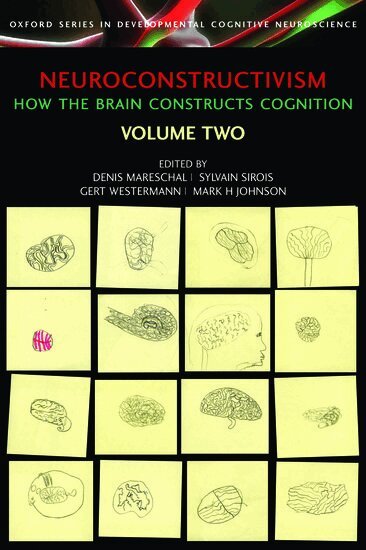
What are the processes, from conception to adulthood, that enable a single cell to grow into a sentient adult? The processes that occur along the way are so complex that any attempt to understand development necessitates a multi-disciplinary approach, integrating data from cognitive studies, computational work, and neuroimaging - an approach till now seldom taken in the study of child development.Neuroconstructivism is a major new 2 volume publication that seeks to redress this balance, presenting an integrative new framework for considering development. Computer and robotic models provide concrete tools for investigating the processes and mechanisms involved in learning and development. Volume 2 illustrates the principles of 'Neuroconstructivist' development, with contributions from 9 different labs across the world. Each of the contributions illustrates how models play a central role in understanding development. The models presented include standard connectionist neural network models as well as multi-agent models. Also included are robotic models emphasizing the need to take embodiment and brain-system interactions seriously. A model of Autism and one of Specific Language Impairment also illustrate how atypical development can be understood in terms of the typical processes of development but operating under restricted conditions. This volume complements Volume 1 by providing concrete examples of how the 'Neuroconstructivist' principles can be grounded within a diverse range of domains, thereby shaping the research agenda in those domains.
991 kr
Skickas inom 5-8 vardagar
What are the processes, from conception to adulthood, that enable a single cell to grow into a sentient adult? The processes that occur along the way are so complex that any attempt to understand development necessitates a multi-disciplinary approach, integrating data from cognitive studies, computational work, and neuroimaging - an approach till now seldom taken in the study of child development.Neuroconstructivism is a major new 2 volume publication that seeks to redress this balance, presenting an integrative new framework for considering development. Computer and robotic models provide concrete tools for investigating the processes and mechanisms involved in learning and development. Volume 2 illustrates the principles of Neuroconstructivist development, with contributions from 9 different labs across the world. Each of the contributions illustrates how models play a central role in understanding development. The models presented include standard connectionist neural network models as well as multi-agent models. Also included are robotic models emphasizing the need to take embodiment and brain-system interactions seriously. A model of Autism and one of Specific Language Impairment also illustrate how atypical development can be understood in terms of the typical processes of development but operating under restricted conditions. This volume complements Volume 1 by providing concrete examples of how the Neuroconstructivist principles can be grounded within a diverse range of domains, thereby shaping the research agenda in those domains.
942 kr
Skickas inom 7-10 vardagar
Human adults appear different from other animals in their ability to form abstract mental representations that go beyond perceptual similarity. In short, they can conceptualize the world. This apparent uniqueness leads to an immediate puzzle: WHEN and HOW does this abstract system come into being? To answer this question we need to explore the origins of adult concepts, both developmentally and phylogenetically; When does the developing child acquire the ability to use abstract concepts? Does the transition occur around 2 years, with the onset of symbolic representation and language? Or, is it independent of the emergence of language? When in evolutionary history did an abstract representational system emerge? Is there something unique about the human brain? How would a computational system operating on the basis of perceptual associations develop into a system operating on the basis of abstract relations? Is this ability present in other species, but masked by their inability to verbalise abstractions? Perhaps the very notion of concepts is empty and should be done away with altogether. This book tackles the age-old puzzle of what might be unique about human concepts. Intuitively, we have a sense that our thoughts are somehow different from those of animals and young children such as infants. Yet, if true, this raises the question of where and how this uniqueness arises. What are the factors that have played out during the life course of the individual and over the evolution of humans that have contributed to the emergence of this apparently unique ability? This volume brings together a collection of world specialists who have grappled with these questions from different perspectives to try to resolve the issue. It includes contributions from leading psychologists, neuroscientists, child and infant specialists, and animal cognition specialists. Taken together, this story leads to the idea that there is no unique ingredient in the emergence of human concepts, but rather a powerful and potentially unique mix of biological abilities and personal and social history that has led to where the human mind now stands.A 'must-read' for students and researchers in the cognitive sciences.
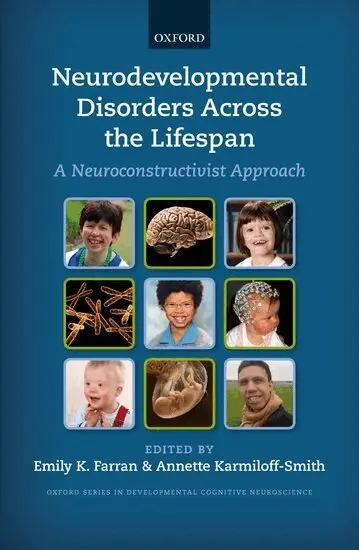
Neurodevelopmental Disorders Across the Lifespan
A neuroconstructivist approach
Inbunden, Engelska, 2011
1 855 kr
Skickas inom 5-8 vardagar
Nowadays, it is widely accepted that there is no single influence (be it nature or nurture) on cognitive development. Cognitive abilities emerge as a result of interactions between gene expression, cortical and subcortical brain networks, and environmental influences. In recent years, our study of neurodevelopmental disorders has provided much valuable information on how genes, brain development, behaviour, and environment interact to influence development from infancy to adulthood. This is the first book to present evidence on development across the lifespan across these multiple levels of description (genetic, brain, cognitive, environmental). In the book, the authors have chosen a well-defined disorder, Williams syndrome (WS), to explore the impact of genes, brain development, behaviour, as well as the individual's environment on development. WS is used as a model disorder to demonstrate the authors approach to understanding development, whilst being presented in comparison to other neurodevelopmental disorders - Autism, Developmental Dyscalculia, Down syndrome, Dyslexia, Fragile X syndrome, Prader-Willi syndrome, Specific Language Impairment, Turner syndrome - to illustrate differences in development across neurodevelopmental disorders. Williams syndrome is particularly informative for exploring development: Firstly, it has been extensively researched at multiple levels: genes, brain, cognition and behaviour, as well as in terms of the difficulties of daily living and social interaction. Secondly, it has been studied across the lifespan, with many studies on infants and toddlers with WS as well as a large number on children, adolescents and adults. The authors also explore a number of domain-general and domain-specific processes in the verbal, non-verbal and social domains, across numerous neurodevelopmental disorders. This illustrates, among other factors, the importance of developmental timing, i.e. that the development of a cognitive skill at a specific timepoint can impact on subsequent development within that domain, but also across domains. In addition, the authors discuss the value of investigating basic-level abilities from as close to the infant start-state as possible, presenting evidence of where cross-syndrome comparisons have shed light on the cascading impacts of subtle similarities and discrepancies in early delay or deviance, on subsequent development. Designed such that readers with an interest in any neurodevelopmental disorder can gain insight into the intricate dynamics of cognitive development, the book covers both theoretical issues and those of clinical relevance. It will be an invaluable reference for any researcher, clinician, student as well as interested parents or teachers wishing to learn about neurodevelopmental disorders from a developmental framework.
1 917 kr
Tillfälligt slut
441 kr
Tillfälligt slut