• Fri frakt över 249 kr
  • •
  • Snabba leveranser
  • •
  • Billiga böcker
Kundservice

Du är på sajten för privatpersoner.

Företag, bibliotek eller offentlig verksamhet?

Du handlar på classic.bokus.com, där alla dina funktioner finns intakta.
Till classic.bokus.com
Bokus logotyp. Gå till startsidan.
  • Erbjudanden
  • Student
  • Topplistor
  • Barn & ungdom
  • Bokus Play
  • E-böcker
  • Ljudböcker
  • Pocketböcker
  • Spel & pussel

Upp till 25% på utvalda nyheter →

Sidfot

Mina sidor

    Hjälp

    • Kundservice
    • Vanliga frågor och svar
    • Frakt och leverans
    • Retur vid ångerrätt
    • Reklamera vara
    • Betalning
    • Köpvillkor
    • Allmänna villkor
    • Information om webbplatsens tillgänglighet

    Om Bokus

    • Om oss
    • Pressrum
    • För studenter
    • För företag
    • För bibliotek och offentlig verksamhet
    • För leverantörer
    • Hållbarhet

    Populärt

    • Aktuella erbjudanden
    • Presentkort
    • Studentlitteratur
    • Nya böcker
    • Topplistor
    • Signerade böcker
    • Engelska böcker

    Inspiration

    • Boktips
    • BookTok
    • Populära bokserier
    • Barnbokskaraktärer
    • Populära författare
    Logotyp för Bokus
    Följ oss på Facebook (extern länk)Följ oss på Instagram (extern länk)Följ oss på YouTube (extern länk)Följ oss på TikTok (extern länk)
    bokus @ CookiesAnpassa cookiesIntegritetspolicyKöpvillkor
    Till Citymail hemsida (extern länk)Till Budbee hemsida (extern länk)Till Postnord hemsida (extern länk)Till Schenker hemsida (extern länk)Till Early Bird hemsida (extern länk)Till Walleys hemsida (extern länk)
    1. Naturvetenskap och teknik
    2. Matematik och naturvetenskap
    3. Biologi
    4. Biovetenskap

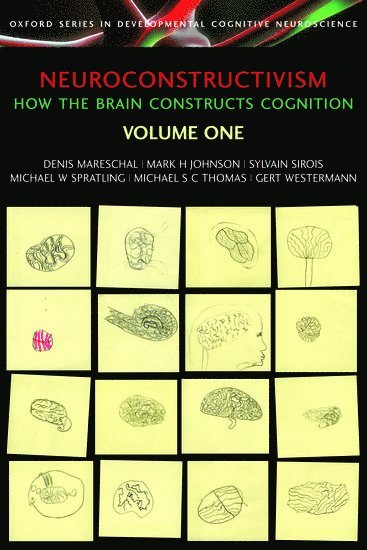
    Neuroconstructivism - I

    How the brain constructs cognition

    AvDenis Mareschal,Mark H. Johnson

    Häftad, Engelska, 2007

    Del i serien Developmental Cognitive Neuroscience

    990 kr

    Beställningsvara. Skickas inom 7-10 vardagar. Fri frakt över 249 kr.

    Fler format och utgåvor

    Inbunden

    2 965 kr

    Beskrivning

    What are the processes, from conception to adulthood, that enable a single cell to grow into a sentient adult? The processes that occur along the way are so complex that any attempt to understand development necessitates a multi-disciplinary approach, integrating data from cognitive studies, computational work, and neuroimaging - an approach till now seldom taken in the study of child development.Neuroconstructivism is a major new 2 volume publication that seeks to redress this balance, presenting an integrative new framework for considering development. In the first volume, the authors review up-to-to date findings from neurobiology, brain imaging, child development, computer and robotic modelling to consider why children's thinking develops the way it does. They propose a new synthesis of development that is based on 5 key principles found to operate at many levels of descriptions. They use these principles to explain what causes a number of key developmental phenomena, including infants' interacting with objects, early social cognitive interactions, and the causes of dyslexia. The "neuroconstructivist" framework also shows how developmental disorders do not arise from selective damage to the normal cognitive system, but instead arise from developmental processes that operate under atypical constraints. How these principles work is illustrated in several case studies ranging from perceptual to social and reading development. Finally, the authors use neuroimaging, behavioural analyses, computational simulations and robotic models to provide a way of understanding the mechanisms and processes that cause development to occur.

    Produktinformation

    • Utgivningsdatum:2007-01-18
    • Mått:155 x 233 x 14 mm
    • Vikt:449 g
    • Format:Häftad
    • Språk:Engelska
    • Serie:Developmental Cognitive Neuroscience
    • Antal sidor:288
    • Förlag:OUP OXFORD
    • ISBN:9780198529910

    Utforska kategorier

    • Biovetenskap inom Naturvetenskap och teknik
    • Arbetspsykologi inom Psykologi och pedagogik
    • Filosofiska discipliner inom Filosofi och religion

    Mer om författaren

    Denis Mareschal obtained his first degree from King's College Cambridge in Natural Science with a specialisation in physics and theoretical physics. He then went on to obtain a Masters in psychology from McGill University with a thesis on the computational modelling of cognitive development. Finally, he obtained a DPhil in Psychology from the University of Oxford for a thesis combining neural network modelling and the experimental testing of infant-object interactions. He took up an initial lecturing position at the University of Exeter (UK) in 1995 and moved to Birkbeck University of London in 1998 where he has been ever since. He was made professor in 2006.Mark H. Johnson is Professor of Psychology and Director of the Centre for Brain & Cognitive Development at Birkbeck, University of London, and a MRC Scientific Team Leader. He received his BSc in Biological Sciences at the University of Edinburgh, Scotland, and his PhD in Neurobiology from the University of Cambridge, UK. Following this training he was appointed Research Scientist (1985-90), and then Senior Research Scientist (1993-98) at the Medical Research Council Cognitive Development Unit, London. From 1989 to 1990 he was also Visiting Assistant Professor at the University of Oregon, Eugene, and from 1991 to 1995 Associate Professor of Psychology at Carnegie Mellon University, Pittsburgh. He has published over 150 scholarly articles and 8 books on brain and cognitive development in human infants and other species, and is Co-Editor of the international journal Developmental Science.Sylvain Sirois' research is mainly concerned with the mechanisms of learning and development, which he studies through a combination of neurally-inspired neural network models, robotics, and empirical studies with babies, children, adults, and the elderly.Michael Spratling received a BEng. degree in Engineering Science from Loughborough University, and MSc and Ph.D. degrees in Artificial Intelligence and Neural Computation from the University of Edinburgh. He has held several research positions, both in psychology and in engineering, including a postdoctoral research fellowship in the Centre for Brain and Cognitive Development at Birkbeck College, University of London. He was appointed as a lecturer in the Division of Engineering at King's College London in 2004.Michael Thomas completed his D.Phil. in Experimental Psychology at University of Oxford in 1997. His principal research interests are in cognitive and language development, with a focus on developmental disorders. For more detail, see http://www.psyc.bbk.ac.uk/research/DNL/Gert Westermann received his Diploma in Computer Science from the University of Braunschweig in Germany (he also spent a year at the University of Texas at Austin) and went on to do a PhD in Cognitive Science at the University of Edinburgh. Following this he worked as a researcher at the Sony Computer Science Laboratory in Paris and subsequently took up a Research Fellowship at Birkbeck College in London. He is now a Senior Lecturer in Psychology at Oxford Brookes University. During 2005-2006 he is on sabbatical in the Department of Experimental Psychology at the University of Oxford.

    Innehållsförteckning

    • PART I - FOUNDATIONS ; 1. Introduction ; 2. Encellment: the emerging function and morphology of neurons ; 3. Embrainment: the brain unboxed ; 4. Embodiment: representations in context ; 5. Principles, mechanisms, and processes ; PART II - CASE STUDIES ; 6. The cortical basis of early visual perception ... a story of multiple representations ; 7. Habituation in infancy ... from interacting neural systems to active exploration ; 8. Phonological development ... the integration of sensory motor representations ; 9. Infants and objects ... from functional brain systems to behavior ; 10. Ensocialment ... minds and brains in society ; 11. Lessons from atypical development ; 12. Dyslexia: a case study of the application of the neuroconstructivist principles ; PART III - CONCLUSIONS ; 13. Conclusions and challenges for the future