Diaries – serie
Visar alla böcker i serien Diaries. Handla med fri frakt och snabb leverans.
9 produkter
Diary of John Quincy Adams, Volume 1 – November 1779 ′ March 1786
November 1779 – March 1786
Av John Quincy Adams, David Grayson Allen m. fl.
Inbunden, 1982
1419 kr
Kommande
Volumes 1 and 2 of the Diary of John Quincy Adams begin the publication of the greatest diary, both in mass and substance, in American History. Recording a span of sixty-eight years, it has been known heretofore only in partial form. When, over a hundred years ago, Charles Francis Adams edited his …
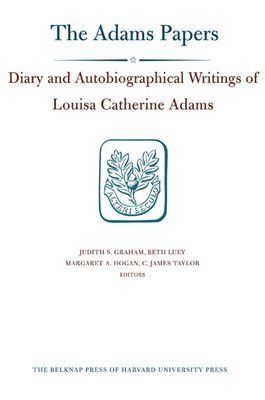
Diary and Autobiographical Writings of Louisa Catherine Adams
1778–1849
Av Louisa Catherine Adams, Judith S. Graham m. fl.
Inbunden, 2013
1777 kr
Lägg i varukorg
The Adams saga takes a stride through the first half of the nineteenth century, as Louisa Catherine Johnson Adams chronicles her life with John Quincy Adams. Born in London in 1775 to a Maryland merchant and his English wife, Louisa recalls her childhood and education in England and France and her …
Diary of Charles Francis Adams, Volume 4 – September 1829 – December 1832
September 1829 – December 1832
Av Charles Francis Adams Jr., Marc Friedlaender m. fl.
Inbunden, 1968
1707 kr
Lägg i varukorg
In these volumes the second decade of the sixty-year diary of Charles Francis Adams, the third of the family’s statesmen, is begun. As was true of the two earlier volumes of the Diary, the section appearing here has not before reached print.Covering the period from Adams’s marriage in September …
Diary of Charles Francis Adams
January 1833 – June 1836
Av Charles Francis Adams Jr., L. H. Butterfield m. fl.
Inbunden, 1974
1707 kr
Lägg i varukorg
A man’s twenty-seventh year is “critical,” according to Charles Francis Adams. And so his proved to be. Twenty-five at the start of these volumes, Adams had yet to embark on the public career that would mark him a statesman, but by their conclusion he had been drawn into the maelstrom of politics. …
Diary of Charles Francis Adams
June 1836 – February 1840
Av Charles Francis Adams Jr., Marc Friedlaender m. fl.
Inbunden, 1986
1707 kr
Lägg i varukorg
The period of June 1836 to February 1840, from Charles Francis Adams’s twenty-eighth to thirty-second year, was characterized by his turn from the political activities that had occupied him for the preceding several years. The course of the Van Buren administration he had helped to elect …
Diary and Autobiography of John Adams, Volume 2 – 1771–1781
1771–1781
Av John Adams, L. H. Butterfield m. fl.
Inbunden, 1961
1190 kr
Lägg i varukorg
John Adams’s Diary, partially published in the 1850s, has proved a quarry of information on the rise of Revolutionary resistance in New England, the debates in the early Continental Congresses, and the diplomacy and financing of the American Revolution; but it has remained unfamiliar to the wider …
Diary of Charles Francis Adams, Volume 1 – January 1820 – June 1825
January 1820 – June 1825
Av Charles Francis Adams Jr., L. H. Butterfield m. fl.
Inbunden, 1968
997 kr
Kommande
Third and last of the Adams dynasty of statesmen, Charles Francis Adams followed in his grandfather’s and father’s footsteps by keeping a diary from youth to old age. With only a few gaps in the earliest years, Charles Francis Adams’s diary extends from 1820 to 1880, furnishing a massively detailed …
Diary of Charles Francis Adams, Volume 2 – July 1825 – September 1829
July 1825 – September 1829
Av Charles Francis Adams Jr., L. H. Butterfield m. fl.
Inbunden, 1968
997 kr
Kommande
Third and last of the Adams dynasty of statesmen, Charles Francis Adams followed in his grandfather’s and father’s footsteps by keeping a diary from youth to old age. With only a few gaps in the earliest years, Charles Francis Adams’s diary extends from 1820 to 1880, furnishing a massively detailed …
Red Lace Diaries
Av S.D. Syns
Häftad, 2026
289 kr
Lägg i varukorg
Jasmine loves men, but one false move on their part, and it's their last.Jasmine moved to a quiet seaside town to start over.Inside, the house she bought feels strange and she hears noises. Outside, the men she meets fail in their actions or the words they choose and Jasmine has no choice but to …