Dolciani Mathematical Expositions - Böcker
Visar alla böcker i serien Dolciani Mathematical Expositions. Handla med fri frakt och snabb leverans.
12 produkter
12 produkter
743 kr
Skickas inom 7-10 vardagar
Functional analysis is an abstract and powerful modern theory that occupies a central role in mathematics. This book provides a quick but precise introduction to the subject, covering everything that a beginning graduate student needs to know. The subject has its roots in the theory of infinite-dimensional vector spaces which is where the book begins, with preliminaries from the theory of normed linear spaces, Hilbert spaces, operator algebras and distributions. The reader will then encounter more advanced topics such as spectral theory, convexity and fixed-point theorems. It contains plenty of examples and exercises, making it an ideal basis for advanced undergraduate and graduate level courses in a subject that has become an essential part of every analyst's toolkit.
967 kr
Skickas inom 7-10 vardagar
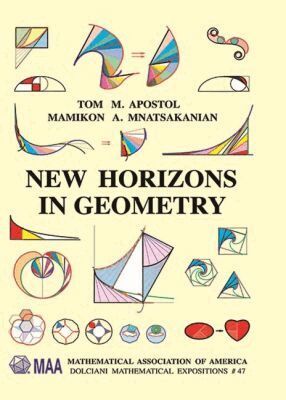
New Horizons in Geometry represents the fruits of 15 years of work in geometry by a remarkable team of prize-winning authors Tom Apostol and Mamikon Mnatsakanian. It serves as a capstone to an amazing collaboration. Apostol and Mamikon provide fresh and powerful insights into geometry that requires only a modest background in mathematics. Using new and intuitively rich methods, they give beautifully illustrated proofs of results, the majority of which are new, and frequently develop extensions of familiar theorems that are often surprising and sometimes astounding. It is mathematical exposition of the highest order. The hundreds of full color illustrations by Mamikon are visually enticing and provide great motivation to read further and savor the wonderful results. Lengths, areas, and volumes of curves, surfaces, and solids are explored from a visually captivating perspective. It is an understatement to say that Apostol and Mamikon have breathed new life into geometry.
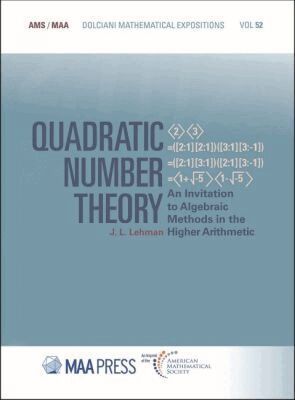
Quadratic Number Theory
An Invitation to Algebraic Methods in the Higher Arithmetic
Inbunden, Engelska, 2019
743 kr
Skickas inom 7-10 vardagar
This text is an introduction to algebraic number theory for readers with a moderate knowledge of elementary number theory and some familiarity with the terminology of abstract algebra. With its exceptionally clear prose, hundreds of exercises, and historical motivation, it would make an excellent textbook for a second undergraduate course in number theory or a terrific choice for independent reading.
443 kr
Skickas
This book tells the story of Diophantine analysis, a subject that, owing to its thematic proximity to algebraic geometry, became fashionable in the last half century and has remained so ever since. This new treatment of the methods of Diophantus-a person whose very existence has long been doubted by most historians of mathematics-will be accessible to readers who have taken some university mathematics. It includes the elementary facts of algebraic geometry indispensable for its understanding. The heart of the book is a fascinating account of the development of Diophantine methods during the Renaissance and in the work of Fermat. This account is continued to our own day and ends with an afterword by Joseph Silverman, who notes the most recent developments including the proof of Fermat's Last Theorem.
443 kr
Skickas
Here is an introduction to modern logic that differs from others by treating logic from an algebraic perspective. What this means is that notions and results from logic become much easier to understand when seen from a familiar standpoint of algebra. The presentation, written in the engaging and provocative style that is the hallmark of Paul Halmos, from whose course the book is taken, is aimed at a broad audience, students, teachers and amateurs in mathematics, philosophy, computer science, linguistics and engineering; they all have to get to grips with logic at some stage. All that is needed to understand the book is some basic acquaintance with algebra.
678 kr
Skickas inom 7-10 vardagar
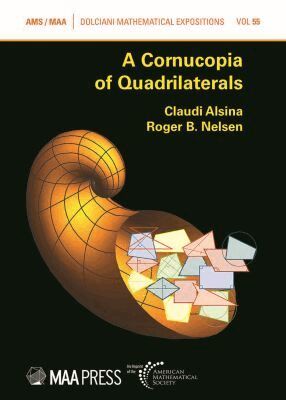
A Cornucopia of Quadrilaterals collects and organizes hundreds of beautiful and surprising results about four-sided figures--for example, that the midpoints of the sides of any quadrilateral are the vertices of a parallelogram, or that in a convex quadrilateral (not a parallelogram) the line through the midpoints of the diagonals (the Newton line) is equidistant from opposite vertices, or that, if your quadrilateral has an inscribed circle, its center lies on the Newton line. There are results dating back to Euclid: the side-lengths of a pentagon, a hexagon, and a decagon inscribed in a circle can be assembled into a right triangle (the proof uses a quadrilateral and circumscribing circle); and results dating to Erdos: from any point in a triangle the sum of the distances to the vertices is at least twice as large as the sum of the distances to the sides. The book is suitable for serious study, but it equally rewards the reader who dips in randomly. It contains hundreds of challenging four-sided problems. Instructors of number theory, combinatorics, analysis, and geometry will find examples and problems to enrich their courses. The authors have carefully and skillfully organized the presentation into a variety of themes so the chapters flow seamlessly in a coherent narrative journey through the landscape of quadrilaterals. The authors' exposition is beautifully clear and compelling and is accessible to anyone with a high school background in geometry.
443 kr
Skickas
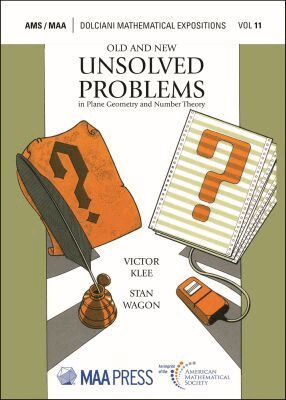
Victor Klee and Stan Wagon discuss some of the unsolved problems in number theory and geometry, many of which can be understood by readers with a very modest mathematical background. The presentation is organized around 24 central problems, many of which are accompanied by other, related problems. The authors place each problem in its historical and mathematical context, and the discussion is at the level of undergraduate mathematics. Each problem section is presented in two parts. The first gives an elementary overview discussing the history and both the solved and unsolved variants of the problem. The second part contains more details, including a few proofs of related results, a wider and deeper survey of what is known about the problem and its relatives, and a large collection of references. Both parts contain exercises, with solutions. The book is aimed at both teachers and students of mathematics who want to know more about famous unsolved problems.
748 kr
Skickas inom 11-20 vardagar
Challenge: Can you find all the integers $a$, $b$, $c$ satisfying $2a^{2} + 3b^{2} = 5c^{2}$? Looks simple, and there are in fact a number of easy solutions. But most of them turn out to be anything but obvious! There are infinitely many possibilities, and as any computer will tell you, each of $a$, $b$, $c$ will usually be large. So the challenge remains ... Find all integers$a$, $b$, $c$satisfying$2a^{2} + 3b^{2} = 5c^{2}$.A major advance in number theory means this book can give an easy answer to this and countless similar questions. The idea behind the approach is transforming a degree-two equation in integer variables $a$, $b$, $c$ into a plane curve defined by a polynomial. Working with the curve makes obtaining solutions far easier, and the geometric solutions then get translated back into integers. This method morphs hard problems into routine ones and typically requires no more than high school math. (The complete solution to $2a^{2} + 3b^{2} = 5c^{2}$ is included in the book.) In addition to equations of degree two, the book addresses degree-three equations--a branch of number theory that is today something of a cottage industry, and these problems translate into ""elliptic curves''. This important part of the book includes many pictures along with the exposition, making the material meaningful and easy to grasp.This book will fit nicely into an introductory course on number theory. In addition, the many solved examples, illustrations, and exercises make self-studying the book an option for students, thus becoming a natural candidate for a capstone course.
743 kr
Skickas inom 7-10 vardagar
There is a nineteen-year recurrence in the apparent position of the sun and moon against the background of the stars, a pattern observed long ago by the Babylonians. In the course of those nineteen years the Earth experiences 235 lunar cycles. Suppose we calculate the ratio of Earth's period about the sun to the moon's period about Earth. That ratio has 235/19 as one of its early continued fraction convergents, which explains the apparent periodicity.Exploring Continued Fractions explains this and other recurrent phenomena—astronomical transits and conjunctions, lifecycles of cicadas, eclipses—by way of continued fraction expansions. The deeper purpose is to find patterns, solve puzzles, and discover some appealing number theory. The reader will explore several algorithms for computing continued fractions, including some new to the literature. He or she will also explore the surprisingly large portion of number theory connected to continued fractions: Pythagorean triples, Diophantine equations, the Stern-Brocot tree, and a number of combinatorial sequences.The book features a pleasantly discursive style with excursions into music (The Well-Tempered Clavier), history (the Ishango bone and Plimpton 322), classics (the shape of More's Utopia) and whimsy (dropping a black hole on Earth's surface). Andy Simoson has won both the Chauvenet Prize and Pólya Award for expository writing from the MAA and his Voltaire's Riddle was a Choice magazine Outstanding Academic Title. This book is an enjoyable ramble through some beautiful mathematics. For most of the journey the only necessary prerequisites are a minimal familiarity with mathematical reasoning and a sense of fun.
443 kr
Skickas
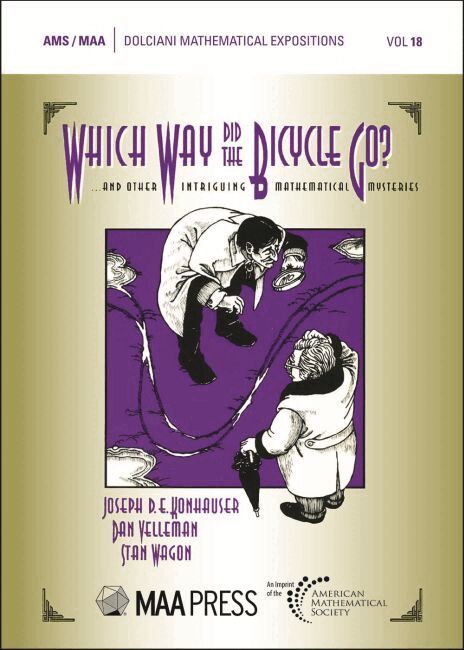
This collection will give students (high school or beyond), teachers, and university professors a chance to experience the pleasure of wrestling with some beautiful problems of elementary mathematics. Readers can compare their sleuthing talents with those of Sherlock Holmes, who made a bad mistake regarding the first problem in the collection: Determine the direction of travel of a bicycle that has left its tracks in a patch of mud.Which Way did the Bicycle Go? contains a variety of other unusual and interesting problems in geometry, algebra, combinatorics, and number theory. For example, if a pizza is sliced into eight 45-degree wedges meeting at a point other than the center of the pizza, and two people eat alternate wedges, will they get equal amounts of pizza? Or: What is the rightmost nonzero digit of the product $1\cdot 2\cdot 3\cdots 1,000,000$? Or: Is a manufacturer's claim that a certain unusual combination lock allows thousands of combinations justified? Complete solutions to the 191 problems are included along with problem variations and topics for investigation.
743 kr
Skickas inom 7-10 vardagar
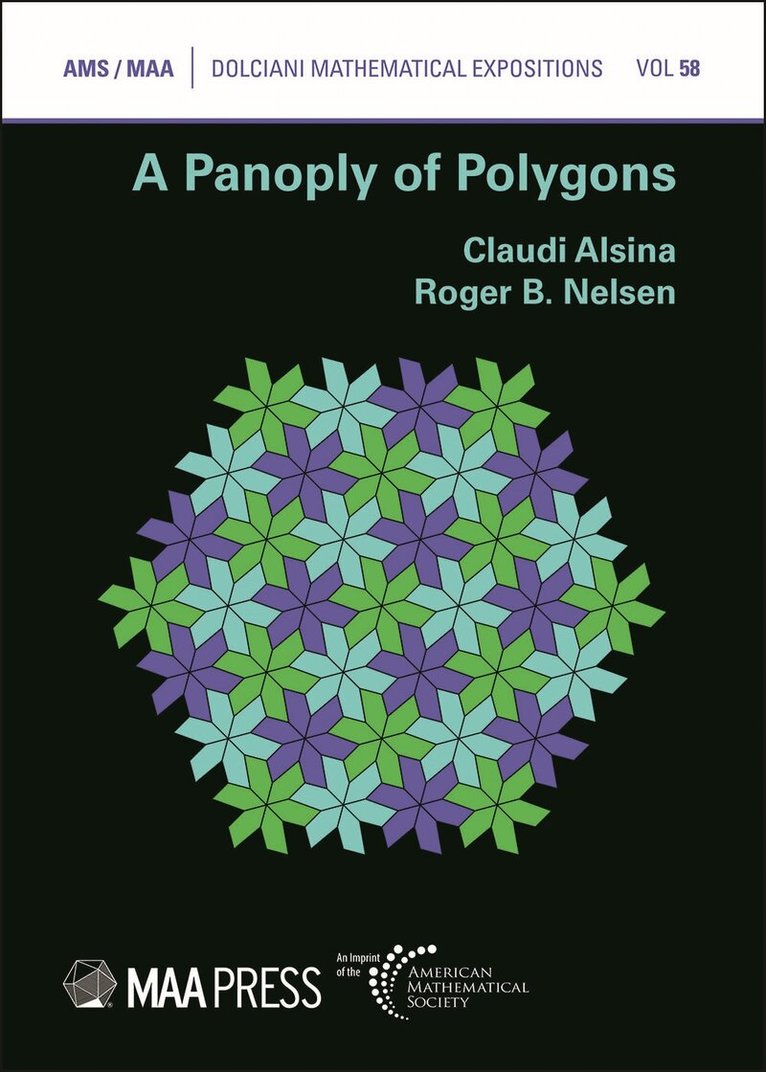
A Panoply of Polygons presents and organizes hundreds of beautiful, surprising and intriguing results about polygons with more than four sides. (A Cornucopia of Quadrilaterals, a previous volume by the same authors, thoroughly explored the properties of four-sided polygons.) This panoply consists of eight chapters, one dedicated to polygonal basics, the next ones dedicated to pentagons, hexagons, heptagons, octagons and many-sided polygons. Then miscellaneous classes of polygons are explored (e.g., lattice, rectilinear, zonogons, cyclic, tangential) and the final chapter presents polygonal numbers (figurate numbers based on polygons). Applications, real-life examples, and uses in art and architecture complement the presentation where many proofs with a visual nature are included.A Panoply of Polygons can be used as a supplement to a high school or college geometry course. It can also be used as a source for group projects or extra-credit assignments. It will appeal, and be accessible to, anyone with an interest in plane geometry. Claudi Alsina and Roger Nelsen are, jointly and individually, the authors of thirteen previous MAA/AMS books. Those books, and this one, celebrate and illuminate the power of visualization in learning, teaching, and creating mathematics.
783 kr
Skickas inom 7-10 vardagar
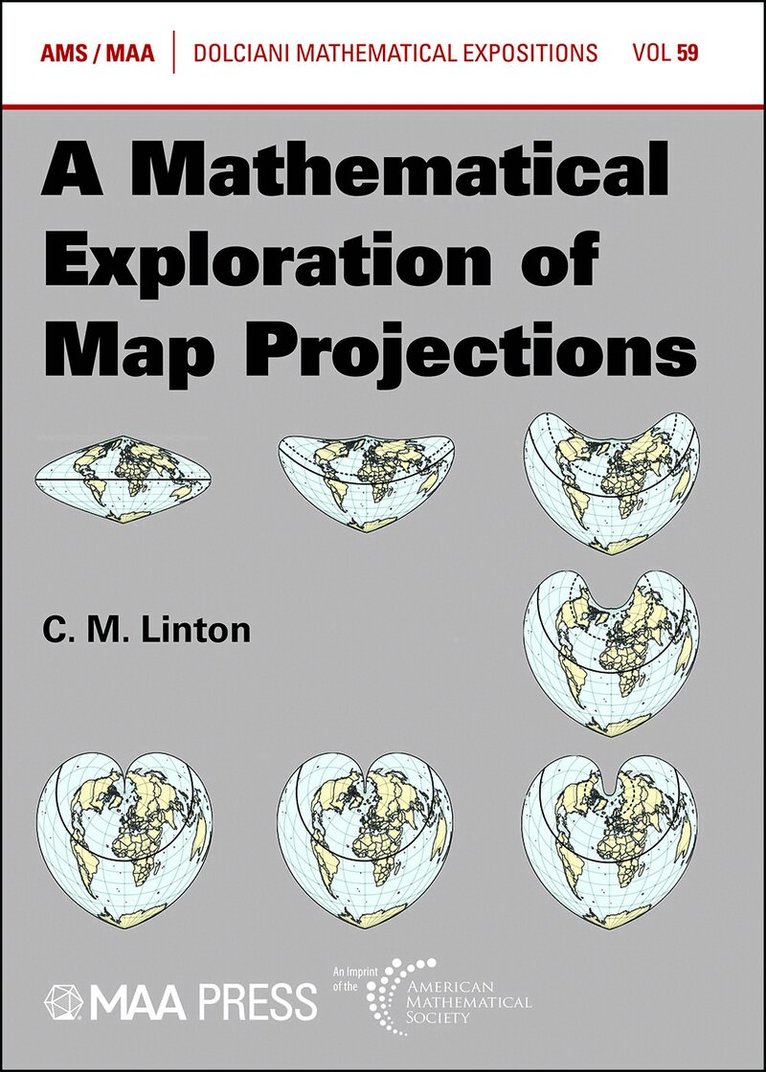
How are maps created? What is the process that enables a location on the Earth's surface to become a point on a sheet of paper? The answer lies in map projections. This book provides a highly readable account of the theory that underpins all major map projections, starting from the concept of map distortion, which all flat maps necessarily possess. The engaging exposition is enhanced by the extensive use of diagrams, including over sixty maps. The opening chapters set the scene, covering the mathematical background, the notion of map distortion and the classification of map projections. The book then turns its attention to the different types of projection, including cylindrical, azimuthal, and conical projections. Following a modern analytic approach, the author uses the tools of multivariable calculus to derive the equations defining these map projections. The book ends with a chapter utilizing complex variables to study conformal projections, and a final summary chapter to wrap up the material. Each chapter is interwoven with a compelling historical narrative enriching the text. A Mathematical Exploration of Map Projections assumes only a prior knowledge of elementary calculus, and is an excellent resource for anyone curious about the mathematics underlying map projections.