Education and Society in South Asia – serie
Visar alla böcker i serien Education and Society in South Asia. Handla med fri frakt och snabb leverans.
5 produkter
5 produkter
389 kr
Skickas inom 5-8 vardagar
In a conversation about youth agency, the most common discourses that come up are of acts of liberation, resistance, and deviance. However, this perspective is fairly narrow and runs the risk of reinforcing pervasive and often polarizing depictions of youth. In order to broaden the understanding of young people's collective actions and their potential social implications, it is necessary to ask: What types of agency do young people demonstrate?This book aims to scrutinize some of the conceptual ideas that underlie prevalent visions of youth as agents of social change and as a source of hope for a better future. As a part of the Education and Society in South Asia series, it provides insightful accounts of students' daily routines on and around a public university campus in Kathmandu, Nepal, and calls attention to a group of non-elite university students who have remained less visible in scholarly and public debates about student activism, youth unemployment, and international migration. By placing different strands of literature on youth, aspiration, and mobility into conversation, In Search of a Future unveils new and important perspectives on how young people navigate competing social expectations, educational inequalities, and limited job prospects.Series: ESSAthis series seeks to problematize our understanding of education, as process, in the context of the making of citizens in a 'modern', changing South Asia. Education has been examined in its institutional avatar ad nauseam. Such efforts view educational institutions as organizations that transmit and evaluate educational knowledge and provide certification based on academic achievement. The causes of inequality, located in gender, caste, class and religion have perhaps been examined in this context as these shape individuals' lives in multiple and complex ways. At the same time, educational institutions are spaces, as processes, through which participants bring meaning and create worlds that hugely impact their personal and intellectual development. Other books in the Series include:Social, Ecological and Moral Vision for Inclusive Education: J. Krishnamurti and Educational Practice
1 583 kr
Skickas inom 5-8 vardagar
This is an ethnographic study of the Vidya Bharati chain of schools in India which are run by a Hindu nationalist organization called the Rashtriya Swayamsevak Sangh (RSS). The first study of its kind, this volume is an important narrative on the role and impact of textbooks in modern India. Despite having limited resources (they are run on a tight budget) and being based on a radical ideology that derives from a 'Hindu' nationalist agenda, the Vidya Bharati schools have achieved considerable success in the free market of private education and have grown to over 12,000 schools within 40 years. They are an important example of the interlinkage between ideology and nationalism in contemporary India. The author analyses school structure, curriculum, teaching quality, institutional goals, and ideology in an effort to identify reasons behind Vidya Bharati's success and to show through his field research that a combined strategy of pragmatism blended with ideology has allowed the schools to become highly sought-after. This analysis then asks broader questions about the failures of the public education system in India.
Anthropological Perspectives on Education in Nepal
Educational Transformations and Avenues of Learning
Inbunden, Engelska, 2023
1 461 kr
Skickas inom 5-8 vardagar
What is education, and who counts as an 'educated person' amidst competing religious, political, and pedagogical ideologies, which have shaped contemporary educational practices and institutions in Nepal? How have social and political changes, an increasing commodification of education, a continued reliance on foreign aid, and expanded geographical horizons contributed to a reshaping of the educational landscape of Nepal and thereby altered, opened up, and closed avenues of learning available to the Nepali people? Grounded in the intersection between anthropology, sociology, and development studies, and based on rich ethnographic evidence, the essays in this edited volume illuminate educational transformations and avenues of learning in the context of wider social and political changes in Nepal. They capture diverse and competing educational experiences and trajectories; examine the process of construction and transmission of knowledge in different sites within and beyond institutions of formal education; and explore the interconnections between education, state, and society.
1 631 kr
Skickas inom 3-6 vardagar
With a wide arc encompassing the institutional big men, who run technical institutes and colleges, and the micro-politics of friendships and relationships, this book is a deep dive into the world of Indian engineering colleges. It juxtaposes the stark realities and lived experiences of students against the global sensibilities and standards to which such institutes lay claim. From the 1980s to the early 2000s, Tamil Nadu witnessed a record rise in the number of private engineering colleges. However, despite the manifold increase in the number of institutions and consequently, first-generation learners, hierarchies and inequalities continue to be reproduced in these almost temple-like institutions. Groups lacking the explicit markers of cultural and social capital struggle to find employment. By presenting perspectives on engineering students desires, anxieties, and processes of self-construction, the monograph examines how gender differences are reinforced through language, rules, regulations, surveillance, and control. In shifting the theoretical emphasis from subjects to subjectivities, Hebbar draws on the youths narratives of upward social mobility, crafting respectability, and notions of adulthood, holding a mirror to the fraught social scape of Indias private education sector.
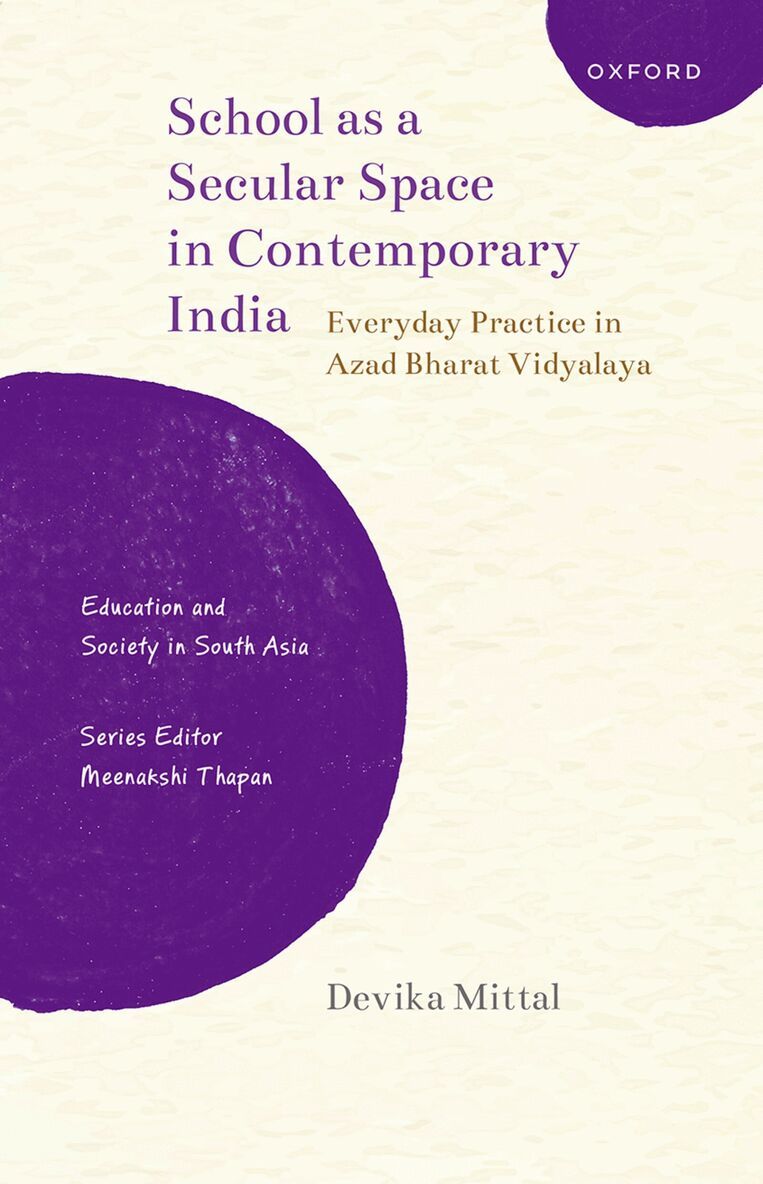
School as a Secular Space in Contemporary India
Everyday Practice in Azad Bharat Vidyalaya
Inbunden, Engelska, 2026
1 166 kr
Kommande
The Constitution of India upholds secularism as a key ideal. Although the 42nd amendment to the Preamble to the Constitution officially declared India to be a 'sovereign, socialist, secular, democratic republic', the Constitution itself does not prescribe a specific definition of secularism. Given their close relationship with the State, Indian schools are expected to uphold Constitutional ideals, including secularism. School as a Secular Space in Contemporary India journeys into the life of a government-aided, non-religious school in Delhi to explore how the abstract concept of secularism is interpreted and enacted therein. Unpacking the school culture, this book offers insights into the nature of secularism in India. It reveals layers of conformity and contestation of the school's goals in general and its conception and practice of secularism in particular. The notion of secularism is interwoven with nationalism, religion, and community-based assertions, and grounded in the concepts of equality and social justice. Exploring the plural, and even competing, narratives of secularism emerging from these intersections, the author argues that these are not confined to the school alone but mirror the paradox of secularism in the Indian society.