Elements in Health Communication - Böcker
Visar alla böcker i serien Elements in Health Communication. Handla med fri frakt och snabb leverans.
10 produkter
10 produkter
241 kr
Skickas inom 7-10 vardagar
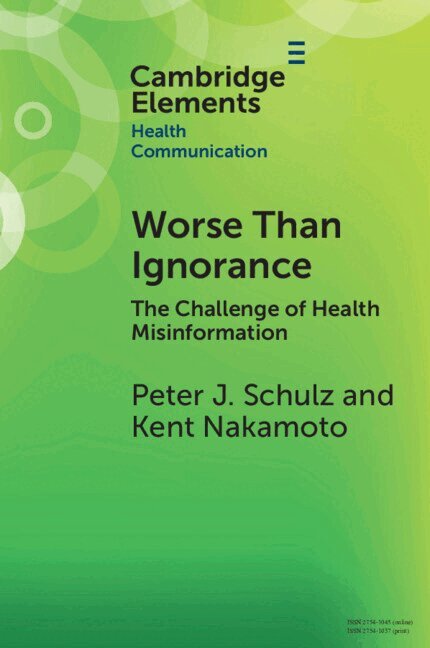
This Element considers health misinformation and the problems it presents. The evolving communication context-changing doctor-patient relationships and developments in information technology-presents patients with a vastly enriched information landscape and new challenges to patients navigating it. These challenges are magnified as growing patient empowerment and autonomy have increased expectations for patient involvement in medical decisions. In this context, the ways people approach presented information, learn from it, understand it, and use it, exacerbate the risk that they become misinformed-believing things that are inimical to improved health. Moreover, these same processes make it difficult to correct such beliefs. Approaches building on trust between patient and professional exemplify improved communication to increase accurate patient knowledge and understanding in the service of better health. This title is also available as Open Access on Cambridge Core.
241 kr
Skickas inom 7-10 vardagar
This Element examines two prominent public health crises – the emergence of bovine spongiform encephalopathy (BSE) in British cattle and the COVID-19 pandemic. It contends that a group of arguments called the informal fallacies functioned as cognitive heuristics and facilitated public health reasoning during both crises. These arguments, which include the argument from ignorance, the argument from authority, and circular argument, are particularly well adapted to the type of uncertainty that surrounds the emergence of novel infectious diseases. By bridging gaps in knowledge, these arguments can facilitate reasoning when evidence about these diseases is limited and the need to take action is urgent. The Element charts a public health journey beginning in the 1950s with a disease called kuru, then examines the response to the emergence of BSE in 1986 and extends to the present day with the COVID-19 pandemic. This title is also available as Open Access on Cambridge Core.
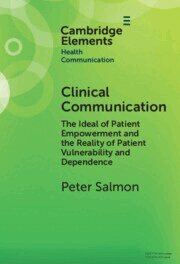
Clinical Communication
The Ideal of Patient Empowerment and the Reality of Patient Vulnerability and Dependence
Häftad, Engelska, 2025
241 kr
Skickas inom 7-10 vardagar
Good communication is necessary for good clinical care, but defining good communication has been surprisingly difficult and controversial. Many current ideas that identify good communication with certain communication behaviours, or 'skills', were ethically inspired to help doctors see beyond disease to the whole patient. However, promoting specific behaviours is problematic because communication is contextually dependent. In recent decades, observational research into practitioner-patient relationships has begun to provide a scientific basis for the field, identifying patients' vulnerability and practitioners' authority as defining features of fundamentally asymmetric clinical relationships. Future educators can learn from research that explores the judgments that experienced practitioners make when they manage communication dilemmas arising from this asymmetry. In future, instead of the current emphasis on teaching communication behaviours, educators could provide practitioners with knowledge about relationships to inform those judgments, while addressing the attitudes and values that motivate and guide their communication.
241 kr
Kommande
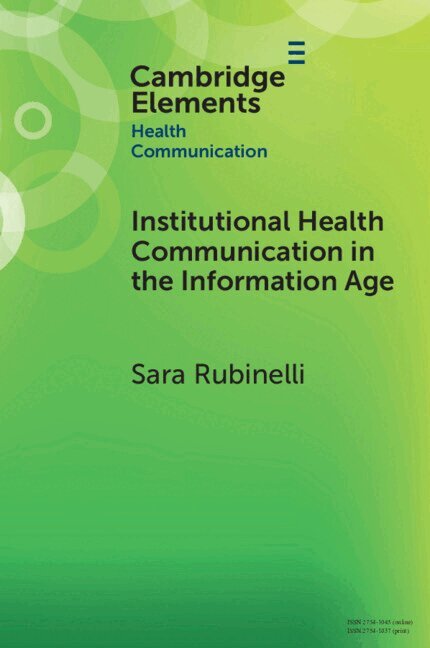
This Element offers a critical exploration of institutional health communication in an era marked by information overload and uneven content quality. It examines how health institutions can navigate the challenges of false, misleading, and poor-quality health information while preserving public trust and scientific integrity. Drawing from disciplines such as health communication, behavioral science, media studies, and rhetoric, this Element promotes participatory models, transparent messaging, and critical health literacy. Through a series of thematic sections and practical examples, it addresses the role of science, politics, media, and digital influencers in shaping public understanding. Designed as both a conceptual guide and a strategic toolkit, this Element aims to support institutions in fostering informed, engaged, and resilient communities through communication that is clear, ethical, and responsive to the complexities of today's health discourse. This title is also available as Open Access on Cambridge Core.
241 kr
Skickas inom 7-10 vardagar
Misinformation can be broadly defined as information that is inaccurate or false according to the best available evidence, or information whose validity cannot be verified. It is created and spread with or without clear intent to cause harm. There is well-documented evidence that misinformation persists despite fact-checking and the presentation of corrective information, often traveling faster and deeper than facts in the online environment. Drawing on the frameworks of social judgment theory, cognitive dissonance theory, and motivated information processing, the authors conceptualize corrective information as a generic type of counter-attitudinal message and misinformation as attitude-congruent messages. They then examine the persistence of misinformation through the lens of biased responses to attitude-inconsistent versus -consistent information. Psychological inoculation is proposed as a strategy to mitigate misinformation.
775 kr
Skickas inom 7-10 vardagar
This Element considers health misinformation and the problems it presents. The evolving communication context-changing doctor-patient relationships and developments in information technology-presents patients with a vastly enriched information landscape and new challenges to patients navigating it. These challenges are magnified as growing patient empowerment and autonomy have increased expectations for patient involvement in medical decisions. In this context, the ways people approach presented information, learn from it, understand it, and use it, exacerbate the risk that they become misinformed-believing things that are inimical to improved health. Moreover, these same processes make it difficult to correct such beliefs. Approaches building on trust between patient and professional exemplify improved communication to increase accurate patient knowledge and understanding in the service of better health. This title is also available as Open Access on Cambridge Core.
775 kr
Skickas inom 7-10 vardagar
This Element examines two prominent public health crises – the emergence of bovine spongiform encephalopathy (BSE) in British cattle and the COVID-19 pandemic. It contends that a group of arguments called the informal fallacies functioned as cognitive heuristics and facilitated public health reasoning during both crises. These arguments, which include the argument from ignorance, the argument from authority, and circular argument, are particularly well adapted to the type of uncertainty that surrounds the emergence of novel infectious diseases. By bridging gaps in knowledge, these arguments can facilitate reasoning when evidence about these diseases is limited and the need to take action is urgent. The Element charts a public health journey beginning in the 1950s with a disease called kuru, then examines the response to the emergence of BSE in 1986 and extends to the present day with the COVID-19 pandemic. This title is also available as Open Access on Cambridge Core.
775 kr
Skickas inom 7-10 vardagar
Misinformation can be broadly defined as information that is inaccurate or false according to the best available evidence, or information whose validity cannot be verified. It is created and spread with or without clear intent to cause harm. There is well-documented evidence that misinformation persists despite fact-checking and the presentation of corrective information, often traveling faster and deeper than facts in the online environment. Drawing on the frameworks of social judgment theory, cognitive dissonance theory, and motivated information processing, the authors conceptualize corrective information as a generic type of counter-attitudinal message and misinformation as attitude-congruent messages. They then examine the persistence of misinformation through the lens of biased responses to attitude-inconsistent versus -consistent information. Psychological inoculation is proposed as a strategy to mitigate misinformation.
775 kr
Kommande
This Element offers a critical exploration of institutional health communication in an era marked by information overload and uneven content quality. It examines how health institutions can navigate the challenges of false, misleading, and poor-quality health information while preserving public trust and scientific integrity. Drawing from disciplines such as health communication, behavioral science, media studies, and rhetoric, this Element promotes participatory models, transparent messaging, and critical health literacy. Through a series of thematic sections and practical examples, it addresses the role of science, politics, media, and digital influencers in shaping public understanding. Designed as both a conceptual guide and a strategic toolkit, this Element aims to support institutions in fostering informed, engaged, and resilient communities through communication that is clear, ethical, and responsive to the complexities of today's health discourse. This title is also available as Open Access on Cambridge Core.
Clinical Communication
The Ideal of Patient Empowerment and the Reality of Patient Vulnerability and Dependence
Inbunden, Engelska, 2025
775 kr
Skickas inom 7-10 vardagar
Good communication is necessary for good clinical care, but defining good communication has been surprisingly difficult and controversial. Many current ideas that identify good communication with certain communication behaviours, or 'skills', were ethically inspired to help doctors see beyond disease to the whole patient. However, promoting specific behaviours is problematic because communication is contextually dependent. In recent decades, observational research into practitioner-patient relationships has begun to provide a scientific basis for the field, identifying patients' vulnerability and practitioners' authority as defining features of fundamentally asymmetric clinical relationships. Future educators can learn from research that explores the judgments that experienced practitioners make when they manage communication dilemmas arising from this asymmetry. In future, instead of the current emphasis on teaching communication behaviours, educators could provide practitioners with knowledge about relationships to inform those judgments, while addressing the attitudes and values that motivate and guide their communication.