Emerald Advances in Historical Criminology – Serie
Visar alla böcker i serien Emerald Advances in Historical Criminology. Handla med fri frakt och snabb leverans.
8 produkter
8 produkter
1 093 kr
Skickas inom 7-10 vardagar
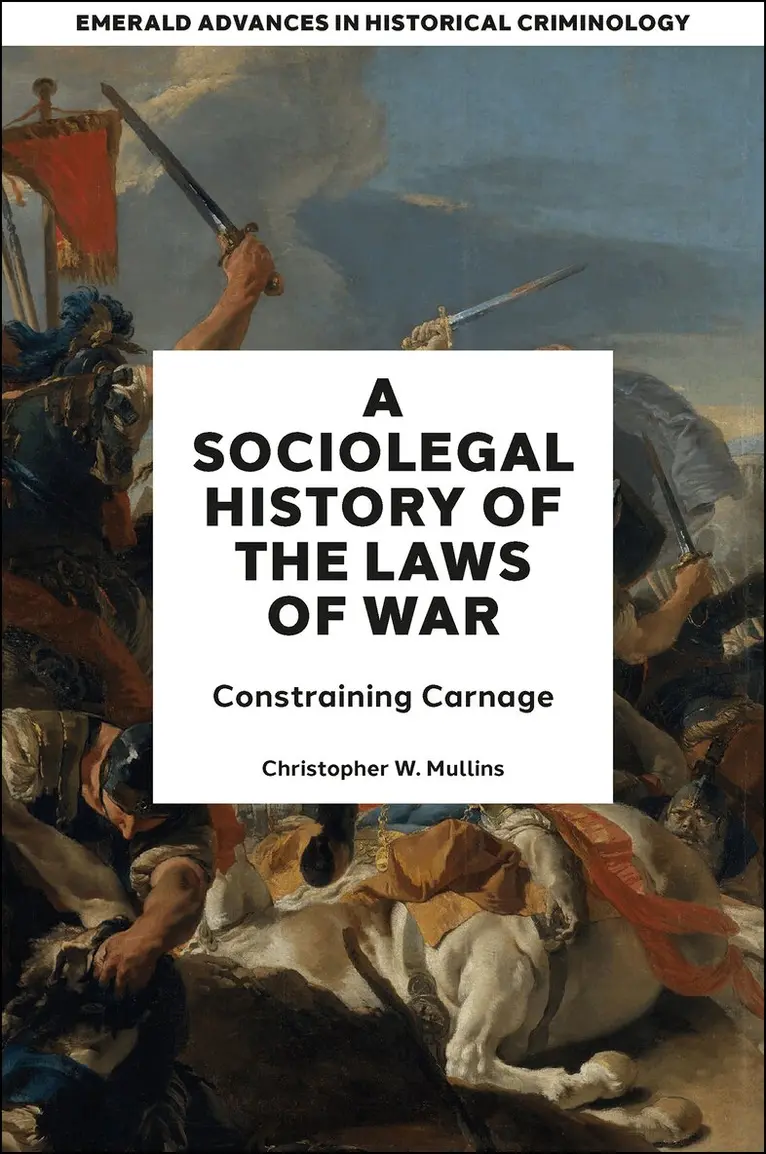
Since the Second World War, international laws governing the conduct of war and the behaviour of soldiers on the field of battle have been of strong academic and legal interest. Yet while they have seen their strongest articulation and enforcement in the contemporary era, rules governing such conduct are deeply rooted in human history.Beginning with the origins of organized warfare in the ancient world, A Socio-Legal History of the Laws of War: Constraining Carnage traces key structural and cultural changes through multiple historical contexts, highlighting various approaches to the nature and purpose of war, as well as the roles of both bystanders and participants. Where other scholarship has focused on the legality of war itself, Christopher W. Mullins concentrates on rules surrounding the behaviour of soldiers and commanders in the field while also demonstrating how these issues have transformed over time.Rooted in critical historical documents from the Tudors to the American Revolution, this rich history, the first of two volumes, provides a cogent understanding of how the current historical moment has developed, as well as of the potential paths that lie ahead.
982 kr
Skickas inom 7-10 vardagar
Revealing the cross utility potential of multiple disciplines to advance knowledge in crime studies, History & Crime showcases new research into crime from across the interdisciplinary perspectives of early modern and modern history, criminology, forensic psychology, and legal studies.Authored by emerging and established scholars from the around the world, the contributions span youth crime, feminist criminology, historic penology and court practices, through to the insanity defence, police corruption, and models for post-conflict governance. The chapters present the breadth of the work currently being undertaken around the world in this ground-breaking field, linking the present to the historic.Through these diverse chapters, the editors illustrate the current scholarship already bridging the oft-asserted divide between history and the social sciences. It is argued that differences in language and methodology may have created a mirage of disciplinary division. The collection consequently offers a unique opportunity for advancing a new framework for trans-disciplinary discourse to allow new research to be more easily interpreted and integrated across traditional disciplinary boundaries. This framework will guide future contributions in everything from histories of crime to future-focused crime scholarship, and by allowing better comprehension, drive ground-breaking new knowledge.
996 kr
Skickas inom 7-10 vardagar
The First British Crime Survey: An Ethnography of Criminology within Government explores the early history of the British Crime Survey, now the Crime Survey for England & Wales, a research enterprise widely perceived to be an international gold standard for the measurement of crime.Over the past forty years, the survey has reshaped public debate with new insights into patterns of crime and perceptions of the criminal justice system. Currently, the administrative origins of the survey can be traced to the growing influence of an international network of criminologists and public officials focused on crime prevention and measurement, the organisation of Home Office research programmes, and public officials’ concerns about urban uprisings, efficiency reforms, media coverage, and the politics of crime.The First British Crime Survey: An Ethnography of Criminology within Government examines the history of this survey through the work practices of the ‘crime survey circus’ which developed new methods for counting and reporting crime. Julian Molina provides a novel contribution to the understanding of how government officials, academics, and ‘administrative criminologists’ address the practical challenges associated with new, large-scale data projects. This ethnography draws on archival sources, interviews with government officials and criminologists, and the author’s experience using survey data within government.A crucial resource for understanding the history of the British Crime Survey, The First British Crime Survey: An Ethnography of Criminology within Government appeals to those interested in the relations between ‘law and order’ politics, crime statistics, administrative criminology, and the criminal justice system.
Transportation, Post-Penal Identity and the Life Course
The Continued Control of Pauper-Emancipists
Inbunden, Engelska, 2025
1 062 kr
Skickas inom 7-10 vardagar
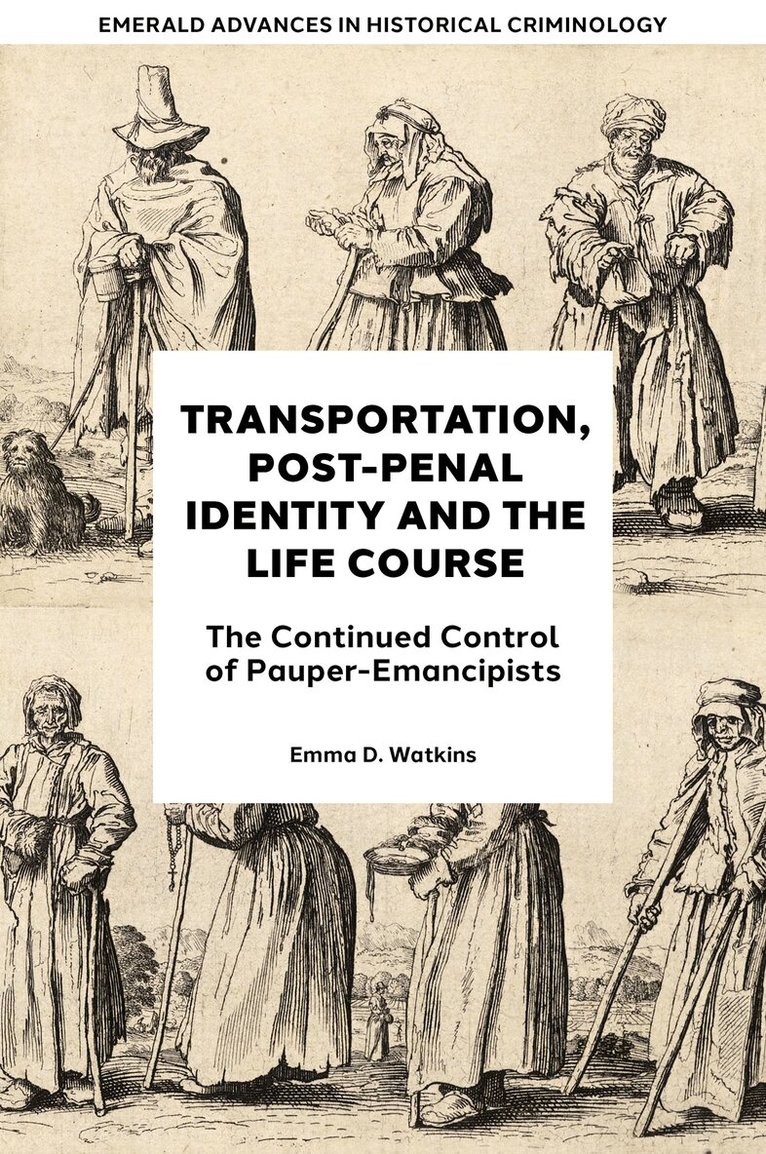
Transportation, Post-Penal Identity and the Life Course explores the life-courses of convicts who, after being transported to Van Diemen’s Land, now Tasmania, and released from servitude, died in pauper establishments.Presenting new case studies that look at the whole lives of former convicts dying in poverty to understand the long-term effects of the convict transportation system, Watkins facilitates an exploration of a broader view of the charitable institutions and its connections with the penal system. Delving into the path dependency and the criminalization of poverty the author uses criminal justice records, civil records, and newspapers for life-course analysis, along with colonial statistical returns and correspondence of officials to contextualize those life-courses. Exploring the Vandemonian charitable system within its post-penal identity and socio-economic context, this book looks at the social mobility of pauper emancipists to disrupt the enduring belief that all convicts who were transported to Australia were ‘better-off’ and that Australia was a ‘working man’s paradise’ in the context of a re-emerging glorification of empire.An interdisciplinary work exploring historical documentation and using criminological methodologies to uncover the lives of working-class people, this is insightful reading for researchers interested in the histories of charitable and criminal justice institutions, working class lives, life-course methodology, and criminalization.
600 kr
Skickas inom 7-10 vardagar
For nearly twenty years, Glasgow has been coined Europe’s murder capital, and identified as having the continent’s highest drug harms. The Contemporary History of Drug-Based Organised Crime in Scotland examines converging multiple complexities that contributed to Scotland’s criminal modus operandi concentrating on drug-based organised crime.Glasgow is the most populous city in Scotland. The region is likewise responsible for a disproportionate number of the country’s crimes. Police Scotland’s serious organised crime unit has identified as much as 70% of the country’s organised criminal activity to occur within or have ties to the region. A significant amount of these crimes is both directly and indirectly related to the illegal supply of drugs. Numerous law enforcement and political and public responses have been undertaken to reduce violence, organised crime, and drug harms in Scotland. Drawing on key case studies, McLean, Holligan and Pugh shed light on the historical factors that contributed to the embedding of violence, gangs, and drugs into the social fabric of the region.The Contemporary History of Drug-Based Organised Crime in Scotland provides insight into the development of drug based organised crime in the region, and how this process has subsequently shaped the wider criminal landscape of Scotland.
Socio-Legal History of the Laws of War
The Birth of International Humanitarian Law
Inbunden, Engelska, 2024
977 kr
Skickas inom 7-10 vardagar
International laws governing the conduct of war and the behaviour of soldiers on the field of battle is a topic of strong academic and legal interest. Moving beyond contemporary work on the laws of war that is legalistic in nature, A Socio-Legal History of the Laws of War demonstrates how the content and application of these laws are driven as much by cultural worldview and normative practice, as by legal principle.Tying the story of the development of the laws of war to key structural and cultural changes occurring within the societies that develop and adopt such behavioural proscriptions, this history, the second of two volumes, examines the emergence of international law and legal orders whereby warfare and its conduct begin moving out of the realm of cultural norms and into a quasi-legal space, where specific principles of international law in general, and laws of war in particular, become more precisely articulated, formalized, and codified.Examining the evolution and multiplication of laws constraining how warfare is waged from the founding of the United Nations and the formalized creation of the Geneva Conventions to the contemporary era, the utilization of ad hoc tribunals in the post-war period, and the establishment of the International Criminal Court in the early 21st century, Mullins provides a cogent understanding of how this historical moment developed and what paths potential lie ahead.
1 062 kr
Skickas inom 7-10 vardagar
Sitting at the extreme end of criminal justice and offending behaviour, public protection policy has been politicised and used to reshape wider debates. Exploring the development of public protection policy and legislation since the early 1990s, Politics and Public Protection considers the necessity for extreme measures and the actual extent of serious crime to unveil the populist nature of the way political debates have been framed over time.Analysing the UK setting where the public protection debate has been ‘weaponised’ to create public fear and ‘with us or against us’ positions, authors Mike Nash and Andy Williams chronicle how this form of politics has now extended into a range of policy areas, including Brexit. Emphasising the political context of the evolution of public protection policy over time, the chapters investigate different types of dangerous criminal behaviour, public protection agencies and responses to panic and failure, providing a critical analysis of the use of risk to reshape and reframe public protection policy and practice.Responding to the need for an updated discussion on public protection and criminal justice legislation that links the past to the present, Politics and Public Protection closely examines the interplay between politics and extreme criminal justice measures.
1 025 kr
Skickas inom 7-10 vardagar
Seeking to redress the traditional focus of historical criminology on the West and Global North, Imperial Crime and Punishment brings a fresh perspective to this burgeoning field by drawing instead on imperial contexts.Chapters focus on the nineteenth and twentieth centuries, which witnessed the development of the recognisably ‘modern’ institutions of the criminal justice system, including policing and institutions of punishment and care. The collection broadly covers punishment and its institutions, enforcement, a reflection on methodological considerations for digital crime history, and more. Examining imperial contexts such as India and Australia beyond their immediate geographical context, authors highlight the global and imperial context including the movement of ideas between the British state and colonies, the international dimension of global punishments, and movement of labour in this period.Offering empirically-based studies from the archives in order to understand and question beliefs about crime and social harm today, as well as ongoing practices both in, and outside of, the criminal justice system, Imperial Crime and Punishment provides a broad temporal and spatial scope to build the historical criminology literature and better understand and critique the world as it currently is.