Foreign Policies of the Middle Powers – serie
Visar alla böcker i serien Foreign Policies of the Middle Powers. Handla med fri frakt och snabb leverans.
6 produkter
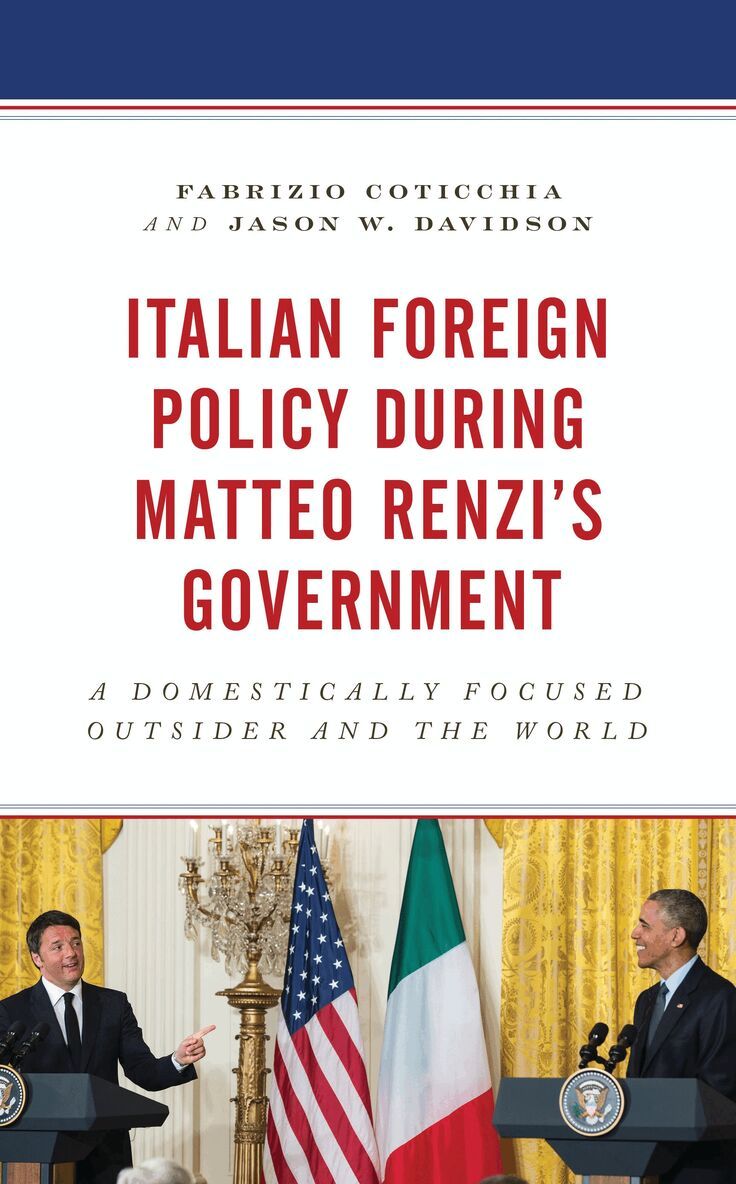
Italian Foreign Policy during Matteo Renzi's Government
A Domestically Focused Outsider and the World
Av Fabrizio Coticchia, Jason W. Davidson
Inbunden, 2019
1211 kr
Lägg i varukorg
This book sets out to explain the foreign policy of Italian Prime Minister Matteo Renzi (February 2014 to December 2016). It offers a unique analytical framework to make sense of Renzi’s foreign policy: the domestically-focused outsider. It argues that to untangle Renzi’s foreign policy one must …
Italy in Uncertain Times
Europeanizing Foreign Policy in the Declining Process of the American Hegemony
Häftad, 2023
300 kr
Lägg i varukorg
This book analyzes how variations in the traditional pillars of Italian foreign policy (the US, the EU and multilateralism) can be related to changes in the US-led international hegemonic order and to the role that Italy plays within that order. To explore these variations, the book proposes an …
Bureaucratic Smokescreens
Aid-Diplomacy Mergers and the Politics of Foreign Policy Reform
Inbunden, 2026
919 kr
Kommande
For much of the postwar era, development agencies operated as largely autonomous institutions, justified as complements to national security and diplomacy. That settlement is now unraveling. Humanitarian aid and development assistance have become increasingly entangled with security politics, amid …
Middle Powers in Asia and Europe in the 21st Century
Av Giampiero Giacomello, Bertjan Verbeek
Häftad, 2021
517 kr
Lägg i varukorg
This volume presents three claims regarding the role of middle powers in the 21st Century: first, states aspiring to become or remain middle powers choose from three possible role: to be a global middle powers; to be a regional pivot; or to be a niche leader. Second, states seeking such roles need …
Niche Diplomacy of Asian Middle Powers
Inbunden, 2021
1140 kr
Lägg i varukorg
The four countries represented in this volume are East Asian middle powers with strategic constraints upon their traditional security policymaking. These middle powers have pursued diplomatic activities raising their international profile or footprint, and advancing their national interest, through …
Bureaucratic Smokescreens
Aid-Diplomacy Mergers and the Politics of Foreign Policy Reform
E-bok, 2026
1013 kr
Kommande
For much of the postwar era, development agencies operated as largely autonomous institutions, justified as complements to national security and diplomacy. That settlement is now unraveling. Humanitarian aid and development assistance have become increasingly entangled with security politics, amid …