Hastings Center Studies in Ethics series - Böcker
Visar alla böcker i serien Hastings Center Studies in Ethics series. Handla med fri frakt och snabb leverans.
13 produkter
13 produkter
629 kr
Skickas inom 7-10 vardagar
Mental illness is the poor, and somehow "damaged," cousin to physical ailments in the eyes of too many in our society. Compare the difference in how people would respond to someone who had fallen and broken their leg on the street, to how most react to those mentally ill among us, on those same streets, who spend their winters on steam grates and forage for food in dumpsters. "Rationing Sanity" is a provocative analysis of the mental health care system in the United States, dealing with issues of justice and access to mental health care. How should a decent society, affluent but facing many serious calls on its resources, best care for citizens afflicted with severe and persistent mental illnesses? James Lindemann Nelson brings together, for the first time, scholars of the ethics of mental health care and top managed care policy analysts to address this crucial problem. "Rationing Sanity" integrates those perspectives with the thoughtful practice-based experience of physicians well versed in the actual care of people with emotional and behavioral problems.Over a period of years, the contributors met face-to-face to engage each other on the ethics of managed mental health care - the result is a unique, collaborative effort that provides a wealth of important new insights on not only how Americans can readjust their attitudes toward the mentally ill - but also how we may find more just and humane treatment for those afflicted.
781 kr
Skickas inom 5-8 vardagar
Regardless of the fate of national health care reform, public policy makers will have to make difficult and tragic choices about which health services are more or less important. This volume, the first comprehensive examination of setting mental health services priorities, systematically explores the history, ethics, and politics of setting priorities for public mental health services. Because mental health services have traditionally been given lower priority and less generous benefits than general health services, they form a striking case study for priority setting. Written by mental health care practitioners and scholars, "What Price Mental Health?" explores the social factors that most influence attempts to set priorities; offers case studies at the state level; illustrates priorities at the federal level and in the private sector; and, identifies the ethical criteria that must be applied in any attempt to set priorities. This volume is conceptionally rich for those familiar with mental health care research, but written in a style understandable to the general reader. Policy makers will find the book useful in the on-going debates about mental health care.Psychologists, public health professionals, researchers and students of psychology, public policy and public health will find this study an absorbing and informative addition to the mental health field.
Coerced Contraception?
Moral and Policy Challenges of Long Acting Birth Control
Häftad, Engelska, 1996
781 kr
Skickas inom 5-8 vardagar
Long-acting and reversible contraceptives, such as Norplant and Depo-Provera, have been praised as highly effective, moderately priced, and generally safe. Yet, as this book argues, the very qualities that make these contraceptives an important alternative for individual choice in family planning also make them a potential tool of coercive social policy. For example, policymakers have linked their use to welfare benefits, and judges, to probation agreements. In this book, authors from the fields of medicine, ethics, law, and the social sciences probe the unique and vexing ethical and policy issues raised by long-acting contraception. The book offers comprehensive ethical guidelines for health care professionals and policymakers, as well as an ethical framework for analyzing policies and practices concerning long-acting contraceptives. The authors consider cultural, social, and ethical issues pertaining to contraception, and they provide historical and scientific background on today's controversies. They explore alternative conceptual and theoretical frameworks, including analyses of autonomy, coercion, and responsibility in reproductive decisions.This volume also notes the special concerns that arise when policies promoting long-term birth control target low-income women and women of color, and when these contraceptives are used in developing countries.
413 kr
Skickas inom 3-6 vardagar
For much of the developed world, health care for a surging elderly population looms as one of the most daunting problems of the coming decade. In this book, contributors from diverse disciplinary backgrounds and countries discuss resource allocation for the elderly and debate plans for the years ahead. Essays focus on five general issues: the meaning of old age, the goals of medicine and health care for the elderly, the balance between the needs of the young and old, the pressures of other social priorities, and the role of families, especially the burden on women, in long-term care. In consideration of the difficult moral and practical issues involved, the editors conclude the volume with a special report containing policy recommendations from representatives of eight countries (the United States, Belgium, the Czech Republic, Germany, Hungary, the Netherlands, Sweden, and the United Kingdom). This important volume will be of interest to policymakers and a broad spectrum of health care professionals, as well as to anyone interested in the fate of the elderly or in coming health care challenges.
629 kr
Skickas inom 7-10 vardagar
An authoritative introduction to bioethics, "Life Choices" examines a comprehensive range of ethical questions and brings together some of the most probing and instructive essays published in the field. Some of the articles are classics in the literature of bioethics, while others address current issues. Topics include moral decision making, abortion, euthanasia and assisted suicide, life-sustaining technologies, organ transplantation, reproductive technologies, and the allocation of health care resources. This second edition features new sections on the goals and allocation of medicine and on the cloning of human beings. It also includes new articles on genetics, the duty to die, and ethical theory. Written by the foremost authorities in bioethics, "Life Choices" provides a comprehensive introduction to the field. Instructors who have used the first edition as a text will welcome this new, updated edition. Scholars and health care practitioners will find it useful as a valuable reference on a wide range of bioethical issues.
425 kr
Skickas inom 5-8 vardagar
In this volume, scholars from philosophy, sociology, history, theology, women's studies, and law explore the looming ethical and social implications of new biotechnologies that are rapidly making it possible to enhance an individual's mental and physical attributes in ways previously only imagined. To clarify the issues, the contributors grapple with the central concept of "enhancement" and probe the uses and abuses of the term. Focusing in particular on the moral issues pertaining to cosmetic surgery and cosmetic psychopharmacology (a category which includes Prozac), they also examine notions of identity, authenticity, normality, and complicity. Other essays in this collection address the social ramifications of the new technologies, including the problems of access and fairness.
986 kr
Skickas inom 3-6 vardagar
This book examines why physicians are often surprisingly reluctant to follow guidelines for treating patients based on research data. It assesses the merits of these concerns - which include worries about legal liability, financial incentives, the scientific validity of the data, and the objectivity of the issuer of the guidelines. It also proposes ways of developing more useful data and more effective guidelines that would reduce their objections.
781 kr
Skickas inom 5-8 vardagar
As prenatal tests proliferate, the medical and broader communities perceive that such testing is a logical extension of good prenatal care - it helps parents have healthy babies. But prenatal tests have been criticized by the disability rights community, which contends that advances in science should be directed at improving their lives, not preventing them. Used primarily to decide to abort a fetus that would have been born with mental or physical impairments, prenatal tests arguably reinforce discrimination against and misconceptions about people with disabilities. In these essays, people on both sides of the issue engage in an honest and occasionally painful debate about prenatal testing and selective abortion. The contributors include both people who live with and people who theorize about disabilities, scholars from the social sciences and humanities, medical geneticists, genetic counselors, physicians, and lawyers. Although the essayists don't arrive at a consensus over the disability community's objections to prenatal testing and its consequences, they do offer recommendations for ameliorating some of the problems associated with the practice.
781 kr
Skickas inom 5-8 vardagar
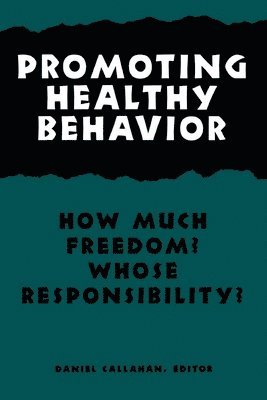
The government, the media, HMOs, and individual Americans have all embraced programs to promote disease prevention. Yet obesity is up, exercise is down, teenagers continue to smoke, and sexually transmitted disease is rampant. Why? These intriguing essays examine the ethical and social problems that create subtle obstacles to changing Americans' unhealthy behavior. The contributors raise profound questions about the role of the state or employers in trying to change health-related behavior, about the actual health and economic benefits of even trying, and about the freedom and responsibility of those of us who, as citizens, will be the target of such efforts. They ask, for instance, whether we are all equally free to live healthy lives or whether social and economic conditions make a difference. Do disease prevention programs actually save money, as is commonly argued? What is the moral legitimacy of using economic and other incentives to change people's behavior, especially when (as with HMOs) the goal is to control costs?One key issue explored throughout the book is the fundamental ambivalence of traditionally libertarian Americans about health promotion programs: we like the idea of good health, but we do not want government or others posing threats to our personal lifestyle choices. The contributors argue that such programs will continue to prove less than wholly successful without a fuller examination of their place in our national values.
369 kr
Tillfälligt slut
Developments in biotechnology, such as cloning and the decoding of the human genome, are generating questions and choices that traditionally have fallen within the realm of religion and philosophy: the definition of human life, human vs. divine control of nature, the relationship between human and non-human life, and the intentional manipulation of the mechanisms of life and death. In "Claiming Power over Life", eight contributors challenge policymakers to recognize the value of religious views on biotechnology and discuss how best to integrate the wisdom of the Christian and Jewish traditions into public policy debates. Arguing that civic discourse on the subject has been impoverished by an inability to accommodate religious insights productively, they identify the ways in which religious thought can contribute to policymaking. Likewise, the authors challenge religious leaders and scholars to learn about biotechnology, address the central issues it raises, and participate constructively in the moral debates it engenders.This book will be of value to policymakers, religious leaders, ethicists, and all those interested in issues surrounding the intersection of religion and biotechnology policy.
758 kr
Skickas inom 5-8 vardagar
All manner of medical practitioners have had their scruples dissected ad infinitum. In spite of the attention paid to medical ethics and bioethics, little has been paid to the ethical roles and responsibilities of those who are ultimately in charge of hospital governance: hospital trustees. Deriving from a Hastings Center research project involving meetings with a national task force of experts and extensive interviews with 98 nonprofit hospital trustees and CEOs over a two-year period, The Ethics of Hospital Trustees shows that the decisions made by these often overlooked members of the health community do raise important ethical issues, and that ethical dimensions of trustee service should be more explicitly recognized and discussed. Practical as well as theoretical, The Ethics of Hospital Trustees uncovers four basic principles: 1. Fidelity to mission; 2. Service to patients; 3. Service to the community; and 4. Institutional stewardship.In delineating the extremely important functions of hospital trustees, from patient safety to financial responsibility, the contributors outline not only how hospital trustees do perform-they give a fresh understanding to how they should perform as well.
428 kr
Skickas inom 3-6 vardagar
At the center of the debate over complementary and alternative medicine - from acupuncture and chiropractic treatments to homeopathy and nutritional supplements - is how to scientifically measure the effectiveness of a particular treatment. Fourteen scholars from the fields of medicine, philosophy, sociology, and cultural and folklore studies examine that debate, and the clash between growing public support and the often hostile stance of clinicians and medical researchers. Proponents and critics have different methodologies and standards of evidence - raising the question of how much pluralism is acceptable in a medical context - particularly in light of differing worldviews and the struggle to define medicine in the modern world. The contributors address both the methodological problems of assessment and the conflicting cultural perspectives at work in a patient's choice of treatment. Sympathetic to CAM, the contributors nonetheless offer careful critiques of its claims, and suggest a variety of ways it can be taken seriously, yet subject to careful scrutiny.
781 kr
Skickas inom 5-8 vardagar
According to a recent Institute of Medicine report, as many as 98,000 Americans die each year as a result of medical error - a figure higher than deaths from automobile accidents, breast cancer, or AIDS. That astounding number of fatalities does not include the number of those serious mistakes that are grievous and damaging but not fatal. Who can forget the tragic case of 17-year-old Jesica Santillan, who died after receiving a heart-lung transplant with an incompatible blood type? What can be done about this? What should be done? How can patients and their families regain a sense of trust in the hospitals and clinicians that care for them? Where do we even begin the discussion? "Accountability" brings the issue to the table in response to the demand for patient safety and increased accountability regarding medical errors. In an interdisciplinary approach, Virginia Sharpe draws together the insights of patients and families who have suffered harm, institutional leaders galvanized to reform by tragic events in their own hospitals, philosophers, historians, and legal theorists.Many errors can be traced to flaws in complex systems of health care delivery, not flaws in individual performance. How then should we structure responsibility for medical mistakes so that justice for the injured can be achieved alongside the collection of information that can improve systems and prevent future error? Bringing together authoritative voices of family members, health care providers, and scholars - from such disciplines as medical history, economics, health policy, law, philosophy, and theology - this book examines how conventional structures of accountability in law and medical structure (structures paradoxically at odds with justice and safety) should be replaced by more ethically informed federal, state, and institutional policies. Accountability calls for public policy that creates not only systems capable of openness concerning safety and error - but policy that also delivers just compensation and honest and humane treatment to those patients and families who have suffered from harmful medical error.