Imagining the Americas - Böcker
Visar alla böcker i serien Imagining the Americas. Handla med fri frakt och snabb leverans.
9 produkter
9 produkter
1 320 kr
Skickas inom 5-8 vardagar
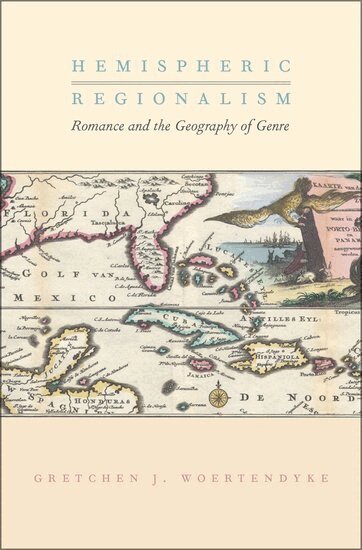
In this broad ranging study, Gretchen Woertendyke reconfigures US literary history as a product of hemispheric relations. Hemispheric Regionalism: Romance and the Geography of Genre, brings together a rich archive of popular culture, fugitive slave narratives, advertisements, political treatises, and literature to construct a new literary history from a hemispheric and regional perspective. At the center of this history is romance, a popular and versatile literary genre uniquely capable of translating the threat posed by the Haitian Revolution--or the expansionist possibilities of Cuban annexation--for a rapidly increasing readership. Through romance, she traces imaginary and real circuits of exchange and remaps romance's position in nineteenth century life and letters as irreducible to, nor fully mediated by, a concept of nation. The energies associated with Cuba and Haiti, manifest destiny and apocalypse, bring historical depth to an otherwise short national history. As a result, romance becomes remarkably influential in inculcating a sense of new world citizenry. The study shifts our critical focus from novel and nation, to romance and region, inevitable, she argues, when we attend to the tangled, messy relations across geographic and historical boundaries.Woertendyke reads the archives of Gabriel Prosser, Nat Turner, and Denmark Vesey along with less frequently treated writers such as John Howison, William Gilmore Simms, and J.H. Ingraham. The study provides a new context for understanding works by Washington Irving, Edgar Allan Poe, Herman Melville, and James Fenimore Cooper and brings together the theories of Charles Brockden Brown, the editorial work of Maturin M. Ballou, and the historical romances of Walter Scott. In Hemispheric Regionalism, Woertendyke demonstrates that US literature has always been the product of hemispheric and regional relations and that all forms of romance are central to this history.
578 kr
Skickas inom 5-8 vardagar
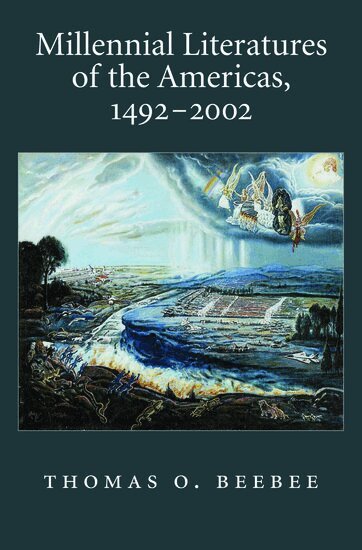
This bracing and far-ranging study compares modern (post-1492) literary treatments of millenarian narratives--"end of the world" stories charting an ultimate battle between good and evil that destroys previous social structures and rings in a lasting new order. While present in many cultures for as long as tales have been told, these accounts take on a profound dramatic resonance in the context of Europe's centuries-long colonization of the American hemisphere. With an impressive interdisciplinary approach that employs insights from history, ethnography, and theology, Thomas O. Beebee provides nuanced readings of the apocalyptic vision in a diverse group of forms and writers, stretching from the letters of Christopher Columbus to the lyrics of Bob Marley and Bob Dylan, the poetry of Ernesto Martínez, and the bestselling novels of the Left Behind franchise, among other works. Throughout, he pointedly illustrates how millennial discourse has been used as a technology of control to further national and imperial agendas while paradoxically, often simultaneously, serving the forces of resistance. Drawing on a wide variety of records, his analysis shows that repeated eruptions of imagined, epochal conflicts reveal native populations fighting against the eradication of traditional ways of life, making sense of unprecedented violence, and searching for sources of origin. It seems that Americans--North, South, Middle, and Caribbean--tend to define themselves by narrating their End. Informed by extensive research and an imaginative marshalling of diverse insights, Beebee presents a comprehensive comparative treatment of millennial themes in works from English, French, Portuguese, and Spanish. In so doing, he illustrates that prophesies of telos, and the literature that imagines them, provide a vital context for understanding the connected yet distinct cultures that have shaped the American hemisphere.
608 kr
Skickas inom 5-8 vardagar
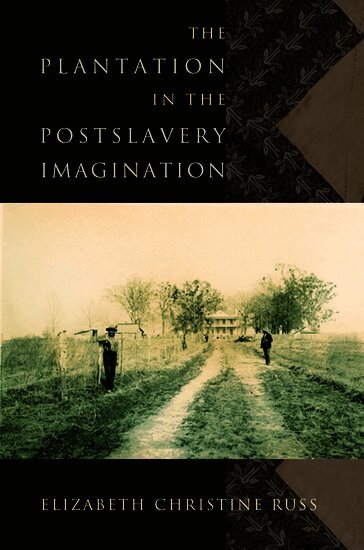
The Plantation in the Postslavery Imagination examines the persistent presence of the plantation in trans-American literatures of the last century. Russ conceives the plantation to be not primarily a physical location, but rather an ideological and psychological trope through which intersecting histories of the New World are told and retold. The permutations of this imagined site (as something related to but separate from the real plantation) illuminate a number of fundamental issues of concern in Latin American and transnational American studies. The book's comparative analyses engage in debates over gender, race, and nation by emphasizing a series of differences: between modern and postmodern imaginaries, the United States and Spanish America, and continental and island plantation societies.
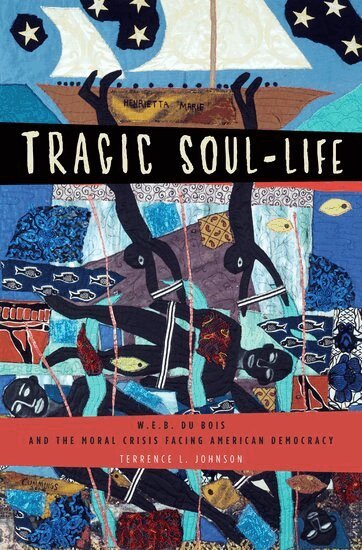
Tragic Soul-Life
W.E.B. Du Bois and the Moral Crisis Facing American Democracy
Inbunden, Engelska, 2012
1 320 kr
Skickas inom 5-8 vardagar
Contemporary debates on the role of religion in American public life ignore the overlap between religion and race in the formation of American democratic traditions and more often than not imagine democracy within the terrain of John Rawls's political liberalism. This kind of political liberalism, which focuses on political commitments at the expense of our religious beliefs, fosters the necessary conditions to open historically closed doors to black bodies, allows blacks to sit at the King's table and creates the necessary safeguards for black protest against discrimination within a constitutional democracy. By implication of its emphasis on rights and inclusion, political liberalism assumes that the presence of black bodies signifies the materialization of a robust American democracy. However, political liberalism discounts the historical role of religion in forming and fashioning the nation's construction of race. Tragic Soul-Life argues that the collision between religion and politics during U.S. slavery and segregation created the fragments from which emerged a firm but shifting moral disdain for blackness within the nation's collective moral imagination.The very problem political liberals want to avoid, our comprehensive philosophy, is central to solving the political and economic problems facing blacks.
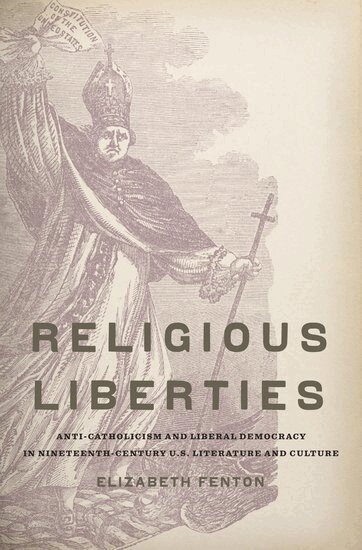
Religious Liberties
Anti-Catholicism and Liberal Democracy in Nineteenth-Century U.S. Literature and Culture
Inbunden, Engelska, 2011
1 320 kr
Skickas inom 5-8 vardagar
In the late eighteenth and nineteenth centuries, U.S. literary and cultural productions often presented Catholicism not only as a threat to Protestantism but also as an enemy of democracy. Focusing on representations of the Catholic as a political force, Elizabeth Fenton argues that U.S. understandings of religious freedom grew partly, and paradoxically, out of a virulent anti-Catholicism. Depictions of Catholicism's imagined intolerance and cruelty allowed U.S. writers time and again to depict their nation as tolerant and free. As Religious Liberties shows, anti-Catholicism particularly shaped U.S. conceptions of pluralism and its relationship to issues as diverse as religious privacy, territorial expansion, female citizenship, political representation, chattel slavery, and governmental partisanship.Religious Liberties examines a wide range of materials-from the Federalist Papers to antebellum biographies of Toussaint Louverture; from nativist treatises to Margaret Fuller's journalism; from convent exposés to novels by Charles Brockden Brown, Catharine Sedgwick, Augusta J. Evans, Nathanial Hawthorne, Harriet Beecher Stowe, Herman Melville, Henry Adams, and Mark Twain-to excavate anti-Catholicism's influence on both the liberal tradition and early U.S. culture. In concert, these texts reveal that Anti-Catholicism facilitated an alignment of U.S. nationalism with Protestantism. Religious Liberties shows that this alignment ultimately has ensured the mutual dependence, rather than the "separation " we so often take for granted, of church and state.
Del 6 - Imagining the Americas
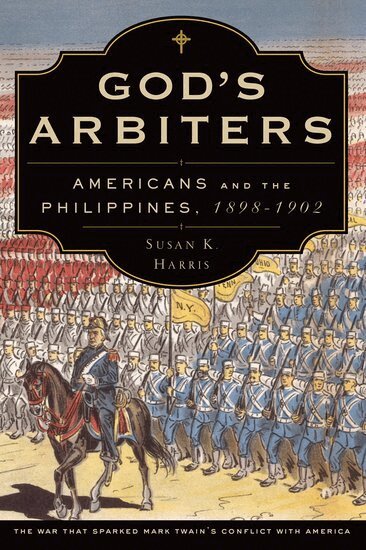
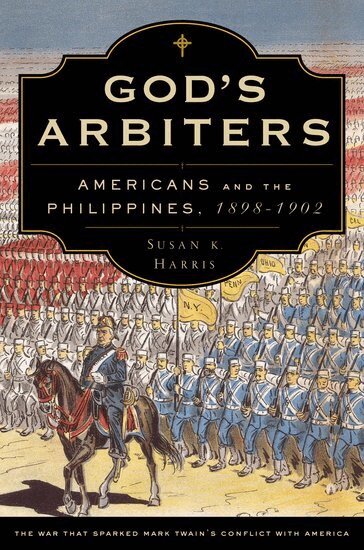
God's Arbiters
Americans and the Philippines, 1898 - 1902
Häftad, Engelska, 2013
435 kr
Skickas inom 5-8 vardagar
When the U.S. liberated the Philippines from Spanish rule in 1898, the exploit was hailed at home as a great moral victory, an instance of Uncle Sam freeing an oppressed country from colonial tyranny. The next move, however, was hotly contested: should the U.S. annex the archipelago? The disputants did agree on one point: that the United States was divinely appointed to bring democracy--and with it, white Protestant culture--to the rest of the world. They were, in the words of U.S. Senator Albert Beveridge, "God's arbiters," a civilizing force with a righteous role to play on the world stage.Mining letters, speeches, textbooks, poems, political cartoons and other sources, Susan K. Harris examines the role of religious rhetoric and racial biases in the battle over annexation. She offers a provocative reading both of the debates' religious framework and of the evolution of Christian national identity within the U.S. The book brings to life the personalities who dominated the discussion, figures like the bellicose Beveridge and the segregationist Senator Benjamin Tillman. It also features voices from outside U.S. geopolitical boundaries that responded to the Americans' venture into global imperialism: among them England's "imperial" poet Rudyard Kipling, Nicaragua's poet/diplomat Rubén Darío, and the Philippines' revolutionary leaders Emilio Aguinaldo and Apolinario Mabini. At the center of this dramatis personae stands Mark Twain, an influential partisan who was, for many, the embodiment of America. Twain had supported the initial intervention but quickly changed his mind, arguing that the U.S. decision to annex the archipelago was a betrayal of the very principles the U.S. claimed to promote.Written with verve and animated by a wide range of archival research, God's Arbiters reveals the roots of current debates over textbook content, evangelical politics, and American exceptionalism-shining light on our own times as it recreates the culture surrounding America's global mission at the turn into the twentieth century.
The Unsettlement of America
Translation, Interpretation, and the Story of Don Luis de Velasco, 1560-1945
Inbunden, Engelska, 2014
1 239 kr
Skickas inom 5-8 vardagar
The Unsettlement of America explores the career and legacy of Don Luis de Velasco, an early modern indigenous translator of the sixteenth-century Atlantic world who traveled far and wide and experienced nearly a decade of Western civilization before acting decisively against European settlement. The book attends specifically to the interpretive and knowledge-producing roles played by Don Luis as a translator acting not only in Native-European contact zones but in a complex arena of inter-indigenous transmission of information about the hemisphere. The book argues for the conceptual and literary significance of unsettlement, a term enlisted here both in its literal sense as the thwarting or destroying of settlement and as a heuristic for understanding a wide range of texts related to settler colonialism, including those that recount the story of Don Luis as it is told and retold in a wide array of diplomatic, religious, historical, epistolary, and literary writings from the middle of the sixteenth century to the middle of the twentieth. Tracing accounts of this elusive and complex unfounding father from the colonial era as they unfolds across the centuries, The Unsettlement of America addresses the problems of translation at the heart of his story and speculates on the implications of the broader, transhistorical afterlife of Don Luis for the present and future of hemispheric American studies.
688 kr
Skickas inom 5-8 vardagar
Mark Twain called it "pious hypocrisies." President McKinley called it "civilizing and Christianizing." Both were referring to the U.S. annexation of the Philippines in 1899. Drawing on documents ranging from Noah Webster's 1832 History of the United States through Congressional speeches and newspaper articles, and the anti-imperialist writings of Mark Twain, Harris keenly assesses the attitudes of Americans and the moralistic rhetoric that governed national and international debates over America's global mission at the turn into the twentieth century. She offers a provocative reading both of the debates' religious framework and of the evolution of Christian national identity within the U.S. She also moves outside U.S. geopolitical boundaries, reviewing responses to the Americans' venture into global imperialism among Europeans, Latin Americans, and Filipinos.
1 440 kr
Skickas inom 5-8 vardagar
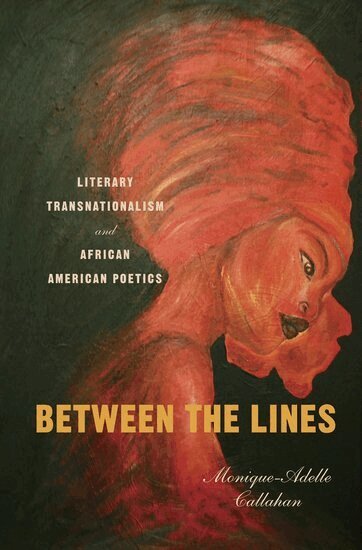
Between the Lines examines the role of women poets of African descent in shaping the history of the Americas. Focusing on three women whose poetry wrestled with the sociopolitical predicaments of the late nineteenth century, Between the Lines ventures a broader definition of African American literature by placing it in a hemispheric context. These poets wrote about slavery and its impact on conceptions of free people and free nations; about an existential struggle against boundaries informed by race, nation, and gender; about the power of words to correct, compose, and constitute identities. For these writers, the poem was a dynamic space where the history of slavery met a need for new concepts of individual and collective freedoms. In their work we encounter the poem as a site of cross-cultural exchange, a literary space in which the boundaries of nation can be re-imagined. Between the Lines situates national poetics in a global economy of identities, histories and languages. It looks to poetry to more fully demonstrate how we use language to conceptualize history, how we daily translate from one cultural or linguistic arena to another, how we constantly write identity into existence through a poetic use of language. Sometimes language fails. Inevitably it traps us in the very boundaries that we try to escape. Between the Lines traces this cycle as it informs the poetry of the Americas as it draws and erases national and transnational lines.