International Courts and Tribunals – serie
Visar alla böcker i serien International Courts and Tribunals. Handla med fri frakt och snabb leverans.
6 produkter
6 produkter
1 066 kr
Kommande
This book concerns a topic of increasing importance in international dispute settlement: the principles according to which an international tribunal with a limited jurisdiction may apply 'law' other than the law specific to its jurisdiction when resolving a dispute. These questions are sometimes regulated in the instruments establishing particular tribunals, but the interpretation of these provisions has proved to be controversial, while many instruments establishing international courts and tribunals fail entirely to provide guidance on these issues. This book has three main objectives: first, to undertake a comprehensive theoretical and comparative study of the treatment of the issue of applicable law in the most important instruments establishing international courts and tribunals; second, to arrive at default rules that should apply to tribunals without an express rule on applicable law; and third, to explore the implications of such rules for the international legal order. The conceptual context of the research question at issue is the increasing fragmentation of the international legal order, which is a result of the proliferation of both international treaties and international dispute settlement activity over the past decade. In this overall context, there have been studies on different aspects of this issue, including the scope of jurisdiction of international tribunals, conflicts between the decisions of international tribunals and - this being an old question - the hierarchy of norms in general international law. However, this book is the first to give a comprehensive and comparative treatment to the topic of the 'applicable law' of specific courts and tribunals.
1 480 kr
Skickas inom 3-6 vardagar
Recent years have witnessed a sharp increase in the number of international courts and tribunals (e.g., WTO, NAFTA, ITLOS, ICC, etc.) and greater willingness on the part of states and other international actors to subject themselves to the compulsory jurisdiction of international adjudicative mechanisms. However, because of the uncoordinated nature of these developments, overlaps between the jurisdictional ambits of the different judicial bodies might occur - i.e., the same dispute could fall under the jurisdiction of more than one forum. This raises both theoretical and practical issues of coordinating between the various jurisdictions.The purpose of this book is to explore the implications of jurisdictional competition and to identify standards that may alleviate problems associated with the phenomenon, which arguably threatens the unity of international law. The first part of the book examines the jurisdictional ambits of the principal international courts and tribunals and delineates areas of overlap between their respective jurisdictions. Them follows a discussion of some of the potential systematic and practical problems that arise out of jurisdictional competition (e.g., forum shopping and multiple proceedings) and considers the expediency of mitigating them. It concludes by identifying existing rules of international law, which govern inter-jurisdictional competition, and considering the desirability of introducing additional norms and arrangements.
775 kr
Skickas inom 5-8 vardagar
Recent years have witnessed a sharp increase in the number of international courts and tribunals (WTO, NAFTA, ITLOS, ICC, etc.) and greater willingness on the part of states and other international actors to subject themselves to the compulsory jurisdiction of international adjudicative mechanisms. However, because of the uncoordinated nature of these developments, overlaps between the jurisdictional ambits of the different judicial bodies might occur, i.e., the same dispute could fall under the jurisdiction of more than one forum. This raises both theoretical and practical issues of coordination between the various jurisdictions.The purpose of this book is to explore the implications of jurisdictional competition and to identify standards that may alleviate problems associated with the phenomenon, which arguably threatens the unity of international law. The first part of the book examines the jurisdictional ambits of the principal international courts and tribunals and delineates areas of overlap between their respective jurisdictions. There follows a discussion of some of the potential systematic and practical problems that arise out of jurisdictional competition (such as forum shopping and multiple proceedings) and a consideration of the expediency of mitigating them. The book concludes by identifying existing rules of international law, which govern inter-jurisdictional competition, and by considering the desirability of introducing additional norms and arrangements.
1 846 kr
Skickas inom 7-10 vardagar
The dramatic rise in the number of international courts and tribunals and the expansion of their legal powers has been one of the most significant developments in international law of the late 20th century. The emergence of an international judiciary provided international law with a stronger than ever law enforcement apparatus, and facilitated the transformation of many aspects of international relations from being power-based to being law-based.The first edition of the Manual on International Courts and Tribunals, published in 1999, was the first book to survey systematically this new institutional landscape, by describing in an accessible and uniformly structured manner the legal powers and operating procedures of all major international judicial and quasi-judicial bodies. In doing so, it laid the groundwork for comparative study and research of the law and practice of international courts and tribunals - an emerging field of international legal research, which has already spurred a series of publications, conferences and academic courses. This second edition updates the first edition by describing the many legal changes that have taken place in the last decade, including important reforms in the laws and procedures of many international courts and tribunals, relevant developments in their increasingly rich jurisprudence and the creation of new judicial fora. Moreover, it assesses the overall record of these judicial bodies. The data and legal analysis offered in the book provide both practitioners and academics with an important basis of knowledge that will help them better understand the details of international adjudication and its context.
884 kr
Skickas inom 7-10 vardagar
This book seeks to investigate the growing jurisdictional interaction between national and international courts ie: their parallel involvement in the same or related disputes in the light of competing theoretical, ideological and methodological discourses on the nature of the relationship and the means to regulate it. In particular, it aims to explore what, if any, rules of international law could, or perhaps should govern such interactions, and regulate forum selection or multiple proceedings involving national and international courts. In addition, the book explores the standards of review employed by international courts vis-à-vis the decisions of their domestic counterparts and vice versa. It posits that the regulation of such interactions ultimately depends on the selection of the overarching paradigm that governs the relations between national and international courts (hierarchical as opposed to non-hierarchical and disintegrative or integrative conceptual frameworks). Following academic discussion of the problems and solutions pertaining to the interaction between national and international courts, the book considers the potential applicability of several jurisdiction-regulating measures to jurisdictional interactions between national and international courts. These include rules on forum selection and rules designed to regulate multiple proceedings (e.g., lis alibi pendens and res judicata), utilization of comity based measures and doctrines, such as discretionary stay or dismissal of proceedings and margin of appreciation judicial review, and examination of the prohibition against abuse of rights. This segment of the book strives to provide lawyers and academics with a 'tool kit' of measures which could be employed in cases involving jurisdictional interactions between national and international courts.
884 kr
Skickas inom 7-10 vardagar
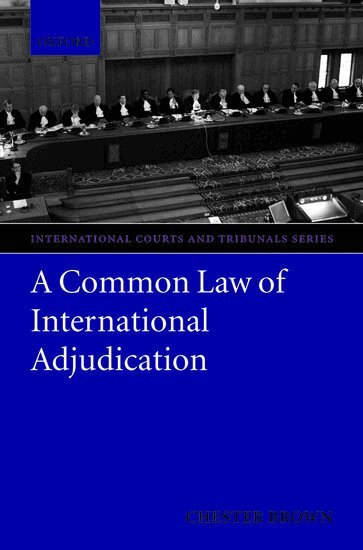
Recent years have seen a proliferation of international courts and tribunals, which has given rise to several new issues affecting the administration of international justice. This book makes a signification contribution to understanding the impact of this proliferation by addressing one important question: namely, whether international courts and tribunals are increasingly adopting common approaches to issues of procedure and remedies. This book's central argument is that there is an increasing commonality in the practice of international courts to the application of rules concerning these issues, and that this represents the emergence of a common law of international adjudication. This book examines this question by considering several key issues relating to procedure and remedies, and analyses relevant international jurisprudence to demonstrate that there is susbstantial commonality. It goes on to look at why international courts are increasingly adopting common approaches to such questions, and why a greater degree of commonality may be found with respect to some issues rather than others. In doing so, light is shed on the methods adopted by international courts to engage in the cross-fertilization of legal principles. The emergence of a common law of international adjudication has important practical and theoretical implications, as it suggests that international courts can also devise common approaches to the challenges that they face in the age of proliferation. It also suggests that international courts do not generally operate as self-contained regimes, but rather that they regard themselves as forming part of a community of international courts, therefore having positive implications for the development of an truly international legal system.