ISCE Book Series: Managing the Complex - Böcker
Visar alla böcker i serien ISCE Book Series: Managing the Complex. Handla med fri frakt och snabb leverans.
10 produkter
10 produkter
752 kr
Skickas inom 7-10 vardagar
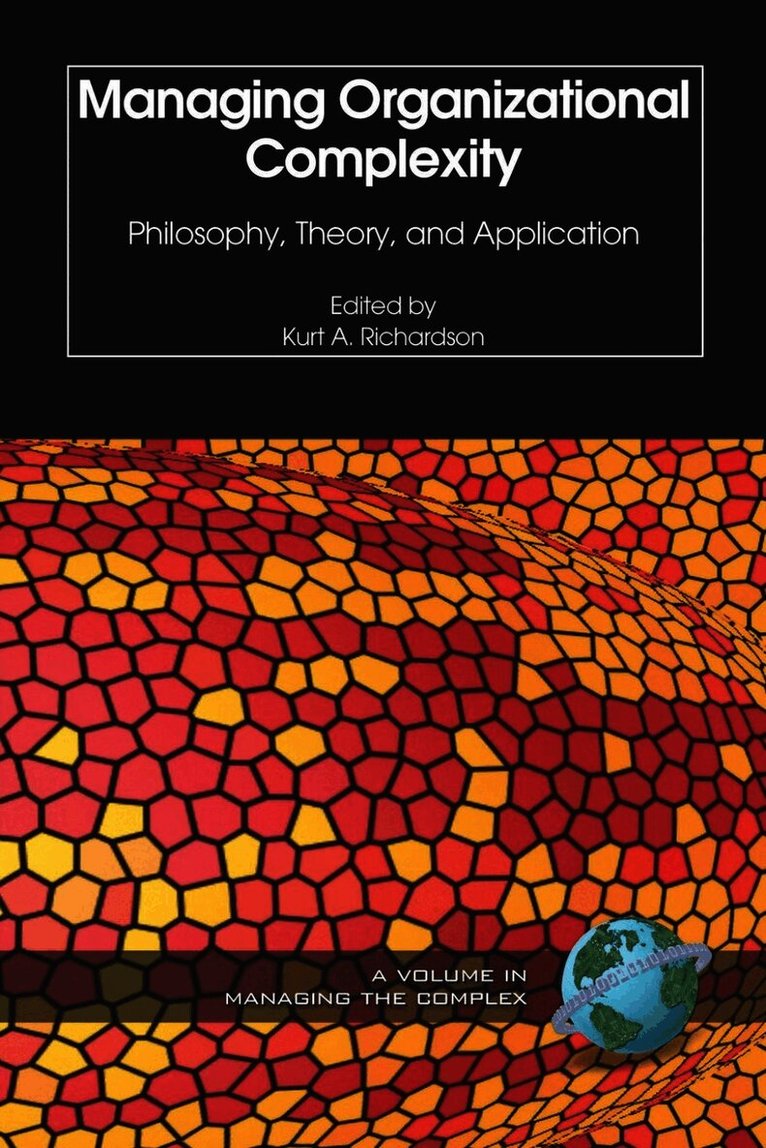
In introducing this first volume of a series exploring issues in managing complexity, Richardson (Institute for the Study of Coherence and Emergence) contends that no one has yet developed a reliable skill set for learning from the noise of complex systems.
1 226 kr
Skickas inom 7-10 vardagar
In introducing this first volume of a series exploring issues in managing complexity, Richardson (Institute for the Study of Coherence and Emergence) contends that no one has yet developed a reliable skill set for learning from the noise of complex systems.
955 kr
Skickas inom 7-10 vardagar
Managing the Complex is an ambitious title - and it would be an audacious one if we were not to begin with a frank admission: to date few to none of us have a skill set which includes managing the complex. We try various things, we write about others, and we wonder about still others. When a tool, perspective, or technique comes along which seems to evoke success, we emulate it probe it and recoil at the all too often admission that it was situation and context which afforded success its opportunity, and not some quality intrinsic to the tool perspective or technique. Indeed, if the study of complexity has done anything for managers, and for those who espouse managerial theory, it is in providing a ‘scientific foundation’ for the notion that context matters. Those who preach abstract ideas have then to reconcile themselves to the notion that situation and embodiment matters. Those who believe in strong causality and determinism are left to wrestle with the role of chance, uncertainty, and chaos. Those who prefer to argue that men move history are confronted with the role of environment and affordances, while those who argue the reverse are left to contend with charisma, irrationality of crowds, and the strange qualities we know as emotions.A series on complex systems has less ambitious goals to contend with than this. Such a series can deal with classifications, and categories, and speak of ‘noise’ as if it were not the central focus of the problem. Managing the complex is about managing ‘noise’ or perhaps we should say it is about ‘dealing with’ ‘accepting’ ‘making room for’ and ‘learning from’ ‘noise’. The articles in this volume and in volumes to come will each be considered as ‘noise’ by some and as ‘gems’ by others, but we hope that practicing managers and academics alike will find plenty of fuel to drive their personal explorations into understanding, and perhaps even managing, the complex.
1 361 kr
Skickas inom 7-10 vardagar
Managing the Complex is an ambitious title - and it would be an audacious one if we were not to begin with a frank admission: to date few to none of us have a skill set which includes managing the complex. We try various things, we write about others, and we wonder about still others. When a tool, perspective, or technique comes along which seems to evoke success, we emulate it probe it and recoil at the all too often admission that it was situation and context which afforded success its opportunity, and not some quality intrinsic to the tool perspective or technique. Indeed, if the study of complexity has done anything for managers, and for those who espouse managerial theory, it is in providing a ‘scientific foundation’ for the notion that context matters. Those who preach abstract ideas have then to reconcile themselves to the notion that situation and embodiment matters. Those who believe in strong causality and determinism are left to wrestle with the role of chance, uncertainty, and chaos. Those who prefer to argue that men move history are confronted with the role of environment and affordances, while those who argue the reverse are left to contend with charisma, irrationality of crowds, and the strange qualities we know as emotions.A series on complex systems has less ambitious goals to contend with than this. Such a series can deal with classifications, and categories, and speak of ‘noise’ as if it were not the central focus of the problem. Managing the complex is about managing ‘noise’ or perhaps we should say it is about ‘dealing with’ ‘accepting’ ‘making room for’ and ‘learning from’ ‘noise’. The articles in this volume and in volumes to come will each be considered as ‘noise’ by some and as ‘gems’ by others, but we hope that practicing managers and academics alike will find plenty of fuel to drive their personal explorations into understanding, and perhaps even managing, the complex.
617 kr
Skickas inom 7-10 vardagar
In this volume, Hugo Letiche tackles the all-important question, is there “care” in healthcare? If, as Klaus Krippendorff(2006) argues, “meaning is a structured space, a network of expected senses, a set of possibilities…[that] emerges in the use of language,” then within the healthcare systems of today, the meaning of “care” has been defined to be the eradication of a problem. We must recognize that patients do not wish to regarded merely as a problem requiring eradication.Letiche is opposed to the very idea that complexity reduction can address the humanity of each individual healthcare situation. He argues that, through narratives and through complexity based social theory, the complexity of each individual situation must be transcended through mindful listening and engaged dialogue. Letiche suggests that in the absence of such mindfulness, the lack of time for true listening, and the inability of providers and systems to allow for patients and family to engage in dialogue lies both the roots of the problem and the potential for its solution. If complexity theory has a role in the analysis understanding and betterment of social systems, then approaches such as the one Letiche undertakes herein will become essential tools of the trade.
1 090 kr
Skickas inom 7-10 vardagar
In this volume, Hugo Letiche tackles the all-important question, is there “care” in healthcare? If, as Klaus Krippendorff(2006) argues, “meaning is a structured space, a network of expected senses, a set of possibilities…[that] emerges in the use of language,” then within the healthcare systems of today, the meaning of “care” has been defined to be the eradication of a problem. We must recognize that patients do not wish to regarded merely as a problem requiring eradication.Letiche is opposed to the very idea that complexity reduction can address the humanity of each individual healthcare situation. He argues that, through narratives and through complexity based social theory, the complexity of each individual situation must be transcended through mindful listening and engaged dialogue. Letiche suggests that in the absence of such mindfulness, the lack of time for true listening, and the inability of providers and systems to allow for patients and family to engage in dialogue lies both the roots of the problem and the potential for its solution. If complexity theory has a role in the analysis understanding and betterment of social systems, then approaches such as the one Letiche undertakes herein will become essential tools of the trade.
Complexity and Knowledge Management Understanding the Role of Knowledge in the Management of Social Networks
Häftad, Engelska, 2010
684 kr
Skickas inom 7-10 vardagar
It seems as if attempts to use knowledge to understand and manage social networks are everywhere. Millions, if not billions, of dollars are being spent in an attempt to derail terrorist networks, with much of it being invested in making sense of massive data streams. There is growing concern that much of this money is being squandered on approaches that will never deliver on their promises.Our armed forces are being prepared to combat terrorist threats by the introduction of “network centric approaches” and “digital battlefields” – basically attempts to provide warfighters with a complete picture of the battlespace. However, the experience of practitioners suggests that the “data smog” this creates is actually counterproductive.From the arena of politics, the recent invigorating battle between senators Clinton and Obama has thrown the spotlight on the deficiencies in political polling (Economist, 2008b). Changes in the structure of the situation (e.g. high turnouts) have thrown the whole industry into chaos. Complexity is being discounted and the results are stark. The conclusion formed in the media was that the situation was wildly unpredictable (so anyone’s to win), and ended up having real consequences for the Democratic challenger in November 2008 (Baldwin, 2008).Turning to business, we find that Société Générale recently lost $7.2bn as the result of a single rogue trader making a series of bogus transactions amid turbulent markets in 2007 and 2008. There has been much speculation on what was known, when it was known, and who knew it. In other words, we have speculation that this is an example of the role of knowledge in the mismanagement of social networks – with spectacular effect.At a glance, the problems highlighted above seem positively overwhelming. Where do you start? But start we must. Simple “cause and effect” thinking doesn’t seem to be able to cut the mustard. There is broad agreement that even if the Kyoto targets were fully met, on schedule, by 2100 it would only delay the warming of the planet by six years (Parry et al., 1998). We need to utilize knowledge in new ways…or maybe uncover insights from old ways.It is hard to think of something more worthy of attention that the role of knowledge in the management of complex systems.In Volume 4 of the Managing the Complex Series we have brought together seventeen essays from authors around the globe to explore the complex systems view of knowledge and its role in social networks. Contributors explore such topics as: the limitations to our knowledge of complex systems, the transfer of knowledge from local to global levels, collaborative knowledge generation, decision making in complex multi-stakeholder situations, organizational learning and innovation, all through the lens of the emerging field of complexity science. The editors hope that this volume will give theorists further avenues to explore in their attempts to understand knowledge creation, maintenance and distribution, and also provide practitioners with new tools to apply in the complex and messy real world.
Complexity and Knowledge Management Understanding the Role of Knowledge in the Management of Social Networks
Inbunden, Engelska, 2010
1 158 kr
Skickas inom 7-10 vardagar
It seems as if attempts to use knowledge to understand and manage social networks are everywhere. Millions, if not billions, of dollars are being spent in an attempt to derail terrorist networks, with much of it being invested in making sense of massive data streams. There is growing concern that much of this money is being squandered on approaches that will never deliver on their promises.Our armed forces are being prepared to combat terrorist threats by the introduction of “network centric approaches” and “digital battlefields” – basically attempts to provide warfighters with a complete picture of the battlespace. However, the experience of practitioners suggests that the “data smog” this creates is actually counterproductive.From the arena of politics, the recent invigorating battle between senators Clinton and Obama has thrown the spotlight on the deficiencies in political polling (Economist, 2008b). Changes in the structure of the situation (e.g. high turnouts) have thrown the whole industry into chaos. Complexity is being discounted and the results are stark. The conclusion formed in the media was that the situation was wildly unpredictable (so anyone’s to win), and ended up having real consequences for the Democratic challenger in November 2008 (Baldwin, 2008).Turning to business, we find that Société Générale recently lost $7.2bn as the result of a single rogue trader making a series of bogus transactions amid turbulent markets in 2007 and 2008. There has been much speculation on what was known, when it was known, and who knew it. In other words, we have speculation that this is an example of the role of knowledge in the mismanagement of social networks – with spectacular effect.At a glance, the problems highlighted above seem positively overwhelming. Where do you start? But start we must. Simple “cause and effect” thinking doesn’t seem to be able to cut the mustard. There is broad agreement that even if the Kyoto targets were fully met, on schedule, by 2100 it would only delay the warming of the planet by six years (Parry et al., 1998). We need to utilize knowledge in new ways…or maybe uncover insights from old ways.It is hard to think of something more worthy of attention that the role of knowledge in the management of complex systems.In Volume 4 of the Managing the Complex Series we have brought together seventeen essays from authors around the globe to explore the complex systems view of knowledge and its role in social networks. Contributors explore such topics as: the limitations to our knowledge of complex systems, the transfer of knowledge from local to global levels, collaborative knowledge generation, decision making in complex multi-stakeholder situations, organizational learning and innovation, all through the lens of the emerging field of complexity science. The editors hope that this volume will give theorists further avenues to explore in their attempts to understand knowledge creation, maintenance and distribution, and also provide practitioners with new tools to apply in the complex and messy real world.
549 kr
Skickas inom 7-10 vardagar
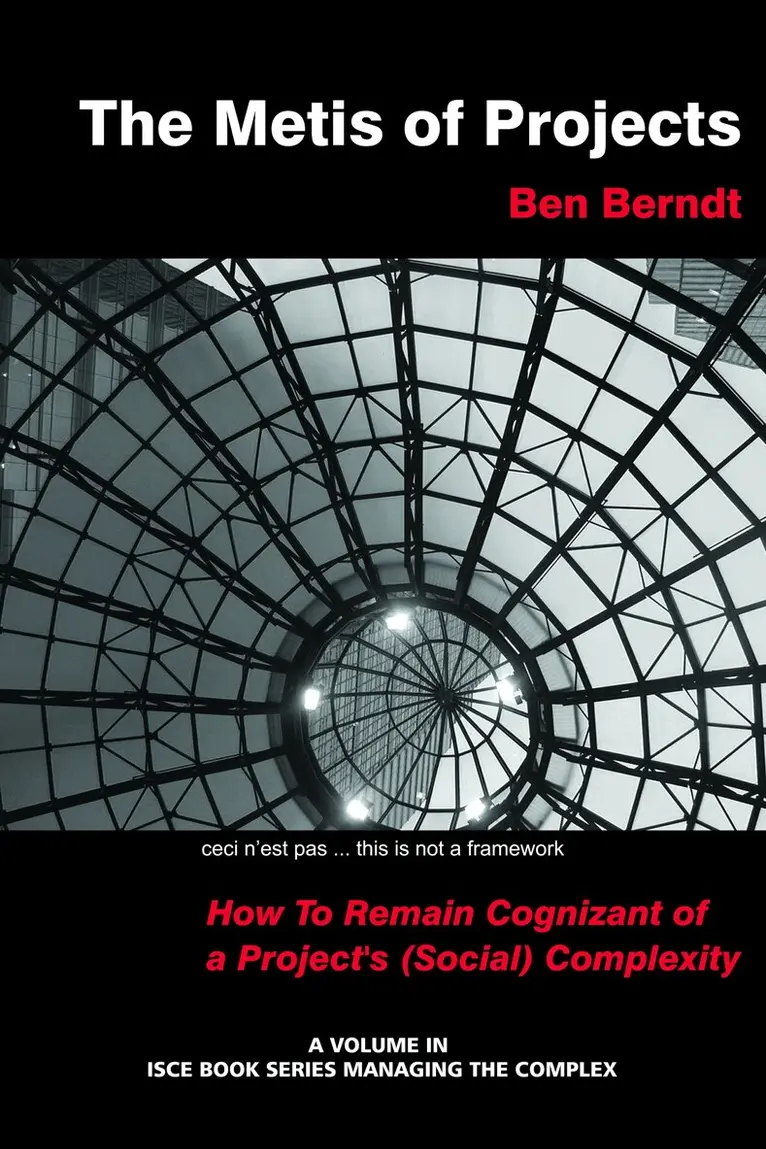
“The Metis of Projects” addresses veteran project manager Ben Berndt’s unease with the use of established (project) management frameworks given their general inefficacy. Despite the use of these frameworks, it is estimated that some 30% of projects still fail because they deliver too late, cost more than expected and/or lack quality. Often, projects and their environments are too complex to be controlled by rather linear frameworks. Where most practitioners define complexity as "complicated," most academics define complexity (more correctly) as interrelatedness. In recent years, the academic community has developed several "level-of-complexity frameworks;" however, these frameworks are not commonly known to practitioners and are therefore not regularly used. And, when examined further, these frameworks appear to be merely environmental scans, used to assess the level of complexity in the project management environment. But projects also carry inherent complexity; they are socially complex, and it is this social complexity that—paradoxically—needs management. Combined with personality assessments, social network theory is used here to glean a better understanding of the social complexity in a project. Berndt believes that, following Hugo Letiche and Michael Lissack's emergent coherence concept, managers should steer clear of frameworks in order to come to grips with the complex, and so he introduces whole systems methodologies, in which group understanding is used to continually set a next step. Berndt concludes his study by describing his multi-view, multi-tool participative project management style, which he thinks best aligns with (managing) the complex.
1 010 kr
Skickas inom 7-10 vardagar
“The Metis of Projects” addresses veteran project manager Ben Berndt’s unease with the use of established (project) management frameworks given their general inefficacy. Despite the use of these frameworks, it is estimated that some 30% of projects still fail because they deliver too late, cost more than expected and/or lack quality. Often, projects and their environments are too complex to be controlled by rather linear frameworks. Where most practitioners define complexity as "complicated," most academics define complexity (more correctly) as interrelatedness. In recent years, the academic community has developed several "level-of-complexity frameworks;" however, these frameworks are not commonly known to practitioners and are therefore not regularly used. And, when examined further, these frameworks appear to be merely environmental scans, used to assess the level of complexity in the project management environment. But projects also carry inherent complexity; they are socially complex, and it is this social complexity that—paradoxically—needs management. Combined with personality assessments, social network theory is used here to glean a better understanding of the social complexity in a project. Berndt believes that, following Hugo Letiche and Michael Lissack's emergent coherence concept, managers should steer clear of frameworks in order to come to grips with the complex, and so he introduces whole systems methodologies, in which group understanding is used to continually set a next step. Berndt concludes his study by describing his multi-view, multi-tool participative project management style, which he thinks best aligns with (managing) the complex.