Maurice Yolles - Böcker
Visar alla böcker från författaren Maurice Yolles. Handla med fri frakt och snabb leverans.
8 produkter
8 produkter
1 770 kr
Skickas inom 7-10 vardagar
The Changing Organization provides a multidisciplinary approach for studying the management of change under conditions of complexity. Single-discipline approaches frequently miss essential elements that reduce the possibility of coherence within a multi-agency organizational setting. Combining a systems and cybernetic 'living system' perspective, Guo, Yolles, Fink, and Iles offer a new agency paradigm designed to model, diagnose and analyse complex, real-world situations. Its capacity to anticipate patterns of behaviour provides useful means by which the origin of crises can be understood, and resolutions reflected upon. Scholars and graduate students in fields as diverse as management, politics, anthropology and psychology will find numerous applications for this book when considering socio-political and organizational change, and it offers an invaluable guide for consultants who may wish to apply advanced techniques of contextual analysis to real-world situations.
A Configuration Approach to Mindset Agency Theory
A Formative Trait Psychology with Affect, Cognition and Behaviour
Inbunden, Engelska, 2021
1 901 kr
Skickas inom 7-10 vardagar
This book explains psychological, sociopolitical and organisational change in multidisciplinary settings. It shows how advanced techniques of contextual analysis can be applied to complex situations and offers a new cybernetic agency paradigm based on living systems theory. It models, diagnoses, and analyses complex, realworld situations to anticipate patterns of behaviour.
A Configuration Approach to Mindset Agency Theory
A Formative Trait Psychology with Affect, Cognition and Behaviour
Häftad, Engelska, 2023
340 kr
Skickas inom 7-10 vardagar
This book explains psychological, sociopolitical and organisational change in multidisciplinary settings. It shows how advanced techniques of contextual analysis can be applied to complex situations and offers a new cybernetic agency paradigm based on living systems theory. It models, diagnoses, and analyses complex, realworld situations to anticipate patterns of behaviour.
604 kr
Skickas inom 7-10 vardagar
The Changing Organization provides a multidisciplinary approach for studying the management of change under conditions of complexity. Single-discipline approaches frequently miss essential elements that reduce the possibility of coherence within a multi-agency organizational setting. Combining a systems and cybernetic 'living system' perspective, Guo, Yolles, Fink, and Iles offer a new agency paradigm designed to model, diagnose and analyse complex, real-world situations. Its capacity to anticipate patterns of behaviour provides useful means by which the origin of crises can be understood, and resolutions reflected upon. Scholars and graduate students in fields as diverse as management, politics, anthropology and psychology will find numerous applications for this book when considering socio-political and organizational change, and it offers an invaluable guide for consultants who may wish to apply advanced techniques of contextual analysis to real-world situations.
955 kr
Skickas inom 7-10 vardagar
Managing the Complex is an ambitious title - and it would be an audacious one if we were not to begin with a frank admission: to date few to none of us have a skill set which includes managing the complex. We try various things, we write about others, and we wonder about still others. When a tool, perspective, or technique comes along which seems to evoke success, we emulate it probe it and recoil at the all too often admission that it was situation and context which afforded success its opportunity, and not some quality intrinsic to the tool perspective or technique. Indeed, if the study of complexity has done anything for managers, and for those who espouse managerial theory, it is in providing a ‘scientific foundation’ for the notion that context matters. Those who preach abstract ideas have then to reconcile themselves to the notion that situation and embodiment matters. Those who believe in strong causality and determinism are left to wrestle with the role of chance, uncertainty, and chaos. Those who prefer to argue that men move history are confronted with the role of environment and affordances, while those who argue the reverse are left to contend with charisma, irrationality of crowds, and the strange qualities we know as emotions.A series on complex systems has less ambitious goals to contend with than this. Such a series can deal with classifications, and categories, and speak of ‘noise’ as if it were not the central focus of the problem. Managing the complex is about managing ‘noise’ or perhaps we should say it is about ‘dealing with’ ‘accepting’ ‘making room for’ and ‘learning from’ ‘noise’. The articles in this volume and in volumes to come will each be considered as ‘noise’ by some and as ‘gems’ by others, but we hope that practicing managers and academics alike will find plenty of fuel to drive their personal explorations into understanding, and perhaps even managing, the complex.
1 362 kr
Skickas inom 7-10 vardagar
Managing the Complex is an ambitious title - and it would be an audacious one if we were not to begin with a frank admission: to date few to none of us have a skill set which includes managing the complex. We try various things, we write about others, and we wonder about still others. When a tool, perspective, or technique comes along which seems to evoke success, we emulate it probe it and recoil at the all too often admission that it was situation and context which afforded success its opportunity, and not some quality intrinsic to the tool perspective or technique. Indeed, if the study of complexity has done anything for managers, and for those who espouse managerial theory, it is in providing a ‘scientific foundation’ for the notion that context matters. Those who preach abstract ideas have then to reconcile themselves to the notion that situation and embodiment matters. Those who believe in strong causality and determinism are left to wrestle with the role of chance, uncertainty, and chaos. Those who prefer to argue that men move history are confronted with the role of environment and affordances, while those who argue the reverse are left to contend with charisma, irrationality of crowds, and the strange qualities we know as emotions.A series on complex systems has less ambitious goals to contend with than this. Such a series can deal with classifications, and categories, and speak of ‘noise’ as if it were not the central focus of the problem. Managing the complex is about managing ‘noise’ or perhaps we should say it is about ‘dealing with’ ‘accepting’ ‘making room for’ and ‘learning from’ ‘noise’. The articles in this volume and in volumes to come will each be considered as ‘noise’ by some and as ‘gems’ by others, but we hope that practicing managers and academics alike will find plenty of fuel to drive their personal explorations into understanding, and perhaps even managing, the complex.
617 kr
Skickas inom 7-10 vardagar
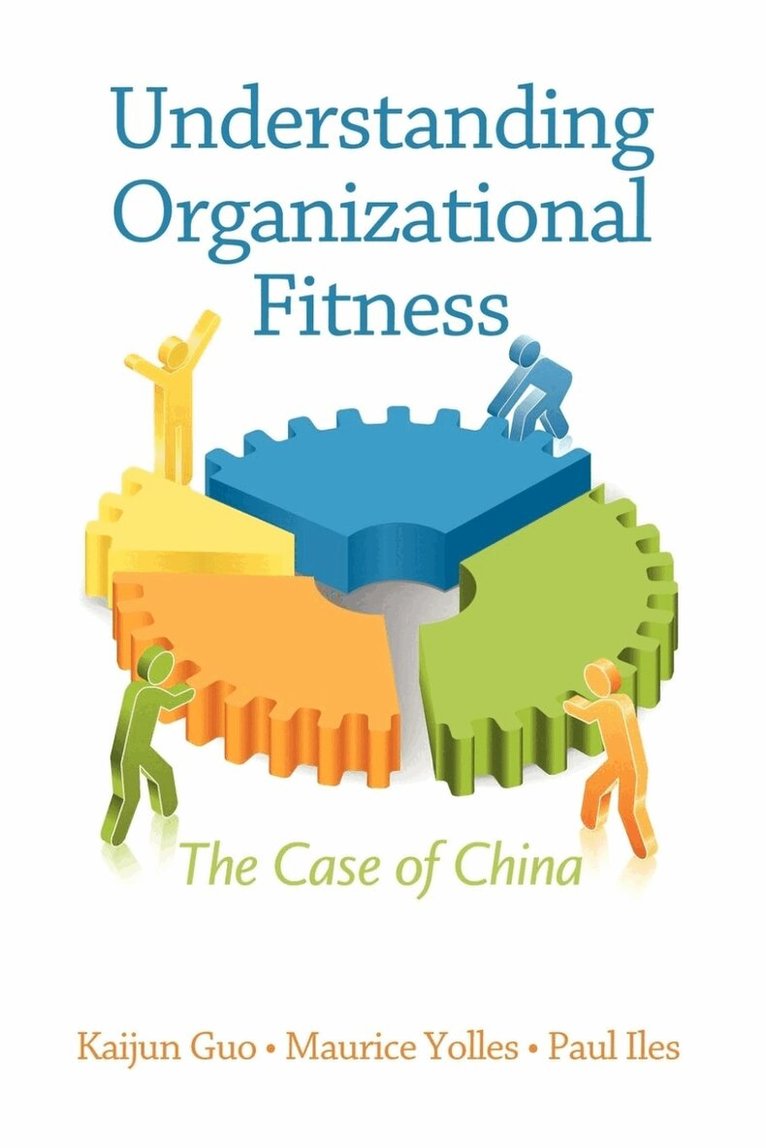
The focus if this book has two dimensions: theoretical and empirical. The theoretical dimension is concerned with the fitness of an organization to satisfactorily address processes of transformational change. Such fitness, it will be argued, can be expressed in terms of the coherence (degree of integration) and pathology (condition of ill health) of the organization being explored. In attempting to assess organizational fitness, a model that comes out of the field of Knowledge Cybernetics will be used and developed further as a strategic organizational map, and applied empirically. The empirical dimension centers on the specific situation of the banking industry in China as it is passing through transformational change. There is a great need for organizations there to guide their own changes in a way that enables them to improve themselves in a changing environment. A methodology that can assist organizations in the change process is Organization Development, an approach often used within a human resource development context, but it has some problems with dealing with such dramatic change. In this theory a new approach will be explored and developed to assess the fitness of an organization to pass through transformational change processes. The direction taken has enabled the theoretical approach adopted to be defined, and the design of the empirical work to emerge from reflections on the initial work undertaken. In particular our interests in this book are to (1) explain theory that is able to assess the fitness of organizations to pass through transformational change and (2) demonstrate how the theory can be applied as a measuring instrument to a detailed case study, exploring the Chinese State banking system.
1 091 kr
Skickas inom 7-10 vardagar
The focus if this book has two dimensions: theoretical and empirical. The theoretical dimension is concerned with the fitness of an organization to satisfactorily address processes of transformational change. Such fitness, it will be argued, can be expressed in terms of the coherence (degree of integration) and pathology (condition of ill health) of the organization being explored. In attempting to assess organizational fitness, a model that comes out of the field of Knowledge Cybernetics will be used and developed further as a strategic organizational map, and applied empirically. The empirical dimension centers on the specific situation of the banking industry in China as it is passing through transformational change. There is a great need for organizations there to guide their own changes in a way that enables them to improve themselves in a changing environment. A methodology that can assist organizations in the change process is Organization Development, an approach often used within a human resource development context, but it has some problems with dealing with such dramatic change. In this theory a new approach will be explored and developed to assess the fitness of an organization to pass through transformational change processes. The direction taken has enabled the theoretical approach adopted to be defined, and the design of the empirical work to emerge from reflections on the initial work undertaken. In particular our interests in this book are to (1) explain theory that is able to assess the fitness of organizations to pass through transformational change and (2) demonstrate how the theory can be applied as a measuring instrument to a detailed case study, exploring the Chinese State banking system.