Lines – serie
Visar alla böcker i serien Lines. Handla med fri frakt och snabb leverans.
11 produkter
11 produkter
1 192 kr
Kommande
Contemporary theorists, including Walter Benjamin, Emmanuel Levinas and Jean-Luc Nancy, have identified that an essential feature of capitalism is an uninterrupted or permanently wakeful continuity of production, exchange, consumption, communication and control. A form of enforced insomnia which keeps people subservient and compliant. This makes sleep a revolutionary act.Insomnia ranges from the history of philosophy to contemporary 'sleep science' and cutting edge theory to provide us with a powerful philosophical and aesthetic intervention – that charts not just the problems of sleep but its revolutionary potential as a new politics of sleep. This is urgent reading for anyone trying to sleep in contemporary capitalism.
441 kr
Kommande
Contemporary theorists, including Walter Benjamin, Emmanuel Levinas and Jean-Luc Nancy, have identified that an essential feature of capitalism is an uninterrupted or permanently wakeful continuity of production, exchange, consumption, communication and control. A form of enforced insomnia which keeps people subservient and compliant. This makes sleep a revolutionary act.Insomnia ranges from the history of philosophy to contemporary 'sleep science' and cutting edge theory to provide us with a powerful philosophical and aesthetic intervention – that charts not just the problems of sleep but its revolutionary potential as a new politics of sleep. This is urgent reading for anyone trying to sleep in contemporary capitalism.
343 kr
Kommande
Felix Guattari (1930-1992) has for too long been in the shadow of his illustrious collaborator, Gilles Deleuze. Ecopsophy permits not only the chance to witness the dazzling mind that formed a foundational part of those extraordinary collaborations, but also the opportunity to grasp the extent to which Guattari’s own philosophical project deserves to be considered in its own right. Ecopsophy is an essential complement to both Guattari’s Chaosmosis and The Three Ecologies, as it transforms the ecological into an assemblage of connectivity between aesthetics, creativity and machinic subjectivity that produces a new paradigm for a more ethical and ecologically aware world. It is the most accessible of Guattari's writings and the editor of this collection - Stephane Nadaud - has organized the materials in a manner that not only makes new connections accross Guattari's oeuvre but also addresses contemporary disciplinary concernsEnglish translations of Chaosmosis and The Three Ecologies have laid the foundation for a bona fide field of Guattari Studies, but the third key part of the triad – Ecosophy – was always notable for its absence. By introducing Ecosophy to an English-speaking audience, for the first time, it is possible to tie the first two books together – creating a hybrid chaosmosis of ecology that fully fuses the finite into the infinite, the human and non-human into their immanent becomings.
273 kr
Skickas inom 5-8 vardagar
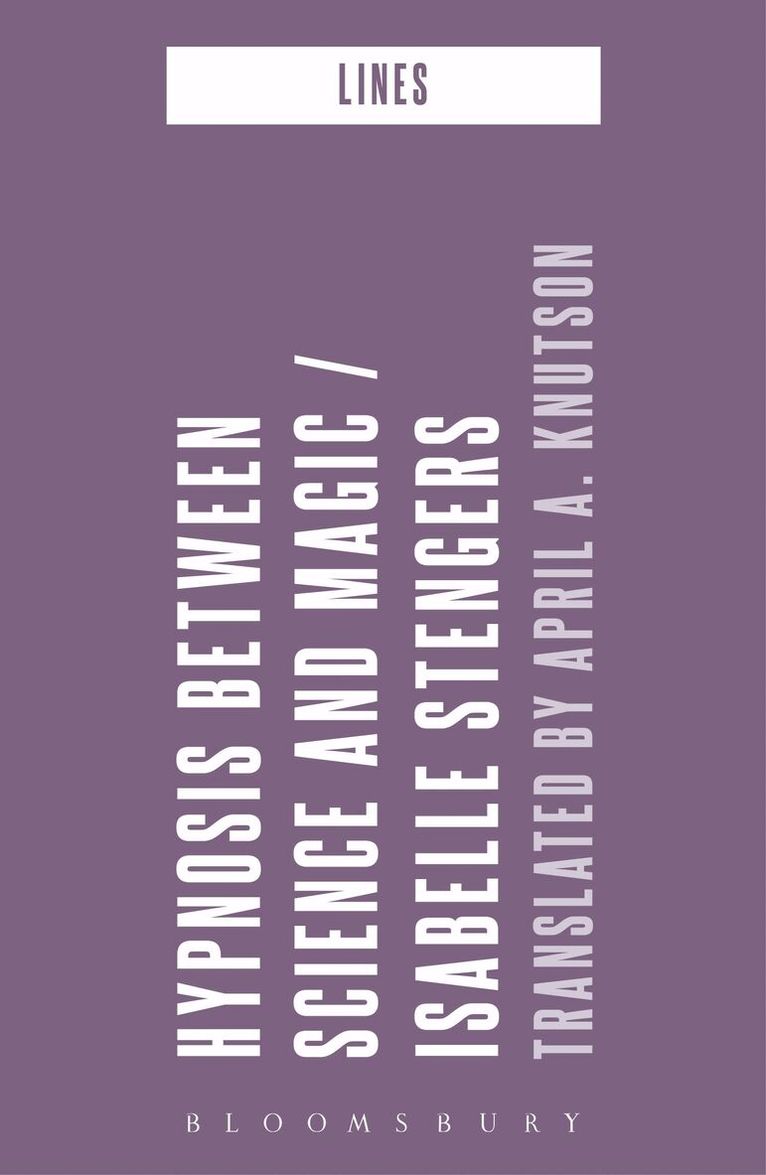
What if judgment returned to the craft of magic? How would that relieve the burdens of critique and realign its priorities? These questions regarding the value of magic to thinking are at the very heart of the acclaimed philosopher of science Isabelle Stengers' political and philosophical thought and her insistence that ‘the smoke of the burned witches still hangs in our nostrils’.Now, in the first English translation of this classic text, Hypnosis Between Science and Magic provides an entry point to the work of Isabelle Stengers, who has so originally and forcefully shifted how we think about the history of ideas. The book focuses in on an area of her thought that has recurred throughout her career: the presumed antagonism between magic and science, and especially the evacuation of magic from all that is thought to be scientifically valid.
875 kr
Skickas inom 10-15 vardagar
What if judgment returned to the craft of magic? How would that relieve the burdens of critique and realign its priorities? These questions regarding the value of magic to thinking are at the very heart of the acclaimed philosopher of science Isabelle Stengers' political and philosophical thought and her insistence that ‘the smoke of the burned witches still hangs in our nostrils’.Now, in the first English translation of this classic text, Hypnosis Between Science and Magic provides an entry point to the work of Isabelle Stengers, who has so originally and forcefully shifted how we think about the history of ideas. The book focuses in on an area of her thought that has recurred throughout her career: the presumed antagonism between magic and science, and especially the evacuation of magic from all that is thought to be scientifically valid.
216 kr
Kommande
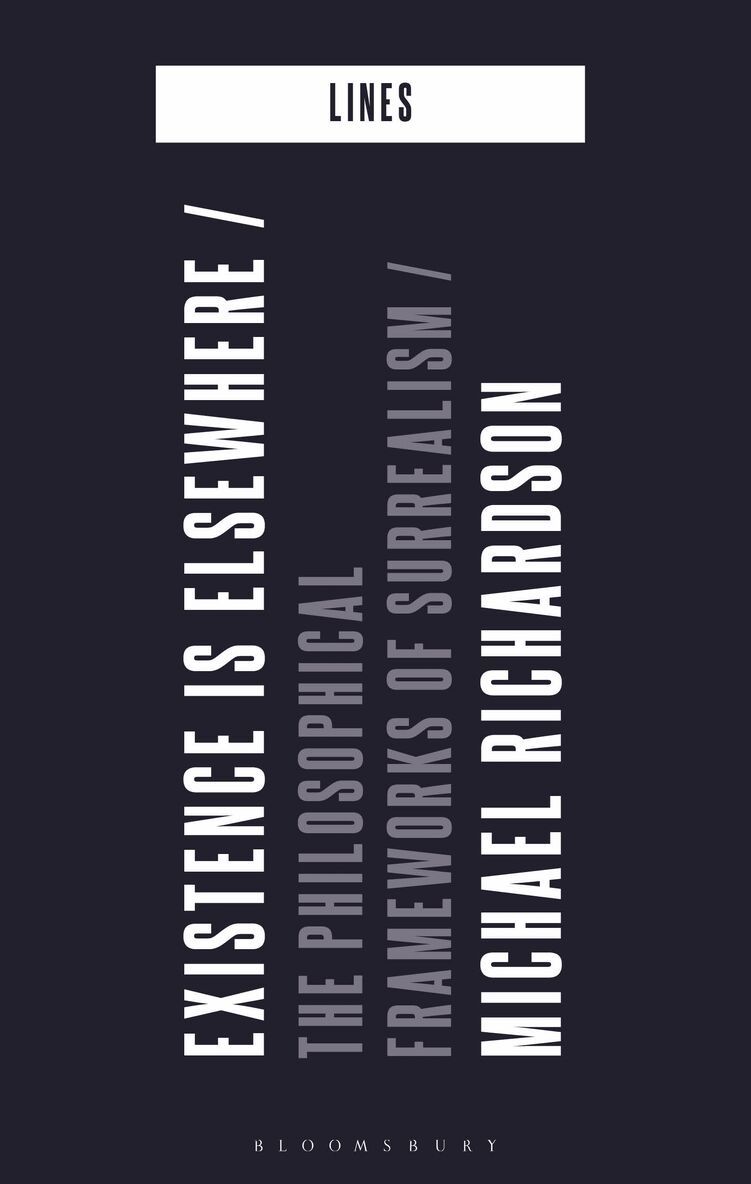
The Philosophical Frameworks of Surrealism offers the first comprehensive account of surrealism as a movement sustained – rather than merely ornamented – by philosophical ideas.Moving far beyond the familiar narrative linking surrealism to Freud, this study reveals a century-long engagement with thinkers as diverse as Hegel, Heraclitus, Parmenides, Schelling, Novalis, Nietzsche, and Fourier, as well as traditions outside the Western canon, from ancient Egypt to Chinese thought.Michael Richardson shows that surrealism was born of a network of encounters: collective experiments, shared crises after the First World War, and intense friendships that shaped its emergence between 1919 and 1924. Its philosophical orientation arose not from systematic study but from a “philosophical poetics” – a way of thinking through practice, intuition, and experiment.Across ten chapters, Richardson traces surrealism’s relationship with dialectical thinking, analogy, myth, and the marvellous. Hegel’s ideas on mediation and becoming illuminate Breton’s concerns with identity and recognition; Heraclitus’ unity of opposites and Parmenides’ journey into the unknown resonate with surrealism’s pursuit of an “elsewhere” beyond perceptual reality; Schelling’s philosophy of nature and the unconscious opens new vistas for understanding surrealism’s animist sensibility, while Nietzsche’s pessimism and affirmation of life sharpen its critique of modernity. The Philosophical Frameworks of Surrealism is an essential resource for readers in philosophy, literature, art history, and modern intellectual history, offering a bold reconceptualization of the history of surrealism, and what it may still become.
1 122 kr
Kommande
The Philosophical Frameworks of Surrealism offers the first comprehensive account of surrealism as a movement sustained – rather than merely ornamented – by philosophical ideas.Moving far beyond the familiar narrative linking surrealism to Freud, this study reveals a century-long engagement with thinkers as diverse as Hegel, Heraclitus, Parmenides, Schelling, Novalis, Nietzsche, and Fourier, as well as traditions outside the Western canon, from ancient Egypt to Chinese thought.Michael Richardson shows that surrealism was born of a network of encounters: collective experiments, shared crises after the First World War, and intense friendships that shaped its emergence between 1919 and 1924. Its philosophical orientation arose not from systematic study but from a “philosophical poetics” – a way of thinking through practice, intuition, and experiment.Across ten chapters, Richardson traces surrealism’s relationship with dialectical thinking, analogy, myth, and the marvellous. Hegel’s ideas on mediation and becoming illuminate Breton’s concerns with identity and recognition; Heraclitus’ unity of opposites and Parmenides’ journey into the unknown resonate with surrealism’s pursuit of an “elsewhere” beyond perceptual reality; Schelling’s philosophy of nature and the unconscious opens new vistas for understanding surrealism’s animist sensibility, while Nietzsche’s pessimism and affirmation of life sharpen its critique of modernity. The Philosophical Frameworks of Surrealism is an essential resource for readers in philosophy, literature, art history, and modern intellectual history, offering a bold reconceptualization of the history of surrealism, and what it may still become.
886 kr
Kommande
Felix Guattari (1930-1992) has for too long been in the shadow of his illustrious collaborator, Gilles Deleuze. Ecopsophy permits not only the chance to witness the dazzling mind that formed a foundational part of those extraordinary collaborations, but also the opportunity to grasp the extent to which Guattari’s own philosophical project deserves to be considered in its own right. Ecopsophy is an essential complement to both Guattari’s Chaosmosis and The Three Ecologies, as it transforms the ecological into an assemblage of connectivity between aesthetics, creativity and machinic subjectivity that produces a new paradigm for a more ethical and ecologically aware world. It is the most accessible of Guattari's writings and the editor of this collection - Stephane Nadaud - has organized the materials in a manner that not only makes new connections accross Guattari's oeuvre but also addresses contemporary disciplinary concernsEnglish translations of Chaosmosis and The Three Ecologies have laid the foundation for a bona fide field of Guattari Studies, but the third key part of the triad – Ecosophy – was always notable for its absence. By introducing Ecosophy to an English-speaking audience, for the first time, it is possible to tie the first two books together – creating a hybrid chaosmosis of ecology that fully fuses the finite into the infinite, the human and non-human into their immanent becomings.
341 kr
Skickas inom 10-15 vardagar
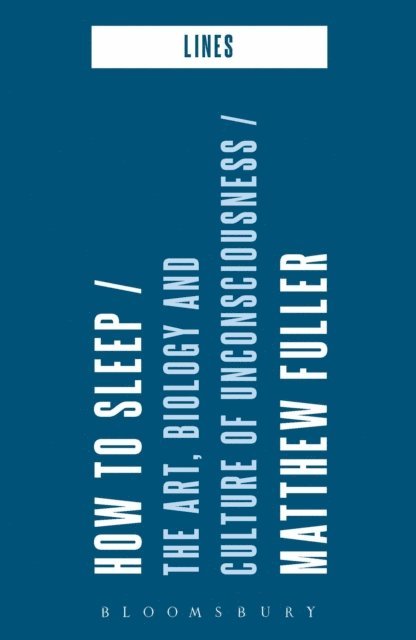
Sleep is quite a popular activity, indeed most humans spend around a third of their lives asleep. However, cultural, political, or aesthetic thought tends to remain concerned with the interpretation and actions of those who are awake. How to Sleep argues instead that sleep is a complex vital phenomena with a dynamic aesthetic and biological consistency.Arguing through examples drawn from contemporary, modern and renaissance art; from literature; film and computational media, and bringing these into relation with the history and findings of sleep science, this book argues for a new interplay between biology and culture. Meditations on sex, exhaustion, drugs, hormones and scientific instruments all play their part in this wide-ranging exposition of sleep as an ecology of interacting processes.How to Sleep builds on the interlocking of theory, experience and experiment so that the text itself is a lively articulation of bodies, organs and the aesthetic systems that interact with them. This book won't enhance your sleeping skills, but will give you something surprising to think about whilst being ostensibly awake.
1 276 kr
Skickas inom 10-15 vardagar
Sleep is quite a popular activity, indeed most humans spend around a third of their lives asleep. However, cultural, political, or aesthetic thought tends to remain concerned with the interpretation and actions of those who are awake. How to Sleep argues instead that sleep is a complex vital phenomena with a dynamic aesthetic and biological consistency.Arguing through examples drawn from contemporary, modern and renaissance art; from literature; film and computational media, and bringing these into relation with the history and findings of sleep science, this book argues for a new interplay between biology and culture. Meditations on sex, exhaustion, drugs, hormones and scientific instruments all play their part in this wide-ranging exposition of sleep as an ecology of interacting processes.How to Sleep builds on the interlocking of theory, experience and experiment so that the text itself is a lively articulation of bodies, organs and the aesthetic systems that interact with them. This book won't enhance your sleeping skills, but will give you something surprising to think about whilst being ostensibly awake.
190 kr
Skickas inom 5-8 vardagar