Linking Levels of Analysis - Böcker
Visar alla böcker i serien Linking Levels of Analysis. Handla med fri frakt och snabb leverans.
4 produkter
4 produkter
444 kr
Skickas inom 7-10 vardagar
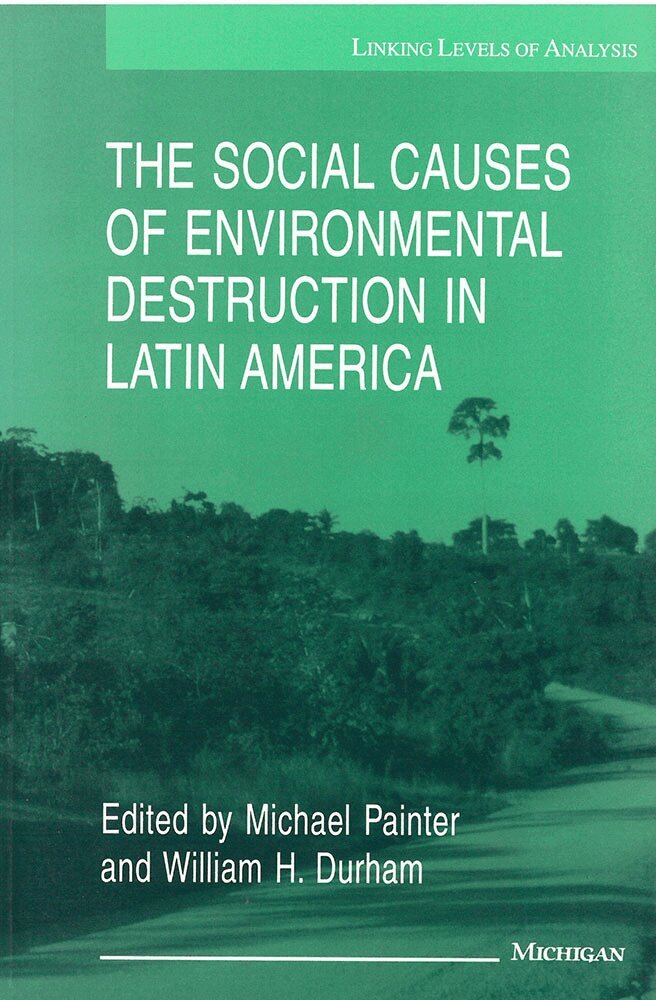
The Social Causes of Environmental Destruction in Latin America is a timely examination of critical cases of land degradation, deforestation, and resource depletion in Central and South America. The contributors—seasoned researchers with years of experience in the regions they discuss—convincingly document the idea that the causes of environmental destruction have their origins in social relations, specifically the dynamics of social classes with fundamentally divergent interests. The conditions facing impoverished families on the one hand, and the granting of land on a concessionary basis to powerful individuals and corporations on the other, create incentives to extensive land use without conservation. The book thus refutes simplistic arguments that address environmental destruction as an outcome of population growth and suggests that advocacy for social equity is not merely an idealistic quest but an ecological imperative. This book is essential reading for anyone interested in development issues and should appeal particularly to anthropologists, sociologists, economists, demographers, and geographers.
Building a New Biocultural Synthesis
Political-Economic Perspectives on Human Biology
Häftad, Engelska, 1998
359 kr
Skickas inom 7-10 vardagar
Anthropology, with its dual emphasis on biology and culture, is--or should be--the discipline most suited to the study of the complex interactions between these aspects of our lives. Unfortunately, since the early decades of this century, biological and cultural anthropology have grown distinct, and a holistic vision of anthropology has suffered.This book brings culture and biology back together in new and refreshing ways. Directly addressing earlier criticisms of biological anthropology, Building a New Biocultural Synthesis concerns how culture and political economy affect human biology--e.g., people's nutritional status, the spread of disease, exposure to pollution--and how biological consequences might then have further effects on cultural, social, and economic systems. Contributors to the volume offer case studies on health, nutrition, and violence among prehistoric and historical peoples in the Americas; theoretical chapters on nonracial approaches to human variation and the development of critical, humanistic and political ecological approaches in biocultural anthropology; and explorations of biological conditions in contemporary societies in relationship to global changes.Building a New Biocultural Synthesis will sharpen and enrich the relevance of anthropology for understanding a wide variety of struggles to cope with and combat persistent human suffering. It should appeal to all anthropologists and be of interest to sister disciplines such as nutrition and sociology.Alan H. Goodman is Professor of Anthropology, Hampshire College. Thomas L. Leatherman is Associate Professor of Anthropology, University of South Carolina.
528 kr
Skickas inom 7-10 vardagar
For years, anthropology has brought the lives and beliefs of "exotic" peoples to audiences in the West. Diagnosing America: Anthropology and Public Engagement reveals the power of anthropological description and analysis when applied to social, economic, and political problems in the contemporary United States and demonstrates the urgent need for this work. Debunking the notion of anthropology as a "value-free" science, the authors argue forcefully for an anthropology expressly committed to cultural pluralism and democratic participation. At the same time, individual essays demonstrate the applicability of standard anthropological methods to the study of contemporary U.S. society and culture as they investigate contested values, community politics, middle-class economics, and workplace culture or describe the psychophysiological stress effects of exclusion on African- Americans and the coping mechanisms of Mexican-Americans along the border. Diagnosing America and the challenging "Statement to the Profession" that concludes it call for anthropologists to reach beyond the parochialism of their own discipline and to engage history, economics, sociology, and the policy sciences. It will be of interest to scholars in each of these fields who are concerned with the study and resolution of contemporary social problems in the United States and to students of American culture in this country and abroad. Shepard Forman is Director of the International Affairs Program of the Ford Foundation and a former Professor of Anthropology, University of Michigan.
Culture and Global Change
Social Perceptions of Deforestation in the Lacandona Rain Forest in Mexico
Häftad, Engelska, 1996
317 kr
Skickas inom 7-10 vardagar
Never before in history have humans had such power over the environment as we have today, and never before have we been so close to the end of nature. With the destruction of the earth a realistic possibility, global change is the point on which theoretical discussions and practical challenges must converge. The authors of this compelling book argue that before suitable solutions can be found to pressing environmental problems, we need a way to gather information on the human dimensions of global changes. How do small and everyday individual actions add up to the intricate networks of global interactions? What are our rights and responsibilities as humans toward the planet and its natural resources? The Lacandon rain forest in Mexico provides a vivid example of an environmental challenge that will demand the concerted efforts of many different groups, and not only technical solutions, to resolve successfully. Using data taken largely from in-depth interviews with landowners, farm workers, cattle raisers, housewives, professionals, and civil servants, the authors draw a rich portrait of the varied perceptions and positions these groups and individuals hold. At issue are the social, rather than psychological, bases of their perspectives. Culture and Global Change offers a model for how the social sciences, and anthropology in particular, can lead the way in developing comprehensive understandings of the interrelationships between groups at the local, regional, and international levels that affect perceptions of the environment and thus the viability of solutions. It is required reading for anthropologists and environmental activists alike. Lourdes Arizpe is Assistant Director-General for Culture, UNESCO. Fernanda Paz and Margarita Vel´zquez work for the Centro Regional de Investigaciones Multidisciplinarias, Universidad Nacional Autonoma de México.