Macat Library – serie
Visar alla böcker i serien Macat Library. Handla med fri frakt och snabb leverans.
436 produkter
436 produkter
Häftad, Engelska, 2017
94 kr
Skickas
To the dismay of many commentators – who had hoped the world was evolving into a more tolerant and multicultural community of nations united under the umbrellas of supranational movements like the European Union – the nationalism that was such a potent force in the history of the 20th-century has made a comeback in recent years. Now, more than ever, it seems important to understand what it is, how it works, and why it is so attractive to so many people. A fine place to start any such exploration is with Ernest Gellner's seminal Nations and Nationalism, a ground-breaking study that was the first to flesh out the counter-intuitive – but enormously influential – thesis that modern nationalism has little if anything in common with old-fashioned patriotism or loyalty to one's homeland. Gellner's intensely creative thesis is that the nationalism we know today is actually the product of the 19th-century industrial revolution, which radically reshaped ancient communities, encouraging emigration to cities at the same time as it improved literacy rates and introduced mass education. Gellner connected these three elements in an entirely new way, contrasting developments to the structures of pre-industrial agrarian economies to show why the new nationalism could not have been born in such communities. He was also successful in generating a typology of nationalisms in an attempt to explain why some forms flourished while others fizzled out. His remarkable ability to produce novel explanations for existing evidence marks out Nations and Nationalism as one of the most radical, stimulating – and enduringly influential – works of its day.
Häftad, Engelska, 2017
96 kr
Skickas inom 10-15 vardagar
David Riesman’s The Lonely Crowd: A Study in the Changing American Character is one of the best-known books in the history of sociology – holding a mirror up to contemporary America and showing the nation its own character as it had never seen it before. Its success is a testament to Riesman’s mastery of one key critical thinking skill: interpretation. In critical thinking, interpretation focuses on understanding the meaning of evidence, and is frequently characterized by laying down clear definitions, and clarifying ideas and categories for the reader. All these processes are on full display in The Lonely Crowd – which, rather than seeking to challenge accepted wisdom or generate new ideas, provides incisive interpretations and definitions of ideas and data from a variety of sources. Above all, Riesman’s book is a work of categorization – a form of interpretation that can be vital to building and communicating systematic arguments. With the aid of his two co-authors (Nathan Glazer and Reuel Denney), he defined three cultural types that formed a perfect pattern for understanding mid-century American society and the changes it was undergoing. The clarity of the book’s definitions tapped directly into the zeitgeist of the 1950s, powering it to best-seller status and an audience that extended far beyond academia.
Häftad, Engelska, 2018
91 kr
Skickas
Social anthropologist Jean Lave and computer scientist Etienne Wenger’s seminal Situated Learning helped change the fields of cognitive science and pedagogy by approaching learning from a novel angle. Traditionally, theories of learning and education had focused on processes of cognition – the mental processes of knowledge formation that occur within an individual. Lave and Wenger chose to look at learning not as an individual process, but a social one. As so often with the creative thinking process, a small, simple shift in emphasis was all that was required to show things in an entirely different light. What Situated Learning illustrated – and emphasized – was that learning is dependent on its social situation. Even though the most effective way to learn is through interaction with experts and peers in a community organized around a common interest, the traditional cognitive learning model failed to account for the way in which learners interact with their ‘community of practice.’ The new hypothesis that Lave and Wenger developed was that learning can be seen as a continuously evolving set of relationships situated within a social context. This allowed Lave and Wenger to place discussions of apprenticeship and workplace learning on a new footing – and led in turn to the book’s impressive impact in business and management scholarship.
Häftad, Engelska, 2017
95 kr
Skickas
Rachel Carson’s 1962 Silent Spring is one of the few books that can claim to be epoch-making. Its closely reasoned attack on the use of pesticides in American agriculture helped thrust environmental consciousness to the fore of modern politics and policy, creating the regulatory landscape we know today. The book is also a monument to the power of closely reasoned argument – built from well organised and carefully evidenced points that are not merely persuasive, but designed to be irrefutable. Indeed, it had to be: upon its publication, the chemical industry utilised all its resources to attempt to discredit both Silent Spring and Carson herself – to no avail. The central argument of the book is that the indiscriminate use of pesticides encouraged by post-war advances in agriculture and chemistry was deeply harmful to plants, animals and the whole environment, with devastating effects that went far beyond protecting crops. At the time, the argument directly contradicted government policy and scientific orthodoxy – and many studies that corroborated Carson’s views were deliberately suppressed by hostile business interests. Carson, however, gathered, organised and set out the evidence in Silent Spring in a way that proved her contentions without a doubt. While environmental battles still rage, few now deny the strength and persuasiveness of her reasoning.
Häftad, Engelska, 2017
97 kr
Skickas inom 10-15 vardagar
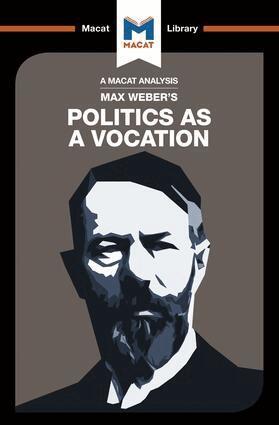
German sociologist Max Weber’s 1919 lecture Politics as a Vocation is widely regarded as a masterpiece of political theory and sociology. Its central strength lies in Weber’s deployment of masterful interpretative skills to power his discussion of modern politics.Interpretation involves understanding both the meaning of evidence and the meaning of terms – questioning definitions, clarifying terms and processes, and supplying good, clear definitions of the author’s own. As a sociologist accustomed to working with historical evidence, Weber based his own work on precisely these skills, solidly backed up by analytical acuity. Politics as a Vocation, written in a Germany shocked by its crippling defeat in World War I, saw Weber turn his eye to an examination of how the modern nation state emerged, and the different ways in which it can be run – interpreting and defining the different types of rule that are possible. It is testament to Weber’s interpretative skills that Politics is famous above all in sociological circles for its clear definition of a state as an institution that claims “the monopoly of legitimate physical violence” in a given territory.
Häftad, Engelska, 2017
97 kr
Skickas inom 10-15 vardagar
Charles Darwin called on a broad and unusually powerful combination of critical thinking skills to create his wide-ranging explanation for biological change, On the Origin of Species. It’s one of those rare books that takes a huge problem – the enormous diversity of different species – and seeks to use a vast range of evidence to solve it. But it was perhaps Darwin’s towering creative prowess that made the most telling contribution to this masterpiece, for it was this that enabled him to make the necessary fresh connections between so much disparate evidence from such a diversity of fields. All of Darwin’s critical thinking skills were required, however, in the course of the decades of work that went into this volume. Taken as a whole, Darwin’s solution to the problem that he set himself is carefully researched, considers multiple explanations, and justifies its conclusions with well-organised reasoning. At the time of the publication, in 1859, there were various explanations for the changes that Darwin – and others – observed; what separated Darwin from so many of his contemporaries is that he deployed critical thinking to arrive at a significantly new way of fitting explanation to evidence; one that remains elegant, complete and predictive to this day.
Häftad, Engelska, 2018
94 kr
Skickas
In Outline of a Theory of Practice, Bourdieu questions the preeminent ideas of social anthropologists such as Levi-Strauss who stressed the structural principles governing human action rather than the actions themselves and, Bourdieu asserts, doesn’t account for all observable nuances of behaviour. Drawing on his fieldwork in Algeria, he expresses the need for a theory of practice focusing on the dynamic flow of human actions in the social world. Bourdieu coins the term ‘habitus’- a relational concept linking structures to the practice of agents. Outline is a significant and original contribution, providing an account of many of the issues Bourdieu continued to develop through his career.
Häftad, Engelska, 2017
108 kr
Skickas
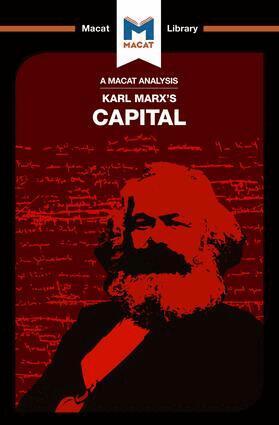
A critical analysis of Karl Marx’s Capital, which is without question one of the most influential books to be published in the course of the past two centuries. Controversial in its politics, and arriving at conclusions that are passionately debated to this day, it is nonetheless a fine example of the creative combination of a philosophical method (the dialectic) with historical and economic information to produce a new interpretation of history. Capitalism, thought Marx, works by exploiting the working class. Their wages do not reflect the value of their labor. Marx concluded that capitalism would fail because of this contradiction at the heart of the capitalist system. He wrote Capital to give activists the theories and language they needed to criticize the system. But the work also outlines the new communist society that Marx hoped would rise in its place, and it helped to inspire the rise of states that largely shaped the modern history of our planet. Today, after a century of conflict, Marx’s analysis still offers valuable tools that help us analyze the modern world. Marx's belief that he had arrived at a scientific way of describing the present and predicting the future may not be shared by many of his modern interpreters. But his ability to connect things together in new ways is not in doubt – and nor is the influence of the new hypotheses that he generated as a result of so much careful analysis.
Häftad, Engelska, 2017
94 kr
Skickas
Benedict Anderson’s 1983 masterpiece Imagined Communities is a ground-breaking analysis of the origins and meanings of “nations” and “nationalism”. A book that helped reshape the field of nationalism studies, Imagined Communities also shows the critical thinking skills of interpretation and analysis working at their highest levels. One crucial aspect of Anderson’s work involves the apparently simple act of defining precisely what we mean when we say ‘nation’ or ‘nationalism’ – an interpretative step that is vital to the analysis he proceeds to carry out. For Anderson, it is clear that nations are not ‘natural;’ as historians and anthropologists are well aware, nations as we understand them are a relatively modern phenomenon, dating back only as far as around 1500. But if this is the case, how can we agree what a ‘nation’ is? Anderson’s proposed definition is that they are “imagined communities” – comprising groups of people who regard themselves as belonging to the same community, even if they have never met, and have nothing in common otherwise. The analysis that follows from this insight is all about examining and breaking down the historical processes that helped foster these communities – above all the birth of printing, and the development of capitalism. Brilliantly incisive, Anderson’s analysis shows how good interpretative skills can form the foundations for compelling and original insight.
Häftad, Engelska, 2017
91 kr
Skickas
Michel Foucault is famous as one of the 20th-century’s most innovative and wide-ranging thinkers. The qualities that made him one of the most-read and influential theorists of the modern age find full expression in History of Sexuality, the last project Foucault was able to complete before his death in 1984.Central to Foucault’s appeal is the creativity of his thought. Creative thinking takes many forms – from redefining an issue in a novel way to making unexpected and illuminating connections. Foucault’s particular talent could perhaps best be described as turning questions inside out. In the case of sexuality, for instance, his interpretation of the historical evidence led him to argue that the sexual categories that we are used to (homosexual, lesbian, straight, and so on) are not “natural,” but constructs that are products of the ways in which power and knowledge interact in society.Such categories, Foucault continues, actually serve to produce the desires they seek to name. And their creation, in turn, is closely linked to the power that society exerts on those who belong to different sexual groups.Foucault’s ideas – familiar now – were so novel in their time that they proved highly challenging. But to see the world through Foucault’s thought is to see it in a profoundly different and illuminating way – an example of creative thinking at its best.
Häftad, Engelska, 2018
94 kr
Skickas
Baruch Spinoza’s Ethics is a dense masterpiece of sustained argumentative reasoning. It earned its place as one of the most important and influential books in Western philosophy by virtue of its uncompromisingly direct arguments about the nature of God, the universe, free will, and human morals.Though it remains one of the densest and most challenging texts in the entire canon of Western philosophy, Ethics is also famous for Spinoza’s unique approach to ordering and constructing its arguments. As its full title – Ethics, Demonstrated in Geometrical Order – suggests, Spinoza decided to use the rigorous format of mathematical-style propositions to lay out his arguments, just as the Ancient Greek mathematician Euclid had used geometrical propositions to lay out the basic rules of geometry.In choosing such a systematic method, Spinoza’s masterwork shows the crucial aspects of good reasoning skills being employed at the highest level. The key use of reasoning is the production of an argument that is well-organised, supports its conclusions and proceeds logically towards its end. Just as a mathematician might demonstrate a geometrical proof, Spinoza sought to lay out a comprehensive philosophy for human existence – an attempt that has influenced generations of philosophers since.
Häftad, Engelska, 2017
94 kr
Skickas
Amartya Sen uses his 1999 work Development as Freedom to evaluate the processes and outcomes of economic development. Having come to the conclusion that development is best summed up as the expansion of freedom, Sen examines traditional definitions and understandings of the term. He says people tend to think of freedoms as economic (the freedom to enter into market exchanges) or political (the freedom to vote and be an active citizen), and tries to understand why the definition has been so narrow hitherto. He concludes that an evaluation of true freedom must necessarily include the freedom to access social services such as healthcare, sanitation and nutrition, just as much as it must acknowledge economic and political freedoms. Evaluating the relevance of the current thinking behind development, Sen concludes that the term ‘freedom’ cannot simply be about income. In many ways, measuring income does not account for various “unfreedoms” (manmade or natural bars to wellbeing) that hinder development. Sen’s evaluation is all the more powerful for its clarity: "The freedom-centered perspective has a generic similarity to the common concern with "quality of life."
Häftad, Engelska, 2017
97 kr
Skickas inom 10-15 vardagar
In Civil Disobedience, Henry David Thoreau looks at old issues in new ways, asking: is there ever a time when individuals should actively oppose their government and its justice system?After a thorough review of the evidence, Thoreau comes to the conclusion that opposition is legitimate whenever government actions or institutions are unacceptable to an individual’s conscience. What is particularly interesting is that Thoreau’s creative mind took him deeper into the argument, as he concluded that this legitimate opposition really wasn’t enough. In Thoreau’s opinion, anyone who believed something to be wrong had a duty to resist it actively.These ideas were completely at odds with the prevailing opinions of the day – that it was the duty of every citizen to support the state. Thoreau connected ideas and notions in a novel manner and went against the tide, generating new hypotheses so that people could see matters in a new light. It is a mark of the success of his creative thinking that his views are now considered mainstream, and that his arguments are still deployed in defence of the principle of civil disobedience.
Häftad, Engelska, 2017
111 kr
Skickas inom 10-15 vardagar
Mary Wollstonecraft’s 1792 Vindication of the Rights of Women is an incendiary attack on the place of women in 18th-century society. Often considered to be the earliest widely-circulated work of feminism, the book is a powerful example of what can be achieved by creative thinkers – people who refuse to be bound by the standard ways of thinking, or to see things through the same lenses that everyone else uses. In the case of the Vindication, Wollstonecraft’s independent thinking went directly against the standard assumptions of the age regarding women. During the seventeenth century and earlier, it was an entirely standard point of view to consider women as, largely speaking, uneducable. They were widely considered to be men’s inferiors, incapable of rational thought. They not only did not need a rational education – it was assumed that they could not benefit from one. Wollstonecraft, in contrast, argued that women’s apparent triviality was a direct consequence of society failing to educate them. If they were not men’s equals, it was the fault of a society that refused to treat them as such. So radical was her message that it would take until the 20th century for her views to become truly accepted.
Häftad, Engelska, 2017
94 kr
Skickas
Kenneth Waltz’s 1979 Theory of International Politics is credited with bringing about a “scientific revolution” in the study of international relations – bringing the field into a new era of systematic study. The book is also a lesson in reasoning carefully and critically. Good reasoning is exemplified by arguments that move systematically, through carefully organised stages, taking into account opposing stances and ideas as they move towards a logical conclusion. Theory of International Politics might be a textbook example of how to go about structuring an argument in this way to produce a watertight case for a particular point of view.Waltz’s book begins by testing and critiquing earlier theories of international relations, showing their strengths and weaknesses, before moving on to argue for his own stance – what has since become known as “neorealism”. His aim was “to construct a theory of international politics that remedies the defects of present theories.” And this is precisely what he did; by showing the shortcomings of the prevalent theories of international relations, Waltz was then able to import insights from sociology to create a more comprehensive and realistic theory that took full account of the strengths of old schemas while also remedying their weaknesses – reasoning out a new theory in the process.
Häftad, Engelska, 2017
97 kr
Skickas
Adam Smith’s 1776 Inquiry into The Nature and Causes of the Wealth of Nations – more often known simply as The Wealth of Nations – is one of the most important books in modern intellectual history.Considered one of the fundamental works of classical economics, it is also a prime example of the enduring power of good reasoning, and the ability of reasoning to drive critical thinking forward. Adam Smith was attempting to answer two complex questions: where does a nation’s wealth come from, and what can governments do to increase it most efficiently? At the time, perhaps the most widely accepted theory, mercantilism, argued that a nation’s wealth was literally the amount of gold and silver it held in reserve. Smith, meanwhile, weighed the evidence and came to a different conclusion: a nation’s wealth, he argued, lay in its ability to encourage economic activity, largely without government interference. Underlying this radical redefinition was the revolutionary concept that powered Smith’s reasoning and which continues to exert a vast influence on economic thought: the idea that markets are self-regulating. Pitting his arguments against those of his predecessors, Smith carefully and persuasively reasoned out a strong case for free markets that reshaped government economic policies in the 19th-century and continues to shape global prosperity today.
Häftad, Engelska, 2017
94 kr
Skickas inom 10-15 vardagar
C. Wright Mills’s 1959 book The Sociological Imagination is widely regarded as one of the most influential works of post-war sociology. At its heart, the work is a closely reasoned argument about the nature and aims of sociology, one that sets out a manifesto and roadmap for the field. Its wide acceptance and popular reception is a clear demonstration of the rhetorical power of Wright’s strong reasoning skills. In critical thinking, reasoning involves the creation of an argument that is strong, balanced, and, of course, persuasive. In Mills’s case, this core argument makes a case for what he terms the “sociological imagination”, a particular quality of mind capable of analyzing how individual lives fit into, and interact with, social structures. Only by adopting such an approach, Mills argues, can sociologists see the private troubles of individuals as the social issues they really are. Allied to this central argument are supporting arguments for the need for sociology to maintain its independence from corporations and governments, and for social scientists to steer away from ‘high theory’ and focus on the real difficulties of everyday life. Carefully organized, watertight and persuasive, The Sociological Imagination exemplifies reasoned argument at its best.
Häftad, Engelska, 2017
94 kr
Skickas
Few people can claim to have had minds as fertile and creative as the French philosopher Jean-Jacques Rousseau. One of the most influential political theorists of the modern age, he was also a composer and writer of opera, a novelist, and a memoirist whose Confessions ranks as one of the most striking works of autobiography ever written. Like many creative thinkers, Rousseau was someone whose restless mind could not help questioning accepted orthodoxies and looking at matters from novel and innovative angles. His 1762 treatise The Social Contract does exactly that. Examining the nature and sources of legitimate political power, it crafted a closely reasoned and passionately persuasive argument for democracy at a time when the most widely accepted form of government was absolute monarchy, legitimised by religious beliefs about the divine right of kings and queens to rule. In France, the book was banned by worried Catholic censors; in Rousseau’s native Geneva, it was both banned and burned. But history soon pushed Rousseau’s ideas into the mainstream of political theory, with the French and American revolutions paving the way for democratic government to gain ground across the Western world. Though it was precisely what got Rousseau’s book banned at the time, the novel idea that all legitimate government rests on the will of the people is now recognised as the core principle of democratic freedom and represents, for many people, the highest of ideals.
Häftad, Engelska, 2017
97 kr
Skickas inom 10-15 vardagar
Few historians trace grand themes across many centuries and places, but Ernst Kantorowicz's great work on the symbolic powers of kingship is a fine example of what can happen when they do. The King's Two Bodies is at once a superb example of the critical thinking skill of evaluation – assessing huge quantities of evidence, both written and visual, and drawing sound comparative conclusions from it – and of creative thinking; the work connects art history, literature, legal records and historical documents together in innovative and revealing ways across more than 800 years of history. Kantorowicz's key conclusions (that history is at root about ideas, that these ideas power institutions, and that both are commonly expressed and understood through symbols) have had a profound impact on several different disciplines, and even underpin many works of popular fiction – not least The DaVinci Code. And they were all made possible by fresh evaluation of evidence that other historians had ignored, or could not see the significance of.
Häftad, Engelska, 2017
97 kr
Skickas inom 10-15 vardagar
C.K. Prahalad and Gary Hamel’s 1990 The Core Competence of the Corporation helped redefine traditional ideas of management strategy. It did so by focusing companies on one of the key critical thinking skills: evaluation. In critical thinking, evaluation is all about judging the strengths and weaknesses of arguments – assessing their reasoning and the relevance or adequateness of the evidence they use. For Prahalad and Hamel, companies could gain a competitive edge by evaluating themselves: their own strengths and weaknesses. By sensitively evaluating core competencies – the collective knowledge inside the organization that distinguishes it from other corporations – they could target efforts and resources with strategic focus. For Prahalad and Hamel, managers need to be able to identify and evaluate their company’s unique skill sets, and the technologies that distinguish them from others businesses. How well they then coordinate these elements defines a company’s competitive strength and how quickly it can adapt to new challenges. As Prahalad and Hamel showed in their case studies, the critical thinking skill of evaluation – knowing what you do best, how well you do it, and how you might improve – is absolutely central to staying ahead of the crowd.
Häftad, Engelska, 2017
108 kr
Skickas
Gilbert Ryle’s 1949 The Concept of Mind is now famous above all as the origin of the phrase “the ghost in the machine” – a phrase Ryle used to attack the popular idea that our bodies and minds are separate. His own position was that mental acts are not at all distinct from bodily actions. Indeed, they are the same thing, merely described in different ways – and if one cuts through the confusing language of the old philosophical debates, he suggests, that becomes clear. While, in many ways, modern philosophers of mind have moved on from or discarded Ryle’s actual arguments, The Concept of Mind remains a classic example of two central critical thinking skills: interpretation and reasoning. Ryle was what is known as an “ordinary language” philosopher – a school who considered many philosophical problems to exist purely because of philosophical language. He therefore considered his task as a philosopher to be one of cutting through confusing language, and clarifying matters – exemplifying the critical thinking skill of interpretation at its best. Rather than adding to philosophical knowledge as such, moreover, he saw his role as one of mapping it – giving it what he called a “logical geography.” As such, The Concept of Mind is also all about reasoning: laying out, organizing, and systematizing clear arguments.
Häftad, Engelska, 2017
97 kr
Skickas inom 10-15 vardagar
Claude Lévi-Strauss is probably the most complex anthropological theorist of all time. His work continues to influence present-day thinkers in his field, but he is perhaps even more influential beyond it. As one of the key figures in the development of what is known today as ‘French theory,’ Lévi-Strauss was one of the most important thinkers of the 20th-century. His theories of interpretation, meaning and culture have helped shape the ideas and methodologies of a range of disciplines, above all literature and philosophy. At the heart of Lévi-Strauss’s work are the questions of meaning and where meaning comes from. As an anthropologist, he was primarily interested in what completely different and separate cultures might have in common. Crucially, he saw how common ground resides not on the surface of cultures (i.e., in similar customs), but deep inside invisible background structures of thought. His quest was to peel away the surface of different cultures through careful interpretation, advancing from one layer to another until he discovered the structures that lay behind all of the exterior practices and meanings. Infamously challenging, his work shows interpretative skills working at the highest, most abstract level possible.
Häftad, Engelska, 2017
94 kr
Skickas
Keith Thomas's classic study of all forms of popular belief has been influential for so long now that it is difficult to remember how revolutionary it seemed when it first appeared. By publishing Religion and the Decline of Magic, Thomas became the first serious scholar to attempt to synthesize the full range of popular thought about the occult and the supernatural, studying its influence across Europe over several centuries. At root, his book can be seen as a superb exercise in problem-solving: one that actually established "magic" as a historical problem worthy of investigation. Thomas asked productive questions, not least challenging the prevailing assumption that folk belief was unworthy of serious scholarly attention, and his work usefully reframed the existing debate in much broader terms, allowing for more extensive exploration of correlations, not only between different sorts of popular belief, but also between popular belief and state religion. It was this that allowed Thomas to reach his famous conclusion that the advent of Protestantism – which drove out much of the "superstition" that characterised the Catholicism of the period – created a vacuum filled by other forms of belief; for example, Catholic priests had once blessed their crops, but Protestants refused to do so. That left farmers looking for other ways of ensuring a good harvest. It was this, Thomas argues, that explains the survival of what we now think of as "magic" at a time such beliefs might have been expected to decline – at least until science arose to offer alternative paradigms.
Häftad, Engelska, 2017
108 kr
Skickas
The impact of William James’s 1890 The Principles of Psychology is such that he is commonly known as the father of his subject. Though psychology itself is a very different discipline in the 21st-century, James’s influence continues to be felt – both within the field and beyond. At base, Principles was designed to be a textbook for what was then an emerging field: a summary and explanation of what was known at that point in time. As its continuing influence shows, though, it became far more – a success due in part to the strength of James’s analytical skills and creative thinking. On the one hand, James was a masterful analyst, able to break down what was known in psychology, to trace how it fitted together, and, crucially, to point out the gaps in psychologists’ knowledge. Beyond that, though, he was a creative thinker, who looked at things from different angles and proposed inventive solutions and hypotheses. Among his best known was an entirely new theory of emotion (the James-Lange theory), and the influential notion of the “stream of consciousness” – the latter of which has influenced generations of psychologists and artists alike.
Häftad, Engelska, 2017
94 kr
Skickas
Hans Morgenthau’s Politics Among Nations is a classic of political science, built on the firm foundation of Morgenthau’s watertight reasoning skills.The central aim of reasoning is to construct a logical and persuasive argument that carefully organizes and supports its conclusions – often around a central concept or scheme of argumentation. Morgenthau’s subject was international relations – the way in which the world’s nations interact, and come into conflict or peace – a topic which was of vital importance during the unstable wake of the Second World War. To the complex problem of understanding the ways in which the post-war nations were jostling for power, Morgenthau brought a comprehensive schema: the concept of “realism” – or, in other words, the idea that every nation will act so as to maximise its own interests. From this basis, Morgenthau builds a systematic argument for a pragmatic approach to international relations in which nations seeking consensus should aim for a balance of power, grounding relations between states in understandings of how the interests of individual nations can be maximized.Though seismic shifts in international politics after the Cold War undeniably altered the landscape of international relations, Morgenthau’s dispassionate reasoning about the nature of our world remains influential to this day.
Häftad, Engelska, 2017
109 kr
Skickas
Hegel’s 1807 Phenomenology of Spirit is renowned for being one of the most challenging and important books in Western philosophy. Above all, it is famous for laying out a new approach to reasoning and philosophical argument, an approach that has been credited with influencing Karl Marx, Jean-Paul Sartre, and many other key modern philosophers. That approach is the so-called “Hegelian dialectic” – an open-ended sequence of reasoning and argument in which contradictory concepts generate and are incorporated into a third, more sophisticated concept. While the Phenomenology does not always clearly use this dialectical method – and it is famously one of the most difficult works of philosophy ever written – the Hegelian dialectic provides a perfect template for critical thinking reasoning skills. A hallmark of good reasoning in the construction of an argument, and the searching out of answers must necessarily consider contradictory viewpoints or evidence. For Hegel, contradiction is key: it is precisely what allows reasoning to progress. Only by incorporating and overcoming contradictions, according to his method, is it possible for thought to progress at all. While writing like Hegel might not be advisable, thinking like him can help take your reasoning to the next level.
Häftad, Engelska, 2017
111 kr
Skickas inom 10-15 vardagar
Friedrich Nietzsche’s On the Genealogy of Morality is a sustained feat of incisive interpretation. Well known as one of Nietzsche’s greatest works, and as one of the most important books of nineteenth-century philosophy, On the Genealogy of Morality also provided the inspiration for the methodologies of several key philosophers of the modern age. Michel Foucault and Judith Butler, among others, cite Nietzsche as an influence specifically because of the interpretative techniques laid out in this work – techniques which are a model for the ways in which interpretation can be used to power critical thinking of the highest order. The key aspects of interpretation are understanding, clarifying, and questioning definitions; what Nietzsche brings to the process is a sense of how important context, history and culture are to understanding any term. In the case of morals, for instance, he argues that if we are to truly understand what we mean by “good” or “evil,” we cannot ever assume the two concepts have a stable meaning, outside of a given moment in history. Indeed, to understand what they mean now, and might mean in the future, we need to trace the genealogy of concepts back to their very roots – a feat of interpretation that Nietzsche undertakes masterfully.
Häftad, Engelska, 2017
111 kr
Skickas inom 10-15 vardagar
In his wonderfully clear and cogent essay On Liberty, Mill contends that individuals should be as free as possible from interference by government. Proposing that individual fulfilment is the surest route to collective happiness, he argues passionately against the "tyranny of the majority," and sets out to create an alternative view of a practical politics that sets proper limits on the powers of government and society. The result, Mill argues, will be not only greater freedom, but also improved social progress. He reached these conclusions by re-interpreting a large body of existing political and philosophical thought – introducing insights drawn from several different schools of thought, and thereby creating an unparalleled defense of classic liberal principals. Much of the clarity of thought that Mill has become celebrated for is the product of his ability to explain meaning, define terms, and highlight problems and issues of definition – making him an exemplar of high quality interpretive thinking.
Häftad, Engelska, 2017
111 kr
Skickas inom 10-15 vardagar
Aristotle’s Metaphysics is a collection of essays on a wide range of topics, almost certainly never put together by Aristotle himself. This helps to explain why the material covers such a very wide range of material, from meaning to mathematics, from logical sequences to religion. It includes very useful treatments of the nature of axioms (or primary truths) such as the law of non-contradiction and the laws of logic. In looking at these, Aristotle provides sustained guides to clear thinking as would be evidenced in analysis and evaluation of arguments and the production of good reasoning. He also provides some valuable discussion of interpretation by looking at homonyms (as in ‘this knife is sharp’ and ‘this note is sharp’) and what he calls ‘paronyms,’ which lie between homonyms and synonyms: an example is the word ‘healthy’. Metaphysics is also useful to study for its frequent examples of hypothetical reasoning, including their use in mathematics (‘if x, then y…’) and science (‘if a moves b, then b moves c...’, so what moves a?). In addition, we find Aristotle analysing Plato’s arguments and subjecting them to sustained (critical) evaluation. While Metaphysics shows Aristotle in many well-developed critical thinking modes, it is first and foremost a work of exquisite reasoning, creating strong arguments that continue to be debated and deployed today, nearly 2500 years after they were written.
Häftad, Engelska, 2017
97 kr
Skickas
John P. Kotter’s Leading Change: Why Transformation Efforts Fail is a classic of business literature, and an example of high-level analysis and evaluation. In critical thinking, analysis is all about the sequence and features of arguments. When combined with evaluation of the strengths and weaknesses of an argument, it provides the perfect basis for understanding corporate strategies and direction. Kotter applied these skills to his own experiences of coaching large and small businesses through changes aimed at improving their performance.At its heart, Kotter’s conclusion was simple: unsuccessful transformations usually result from poor management decisions. His view was that it was not enough for executives to have management skills. Strong leadership is required, together with a clear process that can be used by all kinds of companies and organizations, no matter what sector they are operating in. Looking at his own successes and failures alike, Kotter used his analytical skills to understand the sequence and features of relevant arguments before evaluating their strengths and distilling them down to identify common mistakes managers make when they try to implement change. This practical application of two core critical thinking skills allowed him to develop an eight-stage model for successful organizational transformation – a model still widely used twenty years on.