Mesoamerican Worlds – serie
Visar alla böcker i serien Mesoamerican Worlds. Handla med fri frakt och snabb leverans.
20 produkter
20 produkter
Häftad, Engelska, 2002
533 kr
Skickas inom 5-8 vardagar
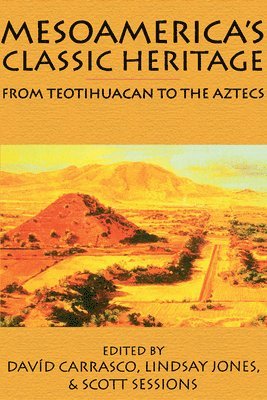
For more than a millennium the great Mesoamerican city of Teotihuacan (c. 150 B.C.E. - 750 C.E.) has been imagined and reimagined by a host of subsequent cultures, including our own. Mesoamerica's Classic Heritage engages the subject of the unity and diversity of pre-Hispanic Mesoamerica by focusing on the classic heritage of this ancient city. This new volume is the product of several years of research by members of Princeton University's Moses Mesoamerican Archive and Research Project and Mexico's Proyecto Teotihuacán. Offering a variety of disciplinary perspectives - including the history of religions, anthropology, archaeology, and art history - and a wealth of new data, Mesoamerica's Classic Heritage examines Teotihuacan's rippling influence across Mesoamerican time and space, including important patterns of continuity and change, and its relationships, both historical and symbolic, with Tenochtitlan, Cholula, and various Maya communities.The contributors to Mesoamerica's Classic Heritage offer a wide range of individual interpretations, but they agree that Teotihuacan, more than any other pre-Hispanic center, was a paradigmatic source that formed the art and architecture, cosmology and ritual life, and conceptions of urbanism and political authority for significant parts of the Mesoamerican world. This great city achieved the prestige of being the site of the creation of the cosmos and of effective social and political space in Mesoamerica through its capacity to symbolize, perform, and export its imperial authority. These essays reveal the different ways in which Teotihuacan's classic heritage both fed and fed on the dynamic interactivity of the entire area. Whether or not a paradigm shift in Mesoamerican studies is taking place, certainly a new contextual understanding of Teotihuacan and the diversities and unities of Mesoamerica is emerging in these pages.
Häftad, Engelska, 2008
660 kr
Skickas inom 5-8 vardagar
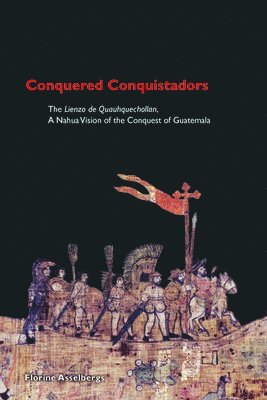
In Conquered Conquistadors, Florine Asselbergs reveals that a large pictorial map, the Lienzo de Quauhquechollan, long thought to represent a series of battles in central Mexico, was actually painted in the 1530s by Quauhquecholteca warriors to document their invasion of Guatemala alongside the Spanish and to proclaim themselves as conquistadors. This painting is the oldest known map of Guatemala and a rare document of the experiences of indigenous conquistadors. The people of the Nahua community of Quauhquechollan (present-day San Martín Huaquechula), in central Mexico, allied with Cortés during the Spanish-Aztec War and were assigned to the Spanish conquistador Jorge de Alvarado. De Alvarado and his allies, including the Quauhquecholteca and thousands of other indigenous warriors, set off for Guatemala in 1527 to start a campaign against the Maya. The few Quauhquecholteca who lived to tell the story recorded their travels and eventual victory on the huge cloth map, the Lienzo de Quauhquechollan. Conquered Conquistadors, published in a European edition in 2004, overturned conventional views of the European conquest of indigenous cultures. American historians and anthropologists will relish this new edition and Asselbergs's astute analysis, which includes context, interpretation, and comparison with other pictographic accounts of the "Spanish" conquest. This heavily illustrated edition includes an insert reproduction of the Lienzo de Quauhquechollan.
Häftad, Engelska, 2008
628 kr
Skickas inom 5-8 vardagar
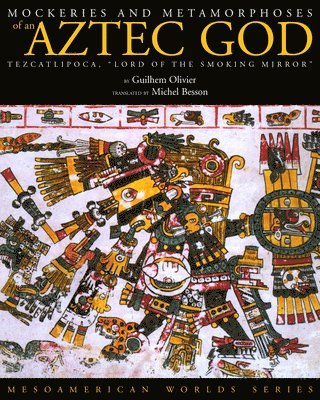
Guilhem Olivier's Mockeries and Metamorphoses of an Aztec God is a masterful study of Tezcatlipoca, one of the greatest but least understood deities in the Mesoamerican pantheon.An enigmatic and melodramatic figure, the Lord of the Smoking Mirror was both drunken seducer and mutilated transgressor and although he severely punished those who violated pre-Columbian moral codes, he also received mortal confessions. A patron deity to kings and warriors as well as a protector of slaves, Tezcatlipoca often clashed in epic confrontations with his "enemy brother" Quetzalcoatl, the famed Feathered Serpent. Yet these powers of Mesoamerican mythology collaborated to create the world, and their common attributes hint at a dual character.In a sophisticated, systematic tour through the sources and problems related to Tezcatlipoca's protean powers and shifting meanings, Olivier guides readers through the symbolic names of this great god, from his representation on skins and stones to his relationship to ritual knives and other deities. Drawing upon iconographic material, chronicles written in Spanish and in Nahuatl, and the rich contributions of ethnography, Mockeries and Metamorphoses of an Aztec God - like the mirror of Tezcatlipoca in which the fates of mortals were reflected - reveals an important but obscured portion of the cosmology of pre-Columbian Mexico.
Häftad, Engelska, 2010
381 kr
Skickas inom 5-8 vardagar
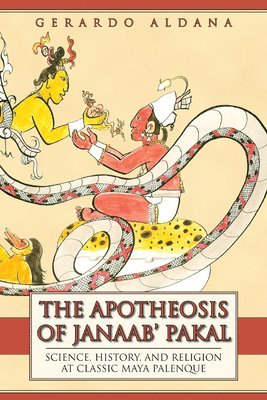
The Apotheosis of Janaab' Pakal takes up anew the riddles within a number of Maya hieroglyphic inscriptions first recognized by Floyd Lounsbury. Gerardo Aldana unpacks these mathematical riddles using an approach grounded in a reading of the texts made possible by recent advances in decipherment. Using a history of science methodology, he expands upon (and sometimes questions) the foundational work of archaeoastronomers.Aldana follows three lines of investigation: a reading of the hieroglyphic inscriptions of the Classic period (a.d. 250-900), mathematical analysis to recover Classic Maya astronomical practice, and a historiography of Maya astronomy. Quoted hieroglyphs appear throughout the text for cross-examination. Aldana reveals the social and political context of Maya astronomy by explicating the science and calendrical calculations found in the tablets of the Temple of Inscriptions and the Cross Group from the city of Palenque. He offers a compelling interpretation of an 819-day count, demonstrating its utility as an astronumerological tool that Maya scribes used to simplify complex calculations.During troubled times in Palenque, Aldana contends, Kan Balam II devised a means to preserve the legitimacy of his ruling dynasty. He celebrated a re-creation of the city as a contemporary analogue of a mythical Creation on three levels: monumental construction for a public audience, artistic patronage for an elite audience, and a secret mathematical astronomical language only for rulers-elect. Discussing all of these efforts, Aldana focuses on the recovery of the secret language and its historical context.
Häftad, Engelska, 2012
423 kr
Skickas inom 5-8 vardagar
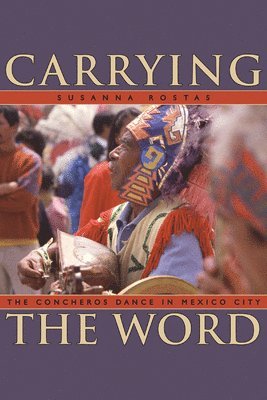
In Carrying the Word: The Concheros Dance in Mexico City, the first full length study of the Concheros dancers, Susanna Rostas explores the experience of this unique group, whose use of dance links rural religious practices with urban post-modern innovation in distinctive ways even within Mexican culture, which is rife with ritual dances.The Concheros blend Catholic and indigenous traditions in their performances, but are not governed by a predetermined set of beliefs; rather they are bound together by long standing interpersonal connections framed by the discipline of their tradition. The Concheros manifest their spirituality by means of the dance. Rostas traces how they construct their identity and beliefs, both individual and communal, by its means. The book offers new insights into the experience of dancing as a Conchero while also exploring their history, organization and practices.Carrying the Word provides a new way for audiences to understand the Conchero's dance tradition, and will be of interest to students and scholars of contemporary Mesoamerica. Those studying identity, religion, and tradition will find this social-anthropological work particularly enlightening.
Häftad, Engelska, 2013
350 kr
Skickas inom 5-8 vardagar
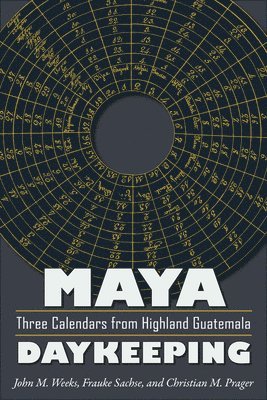
In Maya Daykeeping, three divinatory calendars from highland Guatemala - examples of a Mayan literary tradition that includes the Popul Vuh, Annals of the Cakchiquels, and the Titles of the Lords of Totonicapan - dating to 1685, 1722, and 1855, are transcribed in K'iche or Kaqchikel side-by-side with English translations. Calendars such as these continue to be the basis for prognostication, determining everything from the time for planting and harvest to foreshadowing illness and death. Good, bad, and mixed fates can all be found in these examples of the solar calendar and the 260-day divinatory calendar.The use of such calendars is mentioned in historical and ethnographic works, but very few examples are known to exist. Each of the three calendars transcribed and translated by John M. Weeks, Frauke Sachse, and Christian M. Prager - and housed at the University of Pennsylvania Museum of Archaeology and Anthropology - is unique in structure and content. Moreover, except for an unpublished study of the 1722 calendar by Rudolf Schuller and Oliver La Farge (1934), these little-known works appear to have escaped the attention of most scholars. Introductory essays contextualize each document in time and space, and a series of appendixes present previously unpublished calendrical notes assembled in the early twentieth century.Providing considerable information on the divinatory use of calendars in colonial highland Maya society previously unavailable without a visit to the University of Pennsylvania's archives, Maya Daykeeping is an invaluable primary resource for Maya scholars. Mesoamerican Worlds Series
Häftad, Engelska, 2015
423 kr
Skickas inom 5-8 vardagar
The prevailing view of the lowland Maya during the Postclassic period (A.D. 1050-1500) has been one of an impoverished, "degenerated" society devoid of cultural accomplishment. However, Marilyn A. Masson offers a fresh interpretation of this society as one that represented a complex, sophisticated, extensive organization of semiautonomous units that were closely integrated, yet embraced a decentralized political economy.In the Realm of Nachan Kan opens a window on Postclassic Maya patterns of cultural development and organization through a close examination of the small rural island of Laguna de On, a location that was distant from the governing political centers of the day. Using diachronic analysis of regional settlement patterns, ceramic traditions, household and ritual features, and artifacts from the site, Masson tracks developmental changes throughout the Postclassic period. These data suggest that affluent patterns of economic production and local and long-distance exchange were established within northern Belize by the eleventh century, and continued to develop, virtually uninterrupted, until the time of Spanish arrival.In addition, Masson analyzes contemporary political and religious artistic traditions at the temples of Mayapan, Tulum, and Santa Rita to provide a regional context for the changes in community patterns at Laguna de On. These cultural changes, she maintains, are closely correlated with the rise of Mayapan to power and participation of sites like Laguna de On in a pan-lowland economic and ritual interaction sphere. Offering a thoroughly new interpretation of Postclassic Mayan civilization. In the Realm of Nachan Kan is a must for scholars of Mesoamerican history and culture.
Häftad, Engelska, 2015
518 kr
Skickas inom 5-8 vardagar
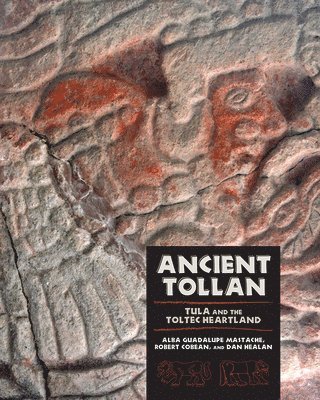
A work of both consensus and innovation based upon extensive archaeological research, Ancient Tollan: Tula and the Toltec Heartland studies Mesoamerica's problem city—Tula, or Tollan, seat of the Toltec state. Along with Teotihuancan and Tenochtitlán, Tula was one of the most important prehispanic urban centers in Highland Central Mexico, reaching the height of its influence during the early Postclassic period between A.D. 900-1200.Chapters of the book are dedicated to topics ranging from the Teotihuancan occupation in the area, architectural and iconographic analysis of Tula's Sacred Precinct, the urban domestic architecture, settlement patterns, and irrigation systems. Using a wealth of data and focusing on the developmental processes of the city's functions on a regional level, Mastche, Cobean, and Healan offer a fresh view and a new understanding of this cultural center, its urban structure, and its rural environment.
Häftad, Engelska, 2016
411 kr
Skickas inom 5-8 vardagar
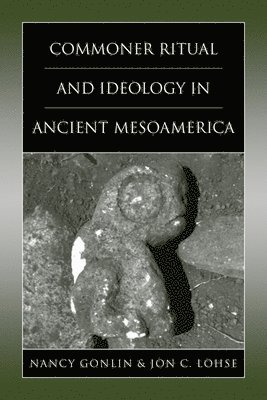
Were most commoners in ancient Mesoamerica poor? In a material sense, yes, probably so. Were they poor in their beliefs and culture? Certainly not, as Commoner Ritual and Ideology in Ancient Mesoamerica demonstrates.This volume explores the ritual life of Mesoamerica's common citizens, inside and outside of the domestic sphere, from Formative through Postclassic periods. Building from the premise that ritual and ideological expression inhered at all levels of society in Mesoamerica, the contributors demonstrate that ideology did not emanate solely from exalted individuals and that commoner ritual expression was not limited to household contexts. Taking an empirical approach to this under-studied and under-theorized area, contributors use material evidence to discover how commoner status conditioned the expression of ideas and values. Revealing complex social hierarchies that varied across time and region, this volume offers theoretical approaches to commoner ideology, religious practice, and sociopolitical organization and builds a framework for future study of the correlation of ritual and ideological expression with social position for Mesoamericanists and archaeologists worldwide.
Häftad, Engelska, 2020
579 kr
Skickas inom 5-8 vardagar
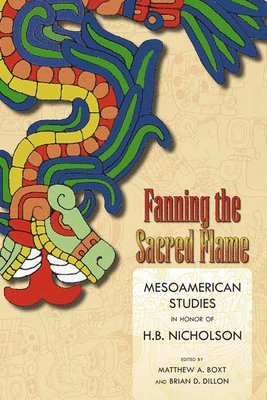
Fanning the Sacred Flame: Mesoamerican Studies in Honor of H. B. Nicholson contains twenty-two original papers in tribute to H. B. "Nick" Nicholson, a pioneer of Mesoamerican research. His intellectual legacy is recognized by Mesoamerican archaeologists, art historians, ethnohistorians, and ethnographers--students, colleagues, and friends who derived inspiration and encouragement from him throughout their own careers. Each chapter, which presents original research inspired by Nicholson, pays tribute to the teacher, writer, lecturer, friend, and mentor who became a legend within his own lifetime.Covering all of Mesoamerica across all time periods, contributors include Patricia R. Anawalt, Alfredo López Austin, Anthony Aveni, Robert M. Carmack, David C. Grove, Richard D. Hansen, Leonardo López Luján, Kevin Terraciano, and more. Eloise Quiñones Keber provides a thorough biographical sketch, detailing Nicholson's academic and professional journey. Publication supported, in part, by The Patterson Foundation and several private donors.
Häftad, Engelska, 2023
408 kr
Skickas inom 5-8 vardagar
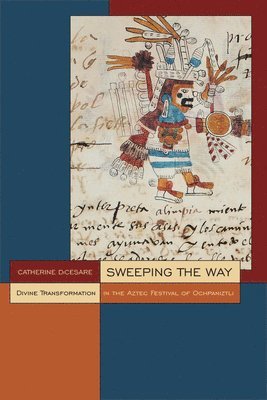
Incorporating human sacrifice, flaying, and mock warfare, the pre-Columbian Mexican ceremony known as Ochpaniztli, or “Sweeping,” has long attracted attention. Although among the best known of eighteen annual ceremonies, Ochpaniztli’s significance has nevertheless been poorly understood. Ochpaniztli is known mainly from early colonial illustrated manuscripts produced in cross-cultural collaboration between Spanish missionary-chroniclers and native Mexican informants and artists.Although scholars typically privilege the manuscripts’ textual descriptions, Sweeping the Way examines the fundamental role of their pictorial elements, which significantly expand the information contained in the texts. DiCesare emphasizes the primacy of the regalia, ritual implements, and adornments of the patron “goddess” as the point of intersection between sacred, cosmic forces and ceremonial celebrants. The associations of these paraphernalia indicate that Ochpaniztli was a period of purification rituals, designed to transform and protect individual and communal bodies alike. Spanish friars were unable to apprehend the complex nature of the festival’s patroness, ultimately fragmenting her identity into categories meeting their expectations, which continues to vex modern investigations.Taken together, the variety of Ochpaniztli sources offer a useful tool for addressing myriad issues of translation and transformation in pre-Columbian and post-conquest Mexico, as Christian friars and native Mexicans together negotiated a complex body of information about outlawed ritual practices and proscribed sacred entities.
Häftad, Engelska, 2001
392 kr
Tillfälligt slut
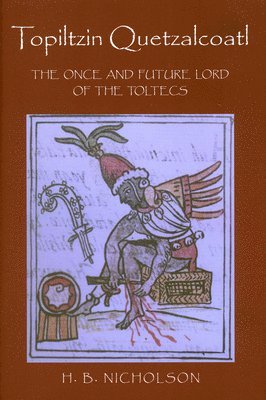
Topiltzin Quetzalcoatl: The Once and Future Lord of the Toltecs is the most comprehensive survey and discussion of primary documentary sources and relevant archaeological evidence available about the most enigmatic figure of ancient Mesoamerica. Probably no indigenous New World personage has aroused more interest or more controversy than this Lord of Tollan, capital of the Toltec Empire, who was merged with the prominent Feathered Serpent god, Quetzalcoatl. Speculation began soon after the Spanish Conquest brought Europeans in contact with this ambiguous figure, and scholarly inquiry has continued unabated to the present. The extant literature on this famous man/god is enormous and steadily growing.Professor Nicholson sorts through this wealth of material, classifying, summarizing, and analyzing all known primary accounts of the career of Topiltzin Quetzalcoatl, in the Spanish, Nahuatl, and Mayan languages, which Spanish missionaries and Spanish-educated natives recorded after the Conquest. In a new introduction, he updates the original source material presently available to scholars interested in this figure. After careful consideration of the evidence, he concludes that, in spite of the obvious myth surrounding this renowned Toltec priest-ruler, at least some of Topiltzin Quetzalcoatl's recorded life and deeds are drawn from historical fact. Nicholson also contends that the tradition of his expected return probably played a role in the peaceable reception of Cortés by Moctezuma II in Mexico's Tenochtitlan in the fall of 1519.Including new illustrations and an index, Topiltzin Quetzalcoatl: The Once and Future Lord of the Toltecs constitutes a major contribution to Mesoamerican ethnohistory and archaeology.
Inbunden, Engelska, 2008
883 kr
Tillfälligt slut
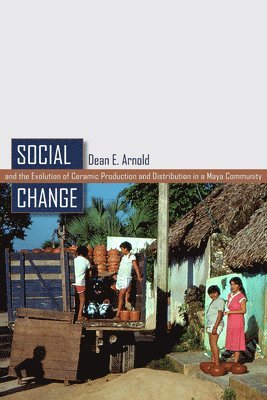
How and why do ceramics and their production change through time? Social Change and the Evolution of Ceramic Production and Distribution in a Maya Community is a unique ethno-archaeological study that attempts to answer these questions by tracing social change among potters and changes in the production and distribution of their pottery in a the Mexican community of Ticul between 1965 and 1997. Dean E. Arnold made ten visits to Ticul, Yucatan, Mexico, witnessing the changes in transportation infrastructure, the use of piped water, and the development of tourist resorts. Even in this context of social change and changes in the demand for pottery, most of the potters in 1997 came from the families that had made pottery in 1965. This book traces changes and continuities in that population of potters, in the demand and distribution of pottery, and in the procurement of clay and temper, paste composition, forming, and firing.In this volume, Arnold bridges the gap between archaeology and ethnography, using his analysis of contemporary ceramic production and distribution to generate new theoretical explanations for archaeologists working with pottery from antiquity. When the descriptions and explanations of Arnold’s findings in Ticul are placed in the context of the literature on craft specialization, a number of insights can be applied to the archaeological record that confirm, contradict, and nuance generalizations concerning the evolution of ceramic specialization. This book will be of special interest to anthropologists, archaeologists, and ethnographers.
Inbunden, Engelska, 2009
752 kr
Tillfälligt slut
Maya Worldviews at Conquest examines Maya culture and social life just prior to contact and the effect the subsequent Spanish conquest, as well as contact with other Mesoamerican cultures, had on the Maya worldview.Focusing on the Postclassic and Colonial periods, Maya Worldviews at Conquest provides a regional investigation of archaeological and epigraphic evidence of Maya ideology, landscape, historical consciousness, ritual practices, and religious symbolism before and during the Spanish conquest. Through careful investigation, the volume focuses on the impact of conversion, hybridization, resistance, and revitalization on the Mayans’ understanding of their world and their place in it.The volume also addresses the issue of anthropologists unconsciously projecting their modern worldviews on the culture under investigation. Thus, the book critically defines and strengthens the use of worldviews in the scholarly literature regardless of the culture studied, making it of value not only to Maya scholars but also to those interested in the anthropologist’s projection of worldview on other cultures in general.
Inbunden, Engelska, 2009
883 kr
Tillfälligt slut
The Valley of Oaxaca was unified under the rule of Monte Albán until its collapse around AD 800. Using findings from John Paddock’s long-term excavations at Lambityeco from 1961 to 1976, Michael Lind and Javier Urcid examine the political and social organization of the ancient community during the Xoo Phase (Late Classic period).Focusing on change within this single archaeological period rather than between time periods, The Lords of Lambityeco traces the changing political relationships between Lambityeco and Monte Albán that led to the fall of the Zapotec state. Using detailed analysis of elite and common houses, tombs, and associated artifacts, the authors demonstrate increased political control by Monte Albán over Lambityeco prior to the abandonment of both settlements. Lambityeco is the most thoroughly researched Classic period site in the valley after Monte Albán, but only a small number of summary articles have been published about this important locale. This, in combination with Lambityeco’s status as a secondary center—one that allows for greater understanding of core and periphery dynamics in the Monte Albán state—makes The Lords of Lambityeco a welcome and significant contribution to the literature on ancient Mesoamerica.
Häftad, Engelska, 2010
212 kr
Tillfälligt slut
Compiled in honor of Anthony F. Aveni, America's leading archaeoastronomer, Skywatching in the Ancient World offers state-of-the-art work in cultural astronomy by well-known experts in Mayan glyphic studies, cultural history, ethnohistory, and the history of science and of religions.This collection's wide range of outstanding scholarship reveals that cultural astronomy has come into its own. The diverse topics addressed by the contributors include the correlation between Colonial Northern Zapotec and Gregorian calendars, the period of use of the Dresden Codex Venus table and the significance of the Lunar Almanacs that precede it, a new interpretation of an Inka tapestry mantle as a commemorative calendar, temple orientations in Hawai'i and church orientations in Medieval England, and the connection in cultural imagery between astronomers (science) and wizards (magic).Contributors include: Harvey M. Bricker, Victoria R. Bricker, Edward E. Calnek, Clemency Coggins, John Justeson, Edwin C. Krupp, Stephen C. McCluskey, Susan Milbrath, Clive Ruggles, David Tavárez, Barbara Tedlock, Dennis Tedlock, Gary Urton, and R. Tom Zuidema. Mesoamerican Worlds Series
Häftad, Engelska, 2011
317 kr
Tillfälligt slut
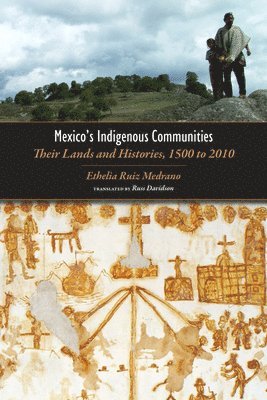
A rich and detailed account of indigenous history in central and southern Mexico from the sixteenth to the twenty-first centuries, Mexico's Indigenous Communities is an expansive work that destroys the notion that Indians were victims of forces beyond their control and today have little connection with their ancient past. Indian communities continue to remember and tell their own local histories, recovering and rewriting versions of their past in light of their lived present.Ethelia Ruiz Medrano focuses on a series of individual cases, falling within successive historical epochs, that illustrate how the practice of drawing up and preserving historical documents-in particular, maps, oral accounts, and painted manuscripts-has been a determining factor in the history of Mexico's Indian communities for a variety of purposes, including the significant issue of land and its rightful ownership. Since the sixteenth century, numerous Indian pueblos have presented colonial and national courts with historical evidence that defends their landholdings.Because of its sweeping scope, groundbreaking research, and the author's intimate knowledge of specific communities, Mexico's Indigenous Communities is a unique and exceptional contribution to Mexican history. It will appeal to students and specialists of history, indigenous studies, ethnohistory, and anthropology of Latin America and Mexico
Häftad, Engelska, 2012
435 kr
Tillfälligt slut
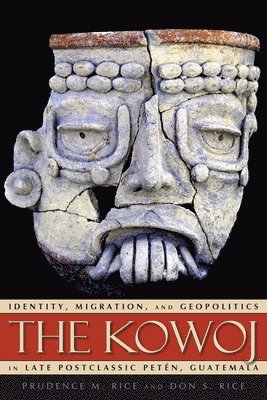
Neighbors of the better-known Itza in the central Petén lakes region of Guatemala, the Kowoj Maya have been studied for little more than a decade. The Kowoj: Identity, Migration, and Geopolitics in Late Postclassic Petén, Guatemala summarizes the results of recent research into this ethno-political group conducted by Prudence Rice, Don Rice, and their colleagues.Chapters in The Kowoj address the question "Who are the Kowoj?" from varied viewpoints: archaeological, archival, linguistic, ethnographic, and bioarchaeological. Using data drawn primarily from the peninsular site of Zacpetén, the authors illuminate Kowoj history, ritual components of their self-expressed identity, and their archaeological identification. These data support the Kowoj claim of migration from Mayapán in Yucatán, where they were probably affiliated with the Xiw, in opposition to the Itza. These enmities extended into Petén, culminating in civil warfare by the time of final Spanish conquest in 1697.The first volume to consider Postclassic Petén from broadly integrative anthropological, archaeological, and historical perspectives, The Kowoj is an important addition to the literature on late Maya culture and history in the southern lowlands. It will be of particular interest to archaeologists, historians, ethnohistorians, art historians, and epigraphers.
Häftad, Engelska, 2016
314 kr
Tillfälligt slut
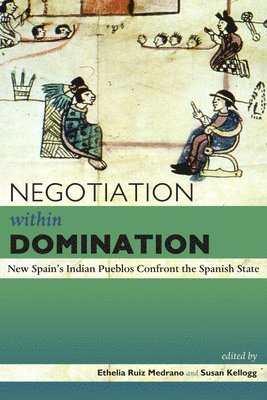
Although indigenous communities reacted to Spanish presence with significant acts of resistance and rebellion, they also turned to negotiation to deal with conflicts and ameliorate the consequences of colonial rule. This affected not only the development of legal systems in New Spain and Mexico but also the survival and continuation of traditional cultures. Bringing together work by Mexican and North American historians, this collection is a crucially important and rare contribution to the field. Negotiation within Domination is a valuable resource for native peoples as they seek to redefine and revitalize their identities and assert their rights relating to language and religion, ownership of lands and natural resources, rights of self-determination and self-government, and protection of cultural and intellectual property. It will be of interest primarily to specialists in the field of colonial studies and historians and ethnohistorians of New Spain.Contributors: R. Jovita Baber, José Manuel A. Chávez-Gómez, Susan Kellogg, Edward W. Osowski, María de los Ángeles Romero Frizzi, Ethelia Ruiz Medrano, Cuauhtémoc Velasco Ávila, Yanna P. Yannakakis
Häftad, Engelska, 2021
516 kr
Tillfälligt slut
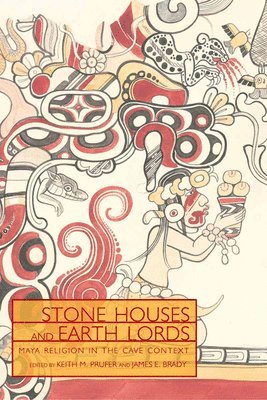
Cave archaeology in the New World, now a focus of intense research, was still a peripheral area of inquiry just fifteen years ago. Stone Houses and Earth Lords is the first volume dedicated exclusively to the use of caves in the Maya Lowlands, covering primarily Classic Period archaeology from A.D. 100 through the Spaniards' arrival. Although the caves that riddled the lowlands show no signs of habitation, most contain evidence of human use - evidence that suggests that they functioned as ritual spaces.Demonstrating the importance of these subterranean spaces to Maya archaeology, contributors provide interpretations of archaeological remains that yield insights into Maya ritual and cosmology. Compiling the best current scholarship in this fast-growing area of research, Stone Houses and Earth Lords is a vital reference for Mayanists, Mesoamerican specialists, and others interested in the human use of caves in the New World. Contributors include: Juan Luis Bonor, James E. Brady, Robert Burnett, Allan B. Cobb, Pierre Robert Colas, Cesar Espinosa, Sergio Garza, David M. Glassman, Christina T. Halperin, Amalia Kenward, Andrew Kindon, Patricia McAnany, Christopher Morehart, Holley Moyes, Vanessa A. Owen, Shankari Patel, Polly Peterson, Keith M. Prufer, Timothy. W. Pugh, Frank Saul, Julie Saul, Ann M. Scott, Andrea Stone, and Vera Tiesler.